Category: How To

  • Hiring an SRRV Visa Consultant: When and Why – SeekCebu

    The Special Resident Retiree’s Visa (SRRV) is one of the world’s most accessible retirement visa programmes. The Retirement Abroad Index 2026 ranked the Philippines #1 globally, with a score of 17 out of 20 for visa accessibility. The PRA has set a target of ₱1.3 billion in revenues for 2026, supported by sustained growth in application fees and annual charges.

    But “accessible” does not mean “simple.” The application process involves multiple government agencies, foreign bank transfers, apostilled documents, medical examinations, and strict timelines. For some applicants, navigating this process alone makes perfect sense. For others, hiring a consultant is the difference between a smooth approval and a frustrating, expensive delay.

    This guide explains when you should hire an SRRV consultant, why you might want one, and how to choose someone legitimate.


    The One Thing You Must Know First

    Consultants are not required.

    The Philippine Retirement Authority (PRA) explicitly states that applicants can file their SRRV application directly through a walk-in application. The PRA’s own website notes: “It is at the discretion of retiree-applicants to get the service of marketers in applying for the SRRVisa or by themselves only through walk-in application.”

    You can absolutely process your SRRV on your own. Many people do. The PRA accepts walk-in applications at their Makati headquarters and satellite offices.

    So why would anyone pay for a consultant? Let’s be honest about that.


    When You Should Hire a Consultant

    You Are Applying from Outside the Philippines

    The SRRV application requires your physical presence in the Philippines for the entire process. The PRA holds onto your passport during processing, which typically takes four to eight weeks.

    If you are not already living in the Philippines, you need to fly in, find accommodation, open a bank account, remit your deposit, gather documents, submit your application, and wait—all while your passport is with the PRA.

    One analysis notes that DIY processing requires at least three to six months, and for applicants not residing in the Philippines, the costs of accommodation, food, and transportation can add up quickly, potentially exceeding what you would pay a consultant.

    A consultant based in the Philippines can handle most of the groundwork before you arrive, reducing your time in the country significantly.

    Your English Is Not Strong

    The SRRV application process is conducted entirely in English. All forms are in English. All communication with the PRA is in English. If English is not your first language and you are not confident navigating bureaucratic forms and government offices, a consultant who speaks your language—or at least can translate and explain—is worth considering.

    Many consultants in the Philippines cater specifically to Chinese, Korean, and Japanese applicants, offering services in those languages.

    You Want to Avoid Costly Mistakes

    The SRRV programme underwent significant changes in September 2025. The Smile and Human Touch categories were abolished. The minimum age was lowered to 40. Deposit tiers were restructured. Many online guides still reference the old rules.

    A PRA-accredited consultant works with the PRA daily. They know the current requirements, the current forms, and the current processing times. They can spot document errors before you submit them—errors that could delay your application by weeks or months.

    You Have Complex Circumstances

    If you have any of the following situations, a consultant can be invaluable:

    • You have a criminal record (even a minor one) and need guidance on how the PRA handles background checks.
    • You have a medical condition that might raise questions during the medical examination.
    • You are applying with dependents and need to ensure all family members are properly included.
    • You plan to convert your deposit into a property investment and need guidance on that process.
    • You have previously overstayed a tourist visa in the Philippines.

    You Value Your Time More Than the Fee

    This is the honest truth that many people overlook. The SRRV application is not technically difficult, but it is time-consuming. You need to visit multiple government offices, coordinate with a bank for an inward remittance, gather apostilled documents from your home country, and navigate Philippine bureaucracy.

    For a retired professional earning a good income, spending dozens of hours on this process might not make financial sense. Paying a consultant to handle it frees you up to focus on other priorities.


    Why You Should Hire a Consultant

    PRA-Accredited Marketers Have Direct Access

    Consultants who are PRA-accredited marketers have a formal relationship with the Philippine Retirement Authority. They are authorised to assist retiree-applicants in securing the necessary documents and accompany them in filing the SRRV application.

    Accredited marketers include travel agencies, law firms, hotels, restaurants, and other business providers, as well as sole proprietors, partnerships, corporations, lawyers, and PRC-licensed brokers.

    This accreditation means they understand the PRA’s internal processes and can often resolve issues more quickly than a walk-in applicant.

    They Help You Get Documents Right the First Time

    One of the most common reasons for SRRV application delays is incorrect or incomplete documentation. A consultant provides you with a clear, personalised list of exactly what documents you need.

    They ensure your police clearance is properly apostilled. They verify that your medical certificate is from an acceptable clinic. They confirm that your bank remittance is structured correctly. They spot issues before the PRA does.

    They Handle the Bank Coordination

    The SRRV deposit must be remitted as an inward transfer from a bank abroad to a PRA-accredited bank in the Philippines. Funds deposited from within the Philippines are not accepted.

    This is one of the trickiest parts of the application for many applicants. A consultant provides the correct bank account details and SWIFT information to ensure your remittance is properly credited. They also help you open a Philippine bank account if you do not already have one.

    They Submit and Follow Up on Your Behalf

    A consultant prepares and submits your complete SRRV application to the PRA on your behalf. They track the progress of your application, follow up with the PRA, and notify you when your visa is approved.

    This is particularly valuable if you are not living in Metro Manila or Cebu, where the PRA has offices.

    They Offer Free Initial Consultations

    Many PRA-accredited consultants offer free initial consultations. JRC Consultancy, for example, offers a free consultation to assess your eligibility, confirm which SRRV category is right for you, confirm the deposit amount, and provide a personalised document checklist.

    This means you can get professional advice at no cost before deciding whether to proceed with their services.


    How to Choose a Consultant

    Verify PRA Accreditation

    This is non-negotiable. Only PRA-accredited marketers are authorised to assist with SRRV applications.

    The PRA maintains a public list of accredited marketers on its website. The list includes:

    • Dragon Visa Consultancy Inc.
    • 1MVP Immigration Services
    • 1nnovation International Travel Consultancy Inc.
    • 365 Visa Consultancy
    • 3D2Y Documentation Services
    • 583 Immigration and Travel Consultancy
    • A and G Travel Consultancy Services
    • A2EN Documentation Services
    • AA POC Consultancy Corp.
    • Abes Malong and Associates

    And many more across multiple pages.

    Before you pay anyone, check the PRA’s list. If they are not on it, walk away.

    Understand What They Charge

    There is some debate in expat forums about consultant fees. One forum post notes: “While I agree that it is best to use an agent for SRRV that is free (by law), I am not sure if it is worth paying $500.00.”

    The same post advises: “If you want to obtain an SRRV then contact Philippine Retirement Authority directly and also report the ‘agent’ who is asking for ‘commission’ or ‘processing fee’ or whatever they call it.”

    This raises an important point: PRA-accredited marketers are not supposed to charge extra fees beyond the official PRA costs. However, many consultants do charge for their services—document preparation, form submission, follow-up, and translation. The key is to understand exactly what you are paying for and to get it in writing.

    Ask These Questions Before Hiring

    • Are you PRA-accredited? Can you show me your accreditation certificate?
    • What exactly does your service include?
    • What is your fee, and what does it cover?
    • Are there any additional costs I should be aware of?
    • How many SRRV applications have you processed?
    • What is your success rate?
    • Can you provide references from previous clients?
    • How long do you expect my application to take?
    • What happens if my application is delayed or denied?

    Be Wary of Red Flags

    Asking for payment in cash. Legitimate consultants accept bank transfers and provide receipts.

    Guaranteeing approval. No consultant can guarantee PRA approval. The PRA makes the final decision.

    Pressuring you to sign quickly. A legitimate consultant gives you time to review the agreement.

    Vague or missing terms in the contract. Everything should be in writing.

    No physical office. A legitimate consultant has a physical office you can visit.


    The Honest Bottom Line

    Hiring an SRRV consultant is not a requirement. It is a convenience. You can absolutely file your SRRV application on your own, and many people do so successfully.

    But a good PRA-accredited consultant can save you time, reduce stress, help you avoid costly mistakes, and navigate the bureaucracy more efficiently than you could on your own.

    When it makes sense:

    • You are applying from abroad and cannot stay in the Philippines for months.
    • Your English is not strong enough to navigate bureaucratic forms.
    • You have complex circumstances that require expert guidance.
    • You value your time more than the consultant’s fee.

    When it does not make sense:

    • You are already living in the Philippines and have the time to handle the process yourself.
    • You are comfortable with bureaucratic processes and have strong English skills.
    • You are on a tight budget and want to save every possible peso.

    How much should you pay?

    The official PRA processing fee is USD 1,600 for the principal applicant. A consultant’s service fee—if they charge one—should be transparent and reasonable. Some consultants include their fee in the overall package; others charge separately. Always get a written quote before you agree to anything.

    The most important advice:

    Never hire a consultant who is not on the PRA’s accredited marketers list. Never pay anyone who promises to “expedite” your application or “guarantee” approval. And never, ever sign a contract without reading it carefully.

    The SRRV is a genuine path to permanent residency in one of the world’s most affordable and welcoming retirement destinations. A good consultant can make the journey smoother. But at the end of the day, it is your application, your money, and your future. Stay informed, ask questions, and trust your instincts.


    Disclaimer

    This guide is intended for informational purposes only and does not constitute professional legal or immigration advice. The author and publisher make no representations or warranties regarding the accuracy, completeness, or reliability of the information provided. Immigration laws, policies, and procedures are subject to change without notice. You are strongly advised to consult directly with the Philippine Retirement Authority (PRA), a licensed immigration lawyer, or a PRA-accredited marketer for guidance specific to your circumstances. The inclusion of any consultant or service provider in this guide does not constitute an endorsement, and the author assumes no liability for any outcomes arising from the use of such services. Always verify current requirements and accreditation directly with the PRA before engaging any service provider.


    Sources & Methodology: This guide is based on official Philippine Retirement Authority (PRA) announcements, the PRA’s accredited marketers list, verified industry reports, and expat forum discussions as of June 2026. The PRA’s accredited marketers list is publicly available at pra.gov.ph/accredited-marketer. This guide is intended for informational purposes only and does not constitute professional legal or immigration advice. Always verify consultant accreditation directly with the PRA before engaging any service provider.

      Author
      John Paul Ybañez Paquibot
      Licensed Real Estate Broker | PRC No. 00014132 | DHSUD No. CVRFO-B-03/18-2672
      Bachelors Realty and Brokerage, Inc. Cebu
      G/F Cap Building, Brgy. Corner, Osmeña Blvd.
      Arlington Pond St. Extension, Cebu City, 6000 Cebu
    • 2026 SRRV Visa Application and Requirements Guide – SeekCebu

      SRRV Visa Application

      The Special Resident Retiree’s Visa, or SRRV, is the gold standard for foreign nationals who want to make the Philippines their long-term home. Unlike the tourist visa extension—which requires regular renewals and carries an implicit “you are a visitor” status—the SRRV grants genuine permanent residency rights. You can live in the Philippines indefinitely, come and go freely without re-entry permits, and access a range of privileges not available to tourists.

      As of 2026, approximately 60,000 global retirees hold an SRRV, with particularly strong interest from Chinese, South Korean, Indian, and American nationals. The Philippine Retirement Authority (PRA) is targeting ₱1.3 billion in revenues for 2026, supported by sustained growth in application fees and annual charges.

      This guide covers everything you need to know about the SRRV in 2026—the significant changes that took effect in September 2025, updated deposit requirements, the full document checklist, and a step-by-step breakdown of the application process.


      What Changed in September 2025

      If you read older guides online, be aware that much of that information is now out of date. The PRA implemented significant changes to the SRRV programme effective September 2025:

      Two categories were abolished. The SRRV Smile sub-category, which had a lower deposit threshold (USD 10,000–20,000) and was popular with younger applicants, was discontinued. The SRRV Human Touch category, designed for those requiring medical treatment, was also removed.

      The minimum age was lowered. Previously 35 for those with pensions and 50 for those without, the minimum age is now standardised at 40 for all applicants, regardless of pension status. This adjustment allows mid-career professionals to use the SRRV program to plan earlier for retirement, long-term residence, or overseas lifestyle arrangements.

      Only two categories remain. SRRV Classic and SRRV Courtesy are now the only active sub-categories of the SRRV programme.

      New deposit amounts for age 40–49. A new tier covering applicants aged 40 to 49 was introduced with higher deposits than the 50+ tier.

      Important: Existing SRRV holders are not affected by these changes. If you already hold a valid SRRV—Smile or Human Touch included—your visa remains valid and you only need to pay your annual fees as normal. The changes apply to new applications only.


      SRRV Visa Options in 2026

      SRRV Classic

      The SRRV Classic is designed for ordinary foreign nationals who wish to retire in the Philippines. Deposits are held in a PRA-accredited bank and remain your property—they are refundable upon surrender of the visa.

      Deposit Requirements for SRRV Classic:

      • Age 50 and above with pension: USD 15,000 deposit, with a minimum pension of USD 800 per month for a single applicant.
      • Age 50 and above without pension: USD 30,000 deposit, no pension required.
      • Age 40 to 49 with pension: USD 25,000 deposit, with a minimum pension of USD 800 per month.
      • Age 40 to 49 without pension: USD 50,000 deposit, no pension required.

      Spousal and Child Dependents: Principal applicants may include their spouse, provided they are legally married under the law of their home country or the Philippines. Legitimate and legally adopted children may also be included as dependents, provided they are unmarried and under 21 years of age at the time of the application.

      Using the Deposit for Investment: For retirees who intend to use their required visa deposit to buy a condo or acquire a long-term lease of a house and lot, the deposit may be withdrawn for “conversion” into an investment after a holding period of thirty days from the date of the issuance of the SRRV.

      SRRV Courtesy

      The SRRV Courtesy is designed for former Filipinos, retired diplomats, international organisation officers, and recognised achievers. Deposits for this category start as low as USD 1,500 for age 50+ applicants.


      Benefits of Holding an SRRV

      SRRV holders enjoy a range of privileges that make retiring in the Philippines genuinely attractive:

      Permanent residency with multiple entry and indefinite stay privileges.

      Discounts and privileges from PRA-accredited merchant partners nationwide. The PRA has partnered with hotels, restaurants, and leisure establishments to offer 20 percent discounts to SRRV holders.

      PhilHealth Insurance at a special rate.

      Exemption from the Bureau of Immigration’s Annual Reporting and the Alien Certificate of Registration (ACR) Identity Card.

      Exemption from Bureau of Immigration Exit/Re-entry Permits.

      Exemption from customs duties and taxes for one-time importation of household goods and personal effects up to USD 7,000.

      Exemption from tax on pensions and annuities.

      Exemption from travel tax.

      Exemption from separate work or student visas or permits.

      Assistance in transacting with other government agencies.

      PRA Newsletter subscription.


      Basic Requirements for SRRV Application

      The PRA requires the following documents and fees for an SRRV application:

      For Principal Applicants

      Passport: Original passport with a valid tourist visa. The tourist visa must be valid for at least one month while processing the SRRV. In cases where the tourist visa expires while the SRRV is being processed, the applicant must have it extended. The passport should have a minimum of six months validity.

      Application Form: Accomplished PRA application form, typed or computerised. The form can be downloaded from the PRA website at pra.gov.ph.

      Medical Certificate: Issued within six months before submission, from any licensed clinic or hospital physician. The medical clearance form can be downloaded from the PRA website. If obtained abroad, the document must be translated into English and authenticated by the Philippine embassy in the country of issuance.

      Police Clearance: From the country of origin or residence for the last six months, issued within six months before submission. The document must be apostilled in your home country before you arrive.

      Bureau of Immigration Clearance Certificate (BICC): Required for applicants who have stayed more than 90 days in the Philippines prior to submission of application documents.

      National Bureau of Investigation (NBI) Clearance: Required for applicants who have stayed more than 90 days in the Philippines prior to submission.

      Photos: Eight recent, high-quality, 2×2-inch pictures with a white background, taken within three months prior to submission.

      Processing Fee: USD 1,500 (or its equivalent amount in pesos) for the principal applicant. Note that some sources indicate this may have increased to USD 1,600—confirm the current fee with the PRA at the time of application.

      Bank Certificate / Proof of Inward Remittance: The requisite dollar deposit must be sent as an inward remittance from any bank abroad to a PRA-accredited bank of choice.

      PRA-Accredited Banks

      The deposit must be remitted through a PRA-accredited bank via telegraphic transfer or bank draft. Accredited banks include:

      Government Bank:

      • Development Bank of the Philippines (DBP)

      Private Banks:

      • Philippine National Bank (PNB) – All Branches
      • Banco de Oro (Pacific Star and Cebu IT Park Branches only)
      • KEB Hana Bank – Manila Branch
      • Unionbank – All Branches
      • Bank of Commerce – All Branches
      • Shinhan Bank – Manila Branch

      Important: As a pre-requisite in opening an account in a PRA-accredited private bank, send a request for a Letter of Introduction from PRA through srrvwalkin@pra.gov.ph with the following details: bank name, branch name and address, SRRV option and amount to be remitted, and a copy of the principal applicant’s passport bio page.

      For DBP remittances: Indicate the following details in the remittance form as “Remittance Purpose”—SRRV deposit of (complete name of principal SRRV applicant as shown in the passport), date of birth, and passport number. DBP will provide PRA with a notarised bank certification within 7-10 working days after receiving the remittance.


      Step-by-Step Application Process

      Step 1: Eligibility Assessment

      Determine your eligibility based on age (minimum 40 years old) and financial readiness. Review the deposit tiers above to understand which category applies to you.

      Step 2: Open a Philippine Bank Account and Place the Time Deposit

      Open an account with a PRA-accredited bank and place the required dollar-denominated time deposit. The deposit must be sent as an inward remittance from any bank abroad.

      Step 3: Prepare Required Documents

      Gather all necessary documents:

      • Valid passport with tourist visa
      • Accomplished PRA application form
      • Medical certificate (issued within 6 months)
      • Police clearance from country of origin (apostilled)
      • BICC and NBI clearance (if applicable)
      • Eight 2×2 photos with white background
      • Proof of pension (if applicable)
      • Bank certificate / proof of inward remittance

      Step 4: Submit Your Application

      Submit your application to the PRA. All SRRV applicants must be physically present in the Philippines for the whole duration of the SRRV application process. Applications can be submitted at:

      • PRA Makati Head Office
      • PRA satellite offices
      • Through PRA-accredited marketers and consultants

      Step 5: Processing and Approval

      The PRA will receive and evaluate your documents. Processing time is typically 4 to 8 weeks. Upon approval, the SRRV will be issued, granting indefinite residency status in the Philippines.

      Step 6: Annual Fees

      Once approved, SRRV holders must pay an annual fee. For the Classic SRRV, this is USD 360 per year.


      Costs Summary

      Cost ItemAmount
      SRRV Deposit (50+, with pension)USD 15,000
      SRRV Deposit (50+, without pension)USD 30,000
      SRRV Deposit (40-49, with pension)USD 25,000
      SRRV Deposit (40-49, without pension)USD 50,000
      Processing Fee (one-time)USD 1,500 – 1,600
      Annual Fee (Classic SRRV)USD 360/year

      Note: The deposit is refundable upon surrender of the visa.


      Red Flags and Common Pitfalls

      Outdated information. Many online guides still reference the Smile and Human Touch categories or the old age requirements of 35 and 50. Always verify that you are reading 2026-specific information.

      Passport validity. Your passport must have a tourist visa valid for at least one month during processing. If your tourist visa expires while processing, you must extend it.

      Document expiration. Medical certificates and police clearances must be issued within six months of submission. Plan your document gathering carefully so nothing expires before you submit.

      Apostille requirements. Police clearances from your home country must be apostilled. This takes time, so sort it before you fly.

      Physical presence requirement. All SRRV applicants must be physically present in the Philippines for the whole duration of the SRRV application process. You cannot apply entirely from abroad.

      Background checks. The PRA now conducts thorough background checks covering Police Clearance, NBI Clearance, BICC, and INTERPOL. Background investigation has become a core.


      PRA Contact Information

      Philippine Retirement Authority (PRA)

      • Address: 29th Floor, Citibank Tower, 8741 Paseo de Roxas, Makati City 1200
      • Telephone: +63-2-848-1412 (available 24/7, seven days a week)
      • Email: clientrealations@pra.gov.ph
      • Website: pra.gov.ph

      For Letter of Introduction requests: srrvwalkin@pra.gov.ph


      The Honest Bottom Line

      The SRRV is genuinely one of the most accessible retirement visa programmes in the world. The Retirement Abroad Index 2026 ranked the Philippines #1 globally, with a score of 17 out of 20 for visa accessibility. The processing time of 4 to 8 weeks is competitive, the deposit requirements are reasonable compared to countries like Malaysia (which requires around USD 200,000), and the benefits are substantial.

      But the programme has become more complex since the September 2025 reforms. The abolition of the Smile and Human Touch categories means fewer options. The new 40-49 age tier comes with significantly higher deposits—USD 50,000 without a pension versus USD 30,000 for the 50+ group. The background checks are more thorough. And the physical presence requirement means you cannot simply mail in an application from abroad.

      If you are 50 or older with a pension of at least USD 800 per month, the SRRV remains an exceptional deal—USD 15,000 deposit, lifetime residency, and a host of benefits. If you are between 40 and 49 without a pension, be prepared for a USD 50,000 deposit and a more rigorous application process.

      My advice: Work with a PRA-accredited consultant if you can afford one. The PRA has a network of accredited marketers who can guide you through the process, help with document preparation, and ensure your remittance is properly credited. If you choose to apply independently, download the latest forms from pra.gov.ph, read the checklists carefully, and confirm all fees with the PRA directly before you start.

      The SRRV is a genuine path to permanent residency in one of the world’s most affordable and welcoming retirement destinations. Just go in with your eyes open, your documents in order, and your expectations realistic about the time and effort required.


      Sources & Methodology: This guide is based on official Philippine Retirement Authority (PRA) announcements, verified industry reports, and accredited consultant guides as of June 2026. Key policy changes effective September 2025 have been incorporated. All deposit amounts and fees are sourced from PRA documentation and accredited consultant disclosures. This guide is intended for informational purposes only and does not constitute professional legal or immigration advice. Always confirm current requirements and fees directly with the PRA before beginning your application.

        Author
        John Paul Ybañez Paquibot
        Licensed Real Estate Broker | PRC No. 00014132 | DHSUD No. CVRFO-B-03/18-2672
        Bachelors Realty and Brokerage, Inc. Cebu
        G/F Cap Building, Brgy. Corner, Osmeña Blvd.
        Arlington Pond St. Extension, Cebu City, 6000 Cebu
      • OFW’s Guide to Buying a Condo in the Philippines (With a Focus on Plumera) – SeekCebu

        OFW's Guide to Buying a Condo in the Philippines

        As a Filipino citizen, you have full legal rights to own property in the Philippines from anywhere in the world. Buying remotely requires careful preparation, especially with paperwork and financing. This guide outlines the standard process with accurate details on Plumera Residences Mactan, a Johndorf Ventures development in Basak, Kagudoy, Lapu-Lapu City, Cebu.


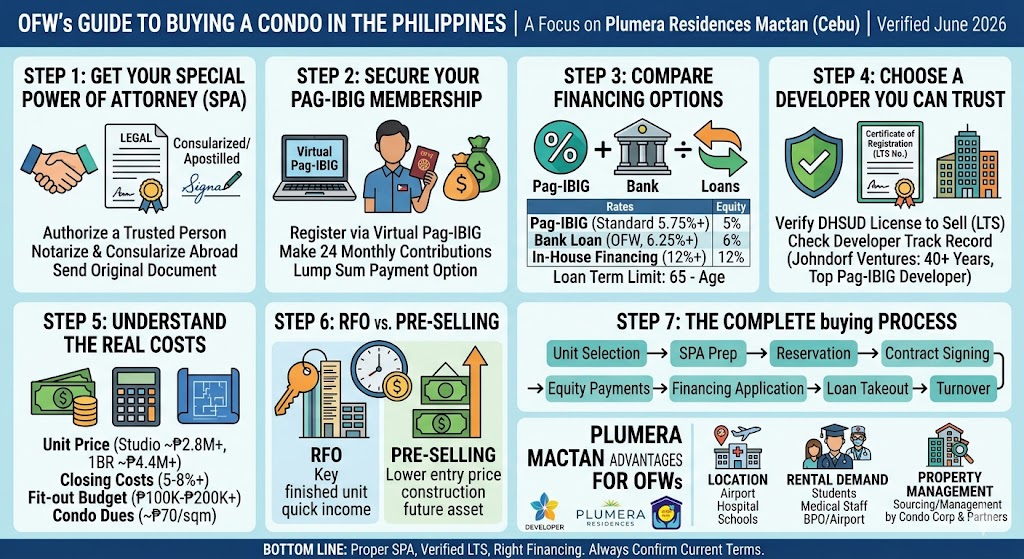
        Step 1: Get Your Special Power of Attorney (SPA)

        A Special Power of Attorney (SPA) authorizes a trusted person in the Philippines (family member, friend, or licensed broker) to act on your behalf.

        Key coverage for the SPA:

        • Signing reservation agreements and Contract to Sell (CTS)
        • Coordinating with the developer, bank, or Pag-IBIG
        • Handling payments and receiving documents

        Process:

        1. Use the developer’s preferred SPA template when possible.
        2. Notarize it in your host country, then have it authenticated (consularized) at the nearest Philippine Embassy or Consulate (or Apostilled if your country is part of the Hague Convention).
        3. Send the original physical document to your attorney-in-fact in the Philippines. Digital copies are not accepted for property transactions.

        Step 2: Secure Your Pag-IBIG Membership

        How to register as an OFW:

        1. Visit the Virtual Pag-IBIG platform.
        2. Select “For OFWs” and create an account.
        3. Verify with mobile number (OTP), email, and valid ID (passport or Philippine ID).
        4. Start contributions once you receive your Pag-IBIG MID number.

        Contributions: Minimum ₱200 per month. You can pay higher amounts voluntarily for larger loan eligibility.

        Housing Loan Eligibility:

        • At least 24 monthly contributions (not necessarily consecutive).
        • Age + loan term must not exceed 65 years at application.

        OFW Tip: Lump-sum payment of equivalent contributions can help qualify faster.

        Pag-IBIG Housing Loan (2026)

        • Maximum loan amount: ₱10,000,000 (increased in May 2026).
        • Interest rates: Start at 5.75% (standard); subsidized 3% for qualifying socialized housing units (lower value thresholds).
        • Loan terms up to 30 years, subject to age limits.

        Step 3: Compare Financing Options

        Pag-IBIG
        Interest Rate (Approx. 2026): 5.75%–9.75% (3% subsidized possible)
        Equity Requirement: Lower
        Best For: Long-term affordability, up to 30 years

        Bank Loan (OFW)
        Interest Rate (Approx. 2026): 6.25%–8.0%
        Equity Requirement: Higher, stricter checks
        Best For: Strong remittance history

        In-House Financing
        Interest Rate (Approx. 2026): 12%–16%
        Equity Requirement: Lowest upfront
        Best For: Short-term bridge

        Note on Loan Terms: Maximum loan term is generally 65 minus your current age. A 45-year-old buyer is typically limited to 20 years.


        Step 4: Choose a Developer You Can Trust

        Verify License to Sell (LTS): Always request the DHSUD Certificate of Registration and valid License to Sell before paying any reservation fee. For Plumera Residences Mactan, relevant LTS numbers include 2133, 2134, and 2135 for various phases.

        Johndorf Ventures Profile:

        • Over 40 years of experience in the Visayas and Mindanao.
        • Recognized by Pag-IBIG as a consistent top developer in the region.
        • Plumera consists of multiple low-rise buildings (primarily 4–5 stories, walk-up style) across rolling phases, with 22 buildings planned.

        Step 5: Understand the Real Costs

        Sample Pricing (2026 Market)

        Studio
        RFO Total Price: ~₱3,450,000 – ₱3,568,000
        Pre-Selling Price Range: ₱2,815,000 – ₱3,500,000
        Typical Equity Terms: ₱6,000–₱13,000/month (24–30 months)

        1-Bedroom
        RFO Total Price: ~₱5,200,000+
        Pre-Selling Price Range: ₱4,400,000 – ₱5,200,000
        Typical Equity Terms: ₱14,000–₱25,000+/month (varies)

        Additional Costs:

        • Reservation fee: ₱15,000–₱25,000 (deductible from equity; commonly ₱20,000).
        • Closing costs/taxes: 5%–8%+ of total price (documentary stamps, transfer taxes, etc.).
        • Fit-out: Units are delivered semi-finished (painted walls, basic kitchen counter & sink, tiled T&B). Budget ₱100,000–₱200,000+ for flooring, partitions, and fixtures if renting out.
        • Recurring: Condo dues ~₱70/sqm (₱1,680 for studio); annual RPT and insurance extra.

        Step 6: RFO vs. Pre-Selling

        • RFO (Ready-for-Occupancy): Immediate possession. Higher price, shorter equity period. Suitable for quick rental income.
        • Pre-Selling: Lower entry price, longer equity terms during construction. Completion timelines vary by building (some targeted 2027+).

        Step 7: The Complete Buying Process

        1. Select unit and review details with a licensed agent.
        2. Prepare and consularize your SPA.
        3. Pay reservation fee (via official channels).
        4. Attorney-in-fact signs the Contract to Sell (CTS) using the SPA.
        5. Pay equity over the agreed term (no interest during equity period).
        6. Apply for Pag-IBIG or bank loan near the end of equity.
        7. Loan takeout: Lender pays the balance to the developer.
        8. Joint inspection, punch-list resolution, and turnover of keys.

        Plumera Mactan: Key Considerations for OFWs

        Location Advantages: Near Mactan-Cebu International Airport, Mactan Doctors’ Hospital, Indiana Aerospace University, MEPZ, and Gaisano Grand Mall. Strong rental demand from students, medical staff, BPO workers, and airport personnel.

        Property Management Realities:

        • Sales & Leasing: Bachelors Realty and Brokerage has a presence in the area and can assist with tenant sourcing and lease agreements as a third-party broker.
        • Building Operations: Maintenance, security, and common areas are managed by the Plumera Condominium Corporation (homeowners’ association) or its appointed property manager.
        • Recommendation: Combine a broker for rentals with direct coordination (via family or attorney-in-fact) with the Condo Corp for maintenance.

        Amenities: Pool, clubhouse, and other facilities typical for the project.


        The Bottom Line

        Buying remotely is straightforward if you use a proper SPA, verify all legal documents (especially LTS), and choose financing that fits your age and cash flow. Plumera offers an affordable entry point in a growing area with rental potential, but always confirm current pricing, availability, and terms directly with Johndorf Ventures or a licensed broker, as they are subject to change.

        The information is for general guidance only and does not constitute financial or legal advice. Consult licensed professionals before deciding.

        Contact Us

          Author
          John Paul Ybañez Paquibot
          Licensed Real Estate Broker | PRC No. 00014132 | DHSUD No. CVRFO-B-03/18-2672
          Bachelors Realty and Brokerage, Inc. Cebu
          G/F Cap Building, Brgy. Corner, Osmeña Blvd.
          Arlington Pond St. Extension, Cebu City, 6000 Cebu

        • A Step-by-Step Guide to Buying a Condo Unit at Plumera Residences, Mactan

          Location: Cagodoy Road, Basak, City of Lapu-Lapu, Cebu
          Developer: Johndorf Ventures
          Turnover: RFO (Ready for Occupancy)

          Plumera Residences Mactan offers affordable, finished studio and one‑bedroom units in a secure community with pools, clubhouse, retail area, and 24/7 backup power. This guide walks you through the exact buying process – including real payment figures for Pag‑IBIG and bank financing.

          Step 1: Choose Your Unit – Studio or 1‑Bedroom
          Feature: Studio – Floor area 24 sqm, Layout Living, dining, kitchen, bed area, 1 T&B, Total price ₱3,568,000, License to Sell 2133; 1-Bedroom – Floor area 36 sqm, Layout Living, dining, kitchen, separate bedroom, 1 T&B, Total price ₱5,467,000, License to Sell 2133, 2134, 2135. Both units are finished (not bare shell) and RFO – you can move in immediately after full payment or loan approval.

          Step 2: Pay the Reservation Fee


          Regardless of which unit you choose:

          Reservation fee: ₱25,000
          Fully deductible from your down payment (equity)
          Paid to Johndorf Ventures or a licensed agent
          You sign a Reservation Agreement
          ✅ The ₱25,000 secures your specific unit and takes it off the market.

          Step 3: Understand Your Payment Scheme


          Plumera offers different financing paths. Choose the one that fits your budget.

          Option A: Studio Unit – Pag‑IBIG Financing
          Total price: ₱3,568,000. Down payment (20% equity): ₱511,000. Monthly equity (24 months): ₱21,292. Loanable amount (80%): ₱3,032,000. Monthly amortization (Pag‑IBIG): Term and monthly: 30 yrs: ₱18,178; 25 yrs: ₱19,535; 20 yrs: ₱21,722; 15 yrs: ₱25,586; 10 yrs: ₱33,661; 5 yrs: ₱58,617.

          Option B: Studio Unit – Bank Financing
          Total price: ₱3,568,000. Down payment (5% equity): ₱178,400. Monthly equity (24 months): ₱7,433. Loanable amount (95%): ₱3,364,600. Monthly amortization (Bank, est. 7‑8%): Term and monthly: 20 yrs: ₱24,105; 15 yrs: ₱28,392; 10 yrs: ₱37,354; 5 yrs: ₱65,047.

          Option C: 1‑Bedroom Unit – Bank Financing Only
          Total price: ₱5,467,000. Down payment (flat equity): ₱100,000 + ₱25,000 reservation = ₱125,000 total. Monthly equity (4 months): ₱25,000. Loanable amount: ₱5,342,000. Monthly amortization (Bank): Term and monthly: 20 yrs: ₱38,272; 15 yrs: ₱45,079; 10 yrs: ₱59,307; 5 yrs: ₱103,276.


          💡 The 1‑bedroom requires a much shorter equity period (4 months) but higher monthly amortization because of the larger loan.

          Step 4: Compare Your Monthly Cash Flow


          Before you decide, calculate your total monthly housing cost after loan approval: For Studio (Pag‑IBIG, 20 yrs): Amortization ₱21,722, Condo dues (₱70/sqm) ₱1,680, Insurance (est.) ₱500, Total monthly ~₱23,900. For Studio (Bank, 20 yrs): Amortization ₱24,105, Condo dues ₱1,680, Insurance ₱500, Total monthly ~₱26,300. For 1‑Bedroom (Bank, 20 yrs): Amortization ₱38,272, Condo dues (₱70/sqm) ₱2,520, Insurance (est.) ₱800, Total monthly ~₱41,600. Also factor in the equity payment period (24 months for studio, 4 months for 1‑bedroom).

          Step 5: Sign the Contract to Sell (CTS)


          Once you’ve chosen a unit and payment scheme, you’ll sign a Contract to Sell with Johndorf Ventures.

          License to Sell: Verify with DHSUD – Studio: #2133; 1‑Bedroom: #2133, 2134, 2135.
          Turnover: RFO – the unit is ready.
          Condo dues: ₱70 per square meter per month (₱1,680 for studio, ₱2,520 for 1‑bedroom).
          Have a lawyer review the CTS, especially the turnover date, penalties for delay, and refund policy under the Maceda Law.

          Step 6: Process Your Loan


          For Pag‑IBIG (studio only):
          Must have 24 monthly savings.
          Submit: proof of income, employment certificate, CTS, developer’s documents.
          Processing: 1–2 months.
          For Bank Financing (studio or 1‑bedroom):
          Prepare: 6–12 months payslips, ITR, bank statements, employment certificate.
          Accredited banks: Ask your agent for Johndorf’s partner banks.
          Processing: 2–4 weeks.
          📌 Get pre‑approved before paying the full equity to avoid delays.

          Step 7: Turnover and Move‑In


          Because all units are RFO, the process is fast:

          Developer issues a Notice of Turnover after full equity payment and loan release.
          Schedule a joint inspection of your unit – check finishes, plumbing, electrical, windows.
          Sign the Acceptance Certificate (note any defects for warranty repair).
          Pay advance condo dues (typically 1–2 months).
          Receive keys and access cards.
          🗝️ The Condominium Certificate of Title (CCT) will be transferred to your name within 3–6 months after full payment.

          Step 8: Enjoy Plumera’s Amenities


          As a resident, you get access to:

          Adult and kids swimming pools
          Multi‑purpose clubhouse
          Retail/commercial area
          24/7 security + perimeter fence
          Fire detection and automatic alarm system
          100% standby emergency power
          Mailbox and garbage storage areas
          Park and lobby/reception


          Final Checklist Before You Reserve
          [ ] Decide on studio vs. 1‑bedroom.
          [ ] Choose Pag‑IBIG or bank (studio only – 1‑bedroom is bank only).
          [ ] Compute your total monthly budget (equity + future amortization + dues + insurance).
          [ ] Verify Licenses to Sell with DHSUD.
          [ ] Pay the ₱25,000 reservation fee (deductible).
          [ ] Get loan pre‑approval.
          [ ] Sign CTS with lawyer review.
          [ ] Complete equity payments (24 months for studio, 4 months for 1‑bedroom).
          [ ] Process loan, then move in.


          Ready to Start Your Plumera Journey?


          You now have the exact numbers and steps for both studio and 1‑bedroom RFO units at Plumera Residences Mactan. Whether you want the lowest monthly cost (studio + Pag‑IBIG) or the quickest equity finish (1‑bedroom + 4 months), there’s a clear path.

          👉 Reserve your unit today – contact a licensed agent or return to the Plumera Residences Main Hub for availability and site visits.

          Contact Us

            Author
            John Paul Ybañez Paquibot
            Licensed Real Estate Broker | PRC No. 00014132 | DHSUD No. CVRFO-B-03/18-2672
            Bachelors Realty and Brokerage, Inc. Cebu
            G/F Cap Building, Brgy. Corner, Osmeña Blvd.
            Arlington Pond St. Extension, Cebu City, 6000 Cebu