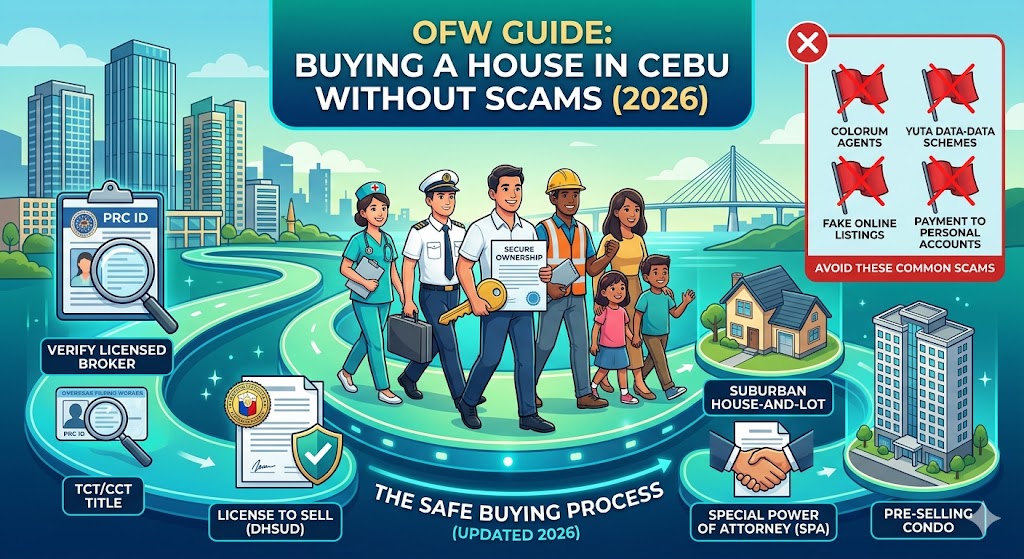
Buying a house in Cebu is a massive milestone for Overseas Filipino Workers (OFWs) investing years of hard-earned money. Cebu offers strong rental demand, growing infrastructure, and excellent options—from pre-selling condominiums in IT Park to house-and-lot subdivisions in Mactan and the South
However, distance makes OFWs vulnerable. Because you are out of the country, you are prime targets for fake titles, unlicensed agents, and unregulated installment schemes. Success depends on strict verification, not shortcuts.
- What You Can Legally Buy
Before looking at properties, understand your legal standing under Philippine law:
Filipino Citizens: If you hold a valid Philippine passport, you can own land, houses, condos, and commercial properties outright. Dual citizens enjoy these same rights.
Foreign Spouses: If you are married to a foreigner, the land and house must be titled in the Filipino spouse’s name to avoid constitutional complications.
Foreigners (Non-Filipinos): Cannot own land. They can only own condominium units (subject to the 40% foreign ownership cap per building) or lease land long-term.
- Choosing the Right Property Type
Cebu’s market is diverse. Your choice dictates your payment structure and risk level:
Property Type: Pre-selling (Under Construction), Ready-for-Occupancy (RFO), Resale (Existing Properties)
The Appeal: Lower entry prices, flexible equity payments (e.g., 24-36 months); Immediate move-in or rental income generation; Often negotiable prices, established neighborhoods
The Risks: High risk of construction delays or stalled projects; Higher upfront costs, requires immediate financing; Requires heavy title verification, higher maintenance
Cebu Market Reality: Pre-selling suits many OFWs because of staggered payments, but be mindful of an oversupply in certain Cebu City condo segments. Research the developer’s track record of actually finishing projects on time.
- The Remote Buying Process
You do not need to fly home to buy property. If you follow this exact sequence, you can safely manage the transaction from abroad.
1. Set Your Budget:Keep housing costs under 30% of your income.
Factor in the down payment, monthly amortizations, closing costs (taxes and fees run 5-10% of the price), and ongoing expenses like HOA dues.
2. Hire a PRC-Licensed Broker:Do not use unverified agents.
Under the Philippine RESA Law, only licensed professionals can sell real estate. Ask for their Professional Regulation Commission (PRC) ID and verify their active status on the official PRC website.
3. Verify the Paperwork:The golden standard of legitimacy.
For new projects, demand the License to Sell (LTS) issued by DHSUD. For existing properties, get a Certified True Copy of the Transfer Certificate of Title (TCT) or Condo Certificate (CCT) from the Registry of Deeds to ensure there are no hidden mortgages or liens.
4. Execute a Special Power of Attorney (SPA):Empower your representative.
Since you cannot physically sign documents, authorize a highly trusted family member or a hired independent lawyer in Cebu via an SPA. You must notarize and apostille (or consularize) this document in your host country.
5. Secure Financing:Pag-IBIG vs. Bank Loans.
Pag-IBIG offers affordable rates and leniency but processes slowly. Commercial banks process faster but have stricter approval requirements.
6. Pay Through Official Channels:Never use personal accounts.
Send reservation fees and down payments strictly to the developer’s official corporate bank account or through a bank escrow. Never send money via remittance centers to an agent’s personal account.
- The Biggest Cebu Real Estate Scams
No matter how much you love the location, walk away immediately if you encounter any of these traps:
Raw Land or “Yuta Data-Data” Schemes: This is incredibly common in Cebu. Sellers subdivide agricultural land and offer it on cheap installments without proper DHSUD permits, road rights-of-way, or drainage plans. It is high risk, and you often cannot get a title for years—if ever.
Fake or Forged Titles: Scammers show impressive-looking photocopies of titles. Avoid this by having your SPA representative pull the original records directly from the Registry of Deeds.
Double Selling: The same property (usually a resale lot) is sold to multiple buyers. Avoid this by ensuring the title is clean and immediately registering your Deed of Absolute Sale.
Extreme High-Pressure Tactics: Statements like, “This is the last unit, you need to send the reservation fee today,” are designed to make you panic and skip your due diligence.
Non-Existent Properties: Scammers steal photos of legitimate properties and post them on Facebook at unrealistically low prices. If a price seems too good to be true for a prime spot in Mactan or Cebu City, it usually is. Have your representative do a physical site visit.
Treat this like any major investment: verify everything, use licensed professionals, and never rush. Your hard-earned money deserves protection.
Frequently Asked Questions (FAQs)
Can an OFW buy a house in the Philippines without going home?
Yes. The entire real estate purchasing process can be handled remotely. As an OFW, you can view properties via virtual tours, attend online briefings, and pay equity through bank transfers. To handle the physical paperwork in Cebu, you must execute a Special Power of Attorney (SPA) to authorize a trusted family member, licensed broker, or lawyer to sign documents and process the title transfer on your behalf.
How much is the reservation fee for a condo in Cebu?
Reservation fees for pre-selling and ready-for-occupancy (RFO) condos in Cebu typically range from ₱15,000 to ₱50,000, depending on the developer and the total contract price of the property. This fee temporarily takes the unit off the market and is usually deducted from your total down payment. Crucial rule: Never send a reservation fee to a real estate agent’s personal bank account or e-wallet. Always deposit directly into the developer’s official corporate account.
What is a Special Power of Attorney (SPA) for OFWs?
A Special Power of Attorney (SPA) is a legal document that grants a designated person the authority to act on your behalf for specific transactions in the Philippines. In real estate, your representative needs an SPA to sign the Contract to Sell, apply for Pag-IBIG or bank home loans, and receive the official property title. To be legally recognized in the Philippines, an OFW must have the SPA notarized and then apostilled (or consularized) at the Philippine Embassy or Consulate in their host country.
Contact Us
Author
John Paul Ybañez Paquibot
Licensed Real Estate Broker | PRC No. 00014132 | DHSUD No. CVRFO-B-03/18-2672
Bachelors Realty and Brokerage, Inc. Cebu
G/F Cap Building, Brgy. Corner, Osmeña Blvd.
Arlington Pond St. Extension, Cebu City, 6000 Cebu
Leave a Reply