(Because a Non-Refundable Fee Is No Joke)
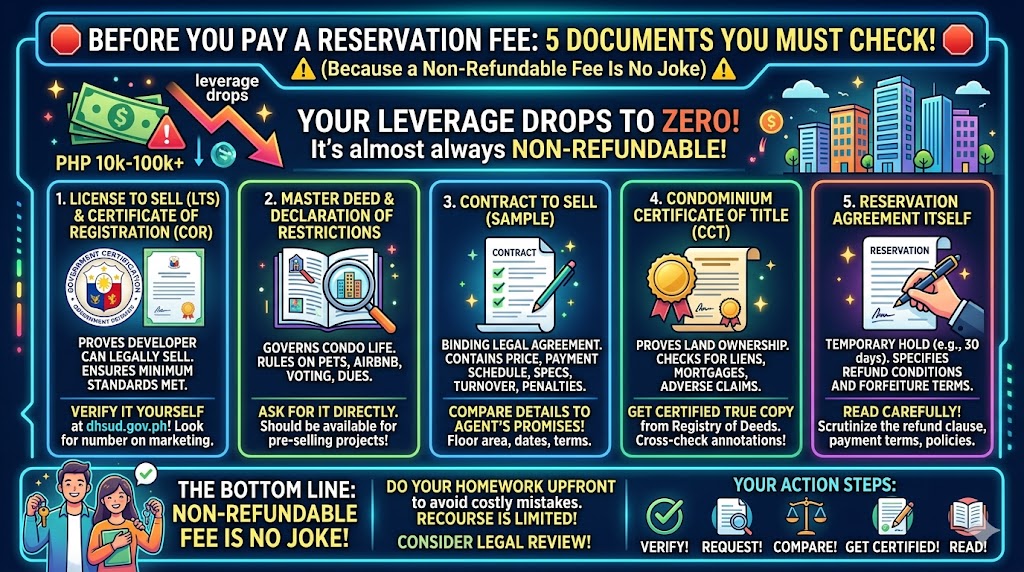
A reservation fee locks in your chosen unit, typically costs PHP 10,000 to PHP 100,000, and is almost always non-refundable. Before you part with that money, you need to see and scrutinize these five documents.
1. The Certificate of Registration and License to Sell
No valid License to Sell (LTS) means the developer has no legal right to sell you anything. Without it, you have very little legal protection if the project collapses or is never completed.
The LTS proves that the developer’s plan for the project has passed the government’s minimum standards on everything from lot sizes to drainage. And the Certificate of Registration (COR) confirms that the developer is a legitimate business entity. Both are issued by the Department of Human Settlements and Urban Development (DHSUD).
Verify it yourself. Never just accept a photocopy from the agent. Look for the LTS number on all marketing materials—legitimate projects are required to display it. Then cross-check it on the official DHSUD list at dhsud.gov.ph/services/list-of-license-to-sell/. If the LTS isn’t found or doesn’t match the developer’s name, consider it a serious red flag. Any hesitation or delay from the developer in showing you these documents is a major warning sign.
2. The Master Deed and Declaration of Restrictions
The Master Deed with Declaration of Restrictions is the foundational document that establishes a condominium project and governs everything about living there. It’s registered with the Registry of Deeds and is part of the public record. Yet many buyers never read it.
This document outlines what you can and cannot do with your unit. It will tell you if pets are allowed, if short-term rentals (like Airbnb) are prohibited, what percentage of the building you own for voting and dues purposes, and who pays for what when repairs are needed. It also creates the condominium corporation that manages the building. If you plan to rent out your unit, look closely for any clause that restricts leasing.
Ask for it directly. Request a copy of the Master Deed from the developer before paying the reservation fee. If you’re told it’s “not available yet” for a pre-selling project, that’s a red flag—developers are required to secure an approved Master Deed as part of the registration process with DHSUD.
3. The Contract to Sell
The reservation agreement is temporary. The Contract to Sell is the real deal—the binding legal agreement that governs the entire transaction. The reservation agreement typically holds the unit for you for about 30 days, and you’ll need to sign the Contract to Sell within that period.
Before paying the reservation fee, you should have seen a draft or sample of the Contract to Sell. This document contains the total contract price, the exact payment schedule, the unit specifications (floor area, unit number, parking slot if applicable), the target turnover date, the penalties for late payments, and the developer’s cancellation policies.
Verify every detail. Compare the contract to what the agent promised. If the floor area is smaller, the payment schedule is tighter, or the turnover date is later than advertised, those differences become legally binding once you sign.
4. The Condominium Certificate of Title
You’re not buying just a unit; you’re buying a share of the land the building stands on. The Condominium Certificate of Title (CCT) proves that the developer actually owns the land and has the legal right to sell units in that project.
For a pre-selling project, the developer holds the master title. Before you pay anything, you need to see that the land is free from any liens, mortgages, or adverse claims that could get in the way of your ownership. These encumbrances are annotated on the back of the title.
Get a certified true copy. Request a certified true copy of the title from the Registry of Deeds yourself—don’t rely on the seller’s copy. Then check the annotation section for any claims, mortgages, or notices of pending litigation. Then hire a geodetic engineer to verify the property boundaries, and have an independent lawyer review the title. If you’re buying a ready-for-occupancy (RFO) unit, make sure your individual CCT has already been issued.
5. The Reservation Agreement Itself
This is the document you’ll be asked to sign right before paying the fee. Read it carefully. Pay special attention to the refund clause: does it explicitly state that the fee is non-refundable? Under what circumstances, if any, can you get it back? If the developer fails to obtain the necessary permits or misrepresents the property, you may have grounds for a refund regardless of the clause, but having it in writing is better.
Also check the reservation period (typically 30 days), the exact payment terms, what happens if you fail to complete the purchase within that period, and whether the developer has the right to cancel the reservation and keep your fee if certain conditions aren’t met.
Don’t sign without a review. If the reservation agreement says the fee is non-refundable “absolutely” or “under any circumstances,” know exactly what you’re getting into before you sign. A quick review by a lawyer at this stage can save you from a costly mistake later.
The Bottom Line
Reservation fees range from PHP 10,000 to over PHP 100,000. That’s a lot of money to lose if something goes wrong. The developer has no legal obligation to refund you if you change your mind or your financing falls through. Once you pay, your recourse is limited.
Your action steps:
- Verify the LTS and COR on the DHSUD website before paying anything.
- Request and review the Master Deed. Ask for a copy.
- Get a draft of the Contract to Sell and compare it to what was promised.
- Pull a certified true copy of the title from the Registry of Deeds.
- Read the reservation agreement carefully—don’t just skim it.
- Consider having a lawyer review all documents before you sign anything.
- Check the developer’s track record on past projects, including delivery timelines and build quality.
These steps take time. But the cost of skipping them is much higher than the cost of doing the work upfront.
Contact Us
Leave a Reply