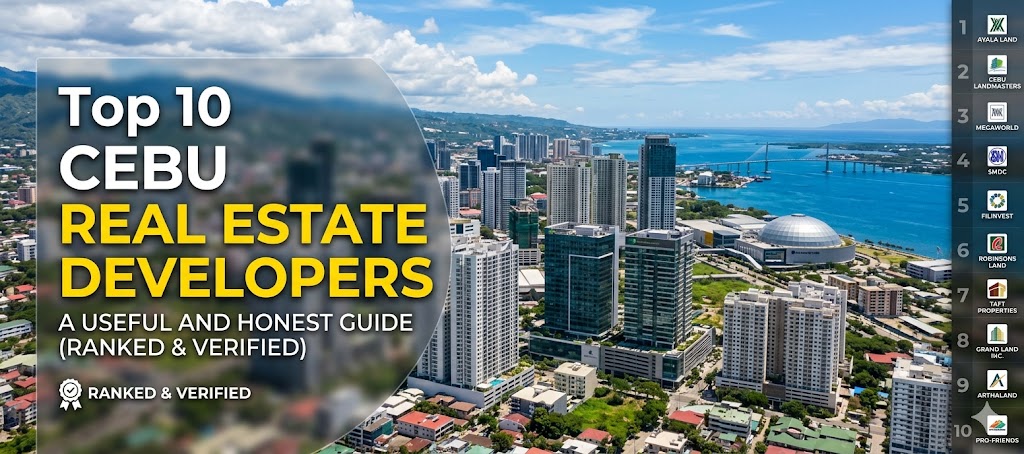
Cebu’s real estate market has matured far beyond its reputation as a scenic tourist stop. Today, it’s one of the Philippines’ most dynamic property markets—drawing national giants and homegrown players alike, all competing to shape the city’s skyline and suburban fringes. But with glossy brochures and aggressive marketing everywhere, separating the genuine builders from the hype merchants takes work.
This guide ranks the ten most significant real estate developers operating in Cebu today—from #1 to #10—based on track records, completed projects, financial health, Cebu-specific presence, and market reputation. Every figure, project timeline, and investment amount in this guide has been verified against the latest available data as of June 2026. Not a single entry here is based on promises alone; every developer on this list has delivered projects you can actually visit and evaluate.
#1 – Cebu Landmasters Inc. (CLI)

The Undisputed Homegrown Champion
If there’s one developer that truly defines Cebu’s real estate ascendancy, it’s Cebu Landmasters. CLI isn’t just a Cebu-based company—it is the top residential developer in the entire Visayas and Mindanao region, commanding an 18% market share according to Colliers’ 2025 Real Estate Market Study. The company was also named Best Developer in Visayas and Best Developer in Mindanao at the 13th PropertyGuru Philippines Property Awards.
Financially, CLI is a fortress. The company posted a ₱3.1-billion consolidated net income for the first nine months of 2025, up 6% year-on-year. By September 2025, total assets had grown to ₱128.7 billion. Its landbank now spans 188 hectares, including a 79-hectare property in Liloan, Cebu, planned as a mixed-use township. Across its entire portfolio, CLI manages 131 projects—comprising 102 residential developments and 16 income-generating properties (10 hotels and 6 office buildings).
CLI’s flagship economic housing brand, Casa Mira, along with its mid-market Garden Series, achieved a 90% sell-out rate—a figure that suggests genuine end-user demand rather than speculative froth.
The honest take: CLI is a legitimate success story with proven delivery across multiple price points. Its 3% cancellation rate and 2.6% delinquency rate indicate resilient, real demand. However, CLI is expanding rapidly—with plans to launch over 20 projects worth ₱48 billion in the coming months. Rapid expansion always carries execution risk, so buyers should still do their due diligence on specific projects rather than buying blind on brand alone.
#2 – Ayala Land

The Gold Standard
Ayala Land is the name that needs no introduction. As one of the biggest names in Philippine real estate, their presence in Cebu is deep and growing. What distinguishes Ayala Land is its master-planned, integrated community approach—combining residential, commercial, and recreational spaces in cohesive estates.
In Cebu, Ayala Land is betting big. The company is investing ₱12.7 billion to redevelop and enhance three malls in Cebu from 2025 to 2028. This breaks down to ₱10.5 billion for the expansion of Ayala Center Cebu and the new Ayala Malls Gatewalk, plus ₱2.2 billion for renovations at AyalaMalls Central Bloc. The renovation of Ayala Center Cebu is now 75–80% complete and slated for full completion by the end of 2025.
Ayala Malls Gatewalk in Mandaue City is scheduled to open on December 16, 2026, with IKEA confirmed as one of its flagship anchor tenants—a major draw that is already driving foot-traffic expectations and elevating property values in the surrounding area.
On the residential front, Ayala Land has expanded its innovative co-living concept, CityFlats, with a second Cebu location at Cebu Business Park, following the successful opening of CityFlats Cebu IT Park in August 2025.
The honest take: You pay a premium for an Ayala Land property—there’s no way around it. But many buyers feel the investment is worth it for the quality of life and long-term value. Ayala Land has the financial muscle, track record, and brand equity to deliver. The catch? That premium pricing means you’re buying at market-leading rates, so capital appreciation may be more gradual than with emerging developers in up-and-coming areas.
#3 – SM Prime Holdings

The Mixed-Use Powerhouse
Most people know SM Prime for its massive shopping malls, but the company is a significant residential player too. In Cebu, SM Prime is going all-in on mixed-use developments that combine offices, residences, retail, and leisure components.
The centerpiece of SM Prime’s Cebu strategy is South Coast City, a 26-hectare master-planned estate at the South Road Properties. Within this development, SM Prime is investing ₱3.6 billion to build the SMX Convention Center Seaside Cebu, featuring over 21,000 square meters of leasable space across six levels with an 18,000-guest seating capacity. It’s scheduled to open in late 2026.
The SM Seaside City Arena is also on the horizon. Recent reports from May 2026 confirm it remains on track for a June 2026 opening, with high-profile event bookings already confirmed through late 2026—a strong indicator that SM Prime is delivering on its timelines.
The honest take: SM Prime’s integrated approach offers genuine lifestyle convenience—live near a mall, work near an office, and have amenities at your doorstep. SM Development Corporation (SMDC), a subsidiary, focuses on condominiums targeting young professionals with relatively affordable units in prime locations. However, SMDC condos are known for high density—many units per floor—which can affect privacy and long-term value compared to lower-density developments. Know what you’re buying before you sign.
#4 – Megaworld Corporation

The Township Pioneer
Megaworld pioneered the “live-work-play” concept in the Philippines, creating self-contained communities where residents can live, work, and play within the same area. In Cebu, their flagship is The Mactan Newtown, a 30-hectare township in Lapu-Lapu City envisioned as a mixed-use business and leisure hub.
The township is now highly mature, featuring four completed residential developments, three more residential buildings under construction, five office towers, and two hotels. Megaworld is reinvesting approximately ₱3.4 billion from its REIT proceeds to expand its provincial townships, including The Mactan Newtown. Two tourism-related facilities are being constructed: the Mactan Expo (a standalone convention center) and the Mactan World Museum (a multi-level historical and cultural museum). One 20-story residential building within the township is now being offered at an average price of ₱300,000 per square meter, up from an initial average of ₱175,000—a testament to the township’s growing value.
The honest take: Megaworld delivers on its township promise—if you buy into a Megaworld development, you’re buying into a complete ecosystem. The catch is that townships take years to fully mature. Early buyers benefit from lower prices but must wait for the full vision to materialize. Also, the “live-work-play” model works best if you actually work within the township; otherwise, you’re paying for amenities you may not fully use.
#5 – Robinsons Land Corporation (RLC)

The Diversified Challenger
Robinsons Land is emerging as a formidable multi-sector player in Cebu. At the 13th PropertyGuru Philippines Property Awards, RLC took home the highest honor—Best Developer (Philippines) —for the fourth consecutive year.
In Cebu, RLC’s crown jewel is the NUSTAR Hotel Cebu on Kawit Island. This ultra-luxury property opened its doors on May 8, 2025, featuring 223 rooms and representing a direct play for the six-star traveler. The hotel has already earned a spot in the 2025 Michelin Guide for Hotels—a rare distinction for a homegrown Filipino brand. The Mall NUSTAR Cebu also won three awards at the PropertyGuru Awards: Best Retail Development, Best Retail Architectural Design, and Best Retail Interior Design. (Alongside NUSTAR, RLC’s Dusit Thani Mactan Cebu also earned a spot in the same Michelin Guide, underscoring the group’s hospitality prowess.)
The honest take: RLC is aggressively diversifying beyond traditional mall operations into luxury hospitality. This diversification strengthens the company’s financial resilience, but it also means residential projects may not always be the primary focus. Buyers should evaluate each RLC residential project on its own merits rather than relying solely on the company’s overall reputation. RLC is a proven winner nationally, but its Cebu residential footprint is still developing.
#6 – Filinvest Land Inc.

The Business District Builder
Filinvest Land has carved a niche in Cebu through its commercial and office developments. The company’s flagship Cebu project is City di Mare (CDM) , a 58-hectare master-planned township at the South Road Properties—a joint venture between Filinvest and the Cebu City Government. CDM is designed as a balanced “live-work-play” environment and is quickly emerging as Cebu’s next premier business and lifestyle hub.
Filinvest is expediting the completion of amenities and infrastructure components of CDM as it continues to attract strong interest from both local and foreign investors. In a sign of the project’s success, only eight hectares of commercial land remain available within the township, indicating that the development is rapidly reaching critical mass.
The honest take: Filinvest is a solid, established player with a strong commercial portfolio. Its residential offerings in Cebu are more limited compared to pure residential developers, so buyers should evaluate specific projects carefully. The company’s deep relationship with the Cebu City government suggests long-term commitment to the market, but if you’re primarily looking for a home rather than an office-adjacent investment, Filinvest may not be your first stop.
#7 – Vista Land (Camella)

The Mass Housing Giant
Vista Land, through its flagship brand Camella, is the country’s leading mass housing developer by number of units sold and projects delivered. The company pioneered master-planned communities in Cebu with the first Camella community on Mactan Island, established in 1991.
Today, Vista Land has developments across Cebu City, Talisay, Mactan Island, and Carcar City. In mid-2025, the company launched Camella Montevia in Talamban, Cebu City, as part of its Visayas expansion campaign. This project is part of Vista Land’s broader “Synchrony” campaign, which aims to provide premium residential living near the South Road Properties and key educational institutions.
The honest take: Vista Land delivers volume and affordability. If you’re looking for an entry-level house-and-lot in a planned community, Camella is a reliable option. However, mass housing developments come with trade-offs—smaller lot sizes, standardized designs, and less exclusivity. The company’s scale is both a strength (proven delivery) and a weakness (cookie-cutter approach). For first-time buyers on a budget, Vista Land is hard to beat. For investors seeking premium appreciation, look higher up this list.
#8 – DMCI Homes

The Engineer’s Approach
DMCI Homes is a relatively new entrant to Cebu, but it’s making a significant splash. The Quadruple A developer is investing approximately ₱24 billion in Kalea Heights, a flagship residential condominium project along Good Shepherd Road in Barangay Guadalupe. It is the largest condominium project in Cebu City and the largest in DMCI Homes’ entire national portfolio, with over 1,000 units planned.
What sets DMCI apart is its engineering pedigree—the company is backed by D.M. Consunji Inc.’s over 70 years of construction expertise. Its signature Lumiventt® Design Technology brings natural light and air circulation deep into building interiors through three-storey-high “Sky Patios,” reducing reliance on artificial lighting and cooling. The 4.6-hectare development dedicates 3.6 hectares to open space—the largest in any Cebu condominium project and within DMCI Homes’ portfolio. Units are priced between ₱5.7 million and ₱14 million, with turnovers beginning in December 2029.
The honest take: DMCI Homes brings a fresh, engineering-driven approach to Cebu’s condo market. The Lumiventt® technology is genuinely innovative for tropical climates. However, Kalea Heights is a pre-selling project with turnover years away—buyers are buying a vision, not a finished product. DMCI’s track record outside Cebu is strong, but this is their first major Cebu project, so some execution risk exists. Company officials have confirmed that Kalea Heights is the first of several developments planned in Cebu, signaling a long-term commitment.
#9 – Primary Homes Inc.

The Cebu-Built Trusted Name
Primary Homes is a Cebu-based developer that has been building subdivisions, condominiums, and commercial projects for over two decades. The company traces its roots to the Primary Structures Group, an “AAA” category construction company.
Primary Homes serves Cebu, Bohol, Negros, and nearby Visayan growth areas, positioning itself as a trusted name in mid-market housing. In 2025, the company unveiled an ambitious roadmap including mixed-use township developments in Cebu, vacation rental properties in Mactan and Panglao Islands, and house-and-lot projects in western Cebu, Bohol, and Negros. Recent launches include Royal Palms Toledo—a 2.8-hectare development featuring 109 units with resort-style amenities—and Almond Drive, a walk-up condominium and house-and-lot project in Talisay City.
The honest take: Primary Homes is a solid, homegrown developer with a proven track record in the Visayas. It doesn’t have the national brand recognition of Ayala or SM, but that can work in buyers’ favor—less brand premium, more value for money. The company’s construction roots (through Primary Structures Group) suggest a genuine understanding of building quality. That said, its project portfolio is more regional and smaller in scale compared to national players. For buyers who want a trusted local name without the national-brand markup, Primary Homes is worth a serious look.
#10 – Rockwell Land

The Luxury Specialist
Rockwell Land, known for its upscale developments in Metro Manila (including the iconic Power Plant Mall), has been expanding its presence in Cebu. The company’s flagship Cebu development is Rockwell at IPI Center, a mixed-use development in the heart of Cebu City.
Rockwell expanded the IPI Center by an additional 7,806 square meters in July 2025, bringing its total footprint to 3.6 hectares. The expansion includes a new entry point along Banilad Road and adds 10,000 square meters of retail space. The centerpiece is The Lincoln, a 53-storey residential tower that embodies exclusive, modern living in Cebu City. To underscore its aggressive growth, Rockwell reported spending ₱4.9 billion on projects and capital expenditures in the first half of 2025, with 70% growth in reservation sales during Q1 2025.
The honest take: Rockwell is the luxury play in Cebu. If you want exclusivity, low density, and premium finishes, Rockwell delivers. But luxury comes at a luxury price—these are among the most expensive residential options in Cebu. Rockwell’s brand is built on quality, but buyers should ensure the premium pricing aligns with their investment goals. The IPI Center expansion suggests Rockwell is committed to Cebu for the long haul, but its Cebu footprint remains tiny compared to every other developer on this list. That’s why it sits at #10—not because of quality, but because of limited local presence.
Final Thoughts: How to Choose
Choosing a developer in Cebu isn’t about picking the biggest name—it’s about matching the developer’s strengths to your specific needs:
- If you want the undisputed Cebu market leader with proven delivery across all price points: Cebu Landmasters (#1) is your answer.
- If you want master-planned, premium communities and don’t mind paying for the brand: Ayala Land (#2) delivers.
- If you want the convenience of living near a mall and a complete ecosystem: SM Prime (#3) and Megaworld (#4) are strong contenders.
- If you’re looking for affordable entry-level housing: Vista Land (#7) is hard to beat.
- If you want engineering innovation and are willing to wait for a pre-selling project: DMCI Homes (#8) offers something genuinely different.
- If you want a trusted Cebu-born developer without the national-brand markup: Primary Homes (#9) is worth your time.
- If money is no object and you want exclusivity: Rockwell Land (#10) is the luxury play.
Before you sign anything, visit completed projects. Talk to residents. Check the License to Sell (LTS) and review the Deed of Restrictions—these are the most common pitfalls for unsuspecting buyers. A developer’s reputation is built project by project, and your investment deserves nothing less than thorough homework. Every developer on this list has delivered finished homes you can actually see. That’s the most honest measure of all.
Sources & Methodology:
Rankings are based on a 2026 market analysis of developer project delivery, verified financial filings, and independent property studies (Colliers, PropertyGuru). Specific project timelines and investment figures have been cross-referenced with official company disclosures and recent mid-2026 industry reports to ensure maximum accuracy at the time of publication. This guide is intended for informational purposes only and does not constitute professional financial or legal advice. Always conduct your own due diligence before making any property investment.
Author
John Paul Ybañez Paquibot
Licensed Real Estate Broker | PRC No. 00014132 | DHSUD No. CVRFO-B-03/18-2672
Bachelors Realty and Brokerage, Inc. Cebu
G/F Cap Building, Brgy. Corner, Osmeña Blvd.
Arlington Pond St. Extension, Cebu City, 6000 Cebu
Leave a Reply