Quick Summary
Can I own land? No.
Can I own a condo? Yes, subject to the 40% foreign ownership cap per building.
Can I lease land? Yes, under specific legal conditions.
Are “nominees” safe? No. They are illegal and dangerous.
The Philippines is one of the most welcoming countries in the world for foreign retirees. English is widely spoken, the cost of living is low, and the culture is famously hospitable. But when it comes to property ownership, the rules are not welcoming at all. They are strict, constitutional, and unforgiving.
Here is the brutal truth: foreigners cannot own land in the Philippines.
This is not a regulation that can be negotiated, loopholed, or wished away. It is written into the 1987 Constitution. Understanding exactly what you can and cannot own—and the serious consequences of trying to cheat the system—is the most important thing you will learn before investing in Philippine real estate.
The Constitution: The Unshakeable Foundation
The 1987 Philippine Constitution is the source of all property ownership rules. Article XII, Section 7 states that private land ownership is limited to Filipino citizens and corporations with at least 60 percent Filipino ownership.
This restriction applies to all forms of land: residential, commercial, agricultural, and industrial. There are no exceptions for long-term residents, retirees with SRRV visas, or foreign investors. The Constitution does not care how long you have lived in the Philippines, how much money you have, or how much you love the country.
If you are a foreigner, you cannot own land. Period.
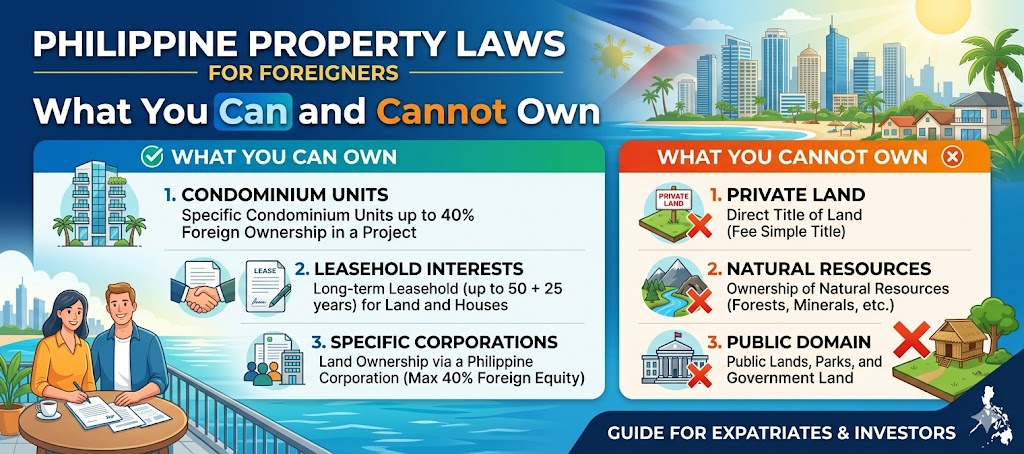
What You CAN Own as a Foreigner
Condominium Units
This is the single biggest exception to the land ownership ban. Under Republic Act No. 4726, the Condominium Act, foreigners can legally own condominium units in their own names.
The 40 Percent Rule
Here is the critical limitation: foreign ownership in any condominium project cannot exceed 40 percent of the total units. The 40 percent limit is strictly enforced. If a condominium building has 100 units, only 40 of them can be owned by foreigners. Once that limit is reached, no more foreign buyers can purchase in that project.
This is a hard cap that applies to the entire building, not per floor or per tower. If you are buying a condo as a foreigner, you must confirm with the developer or the condominium corporation that the 40 percent foreign ownership limit has not been exceeded.
What You Actually Own
When you buy a condominium unit in the Philippines, you receive a Condominium Certificate of Title (CCT) . This gives you exclusive ownership of your unit. The condominium corporation holds title to the land and common areas, and you become a shareholder in that corporation. This structure is what makes foreign ownership legally possible—you own a unit in a building, not the land itself.
Important: A foreigner can own a condominium unit without needing to form a corporation or use a Filipino nominee. The unit is titled directly in your name.
Long-Term Leases on Land
If you want a house with a garden or a piece of land to build on, you cannot own it. But you can lease it.
The law governing long-term leases for foreign investors is Republic Act No. 12252, known as the Amended Investors’ Lease Act, signed into law on September 3, 2025. This law significantly liberalized the lease terms available to foreigners.
The 99-Year Lease
Under the amended law, foreign investors can lease private lands for a maximum aggregate period of 99 years. Previously, the maximum was 50 years with one 25-year renewal.
Key Conditions for the 99-Year Lease:
- The investment must be registered under the Foreign Investments Act of 1991, the CREATE Act, or other applicable laws.
- The leased land must be used only for the approved investment purpose.
- The lease contract must be registered with the Registry of Deeds and annotated on the certificate of title covering the leased area.
- The lease agreement must have termination clauses related to change in purpose or failure to commence the project within a reasonable period.
What This Means for Retirees
Here is the honest truth: the 99-year lease is designed for foreign investors with registered business investments, not for retirees who simply want a house and garden. For a retiree, the more relevant option is a standard long-term lease of private land. Under general Philippine property law, foreigners may lease private land for a maximum term of 25 years, renewable for another 25 years upon mutual agreement.
One critical warning: A lease gives you the right to use the land, not to own it. You can build on it, live on it, and enjoy it. But the land itself always belongs to the Filipino owner. Your lease is a contract, not a title.
Inherited Property
If you are a former Filipino citizen who has acquired foreign citizenship, you can inherit property under certain conditions. Former natural-born Filipinos may own residential property up to 1,000 square meters of urban land or one hectare of rural land. This exception does not apply to foreigners who were never Filipino citizens.
What You CANNOT Own
Land of Any Kind
This is the absolute prohibition. Foreigners cannot own residential land, commercial land, agricultural land, industrial land, or any other type of land.
This includes:
- House and lot packages (you can lease the land but not own it)
- Vacant lots
- Farmland
- Beachfront property
- Commercial lots
If a seller tells you that a foreigner can own land “through a special arrangement,” they are either misinformed or trying to deceive you.
Majority Ownership in a Real Estate Corporation
Foreigners can invest in Philippine corporations, but they cannot own more than 40 percent of a company that owns land or engages in the real estate business. This is known as the 40 percent foreign equity limit.
The Securities and Exchange Commission (SEC) enforces this strictly through the Two-Tier Test:
- First Tier: At least 60 percent of voting shares must be Filipino-owned.
- Second Tier: At least 60 percent of all outstanding capital stock—both voting and non-voting shares—must be Filipino-owned.
If a corporation fails either test, it is considered foreign-owned and cannot legally own land in the Philippines.
The Anti-Dummy Law: The Teeth Behind the Constitution
The Constitution is the rule. The Anti-Dummy Law (Commonwealth Act No. 108) is the enforcement mechanism.
This law penalizes anyone who uses a Filipino’s name or citizenship to evade constitutional or legal restrictions on foreign ownership. It makes it a criminal offense to:
- Use a Filipino citizen as a “dummy” or nominee to acquire land on behalf of a foreigner.
- Falsely simulate the existence of the required minimum Filipino capital ownership.
- Allow foreign intervention in the management of a corporation engaged in a partially nationalized activity.
The Penalties Are Serious
Violations of the Anti-Dummy Law can result in criminal prosecution, fines, and imprisonment. The law has been used recently in high-profile cases. In April 2026, former Bamban mayor Alice Guo was indicted for Anti-Dummy Law violations in connection with land acquisitions made through misrepresented identities.
A Proposed New Law Would Make It Even Harder
In November 2024, a group of lawmakers filed House Bill 11043, which would authorise the government to seize illegally acquired real estate properties owned by foreign nationals. The bill would create a prima facie presumption that real estate titled under a foreign national is unlawfully acquired unless proven otherwise—shifting the burden of proof to the buyer.
The bill was filed in response to investigations revealing that some foreign nationals secured fake birth certificates and passports to purchase land illegally. While the bill is not yet law, it signals the government’s determination to enforce the constitutional prohibition.
Common Traps and Scams to Avoid
The “Nominee” or “Dummy” Arrangement
Some unethical sellers will offer to put land in a Filipino’s name with a “side agreement” that you are the real owner. This is illegal, dangerous, and almost always ends badly.
What can go wrong:
- The Filipino nominee can sell the land without your consent.
- The nominee’s heirs can claim the land after their death.
- The arrangement can be discovered and the land forfeited to the government.
- You can be criminally prosecuted under the Anti-Dummy Law.
Do not do this. Ever.
The “99-Year Lease” Misunderstanding
Some developers and agents market “99-year leases” to foreigners as if they are the same as ownership. They are not. A lease is a contract. It can be broken, challenged, or not renewed. You do not hold title. You do not have the same rights as an owner.
The honest truth: A 99-year lease is a legitimate option for investors with registered business investments. But for a retiree looking for a home, a 25-year renewable lease with a trusted Filipino landowner is the more practical—and legally sound—option.
The “Corporation Loophole”
Some agents will tell you that forming a corporation will allow you to own land. This is only partially true and often misleading.
Here is the actual rule: A corporation can own land in the Philippines only if it is at least 60 percent Filipino-owned. If you are a foreigner forming a corporation, you can own at most 40 percent of that corporation. You cannot use a corporation to circumvent the constitutional prohibition.
If an agent tells you otherwise, they are either ignorant or dishonest.
What About the SRRV?
The Special Resident Retiree’s Visa (SRRV) gives you permanent residency in the Philippines. It does not give you the right to own land.
However, there is one important benefit for SRRV holders: you may withdraw your SRRV deposit to purchase a condominium unit or acquire a long-term lease, subject to PRA rules. Your deposit is converted into an investment. This is a legitimate use of the SRRV deposit, but it does not change the underlying property laws—you still must comply with the 40 percent condominium rule or lease land from a Filipino owner.
The Honest Bottom Line
The Philippine Constitution is clear: foreigners cannot own land. There are no exceptions for retirees, long-term residents, or investors. The only legal ways for a foreigner to have a property interest in the Philippines are:
- Buy a condominium unit in a project where the 40 percent foreign ownership cap has not been exceeded.
- Lease land through a legally registered long-term lease contract.
- Inherit property if you are a former Filipino citizen (subject to limits).
Any arrangement that claims to give a foreigner outright ownership of land is almost certainly illegal, risky, or both. The Anti-Dummy Law is real, and the government is increasingly aggressive in enforcing it.
My advice: Work with a reputable Philippine lawyer who specialises in real estate. Do not rely on the seller’s agent, the developer’s marketing materials, or online forums for legal advice. Visit the property, check the title at the Registry of Deeds, and confirm the 40 percent foreign ownership limit with the condominium corporation before buying a condo.
The Philippines is a wonderful place to retire. But property law here is not flexible, not forgiving, and not open to interpretation. Know the rules, follow them, and you can enjoy your retirement without legal nightmares.
Disclaimer
This guide is intended for informational purposes only and does not constitute professional legal advice. Property laws, regulations, and interpretations are subject to change. You are strongly advised to consult with a licensed Philippine attorney who specialises in real estate law before making any property investment. The author assumes no liability for any outcomes arising from the use of this information. Always verify current legal requirements directly with the relevant government agencies and your legal counsel.
For official information, refer to the Philippine Retirement Authority (PRA) and the Securities and Exchange Commission (SEC).
Sources & Methodology: This guide is based on the 1987 Philippine Constitution, Republic Act No. 4726 (Condominium Act), Republic Act No. 12252 (Amended Investors’ Lease Act), the Anti-Dummy Law (Commonwealth Act No. 108), SEC-OGC Opinion No. 24-36, official government announcements, and verified legal analyses as of June 2026. All legal citations have been cross-referenced with official sources. This guide is intended for informational purposes only and does not constitute professional legal advice. Always consult with a licensed Philippine attorney before making any property investment.
Author
John Paul Ybañez Paquibot
Licensed Real Estate Broker | PRC No. 00014132 | DHSUD No. CVRFO-B-03/18-2672
Bachelors Realty and Brokerage, Inc. Cebu
G/F Cap Building, Brgy. Corner, Osmeña Blvd.
Arlington Pond St. Extension, Cebu City, 6000 Cebu
Leave a Reply