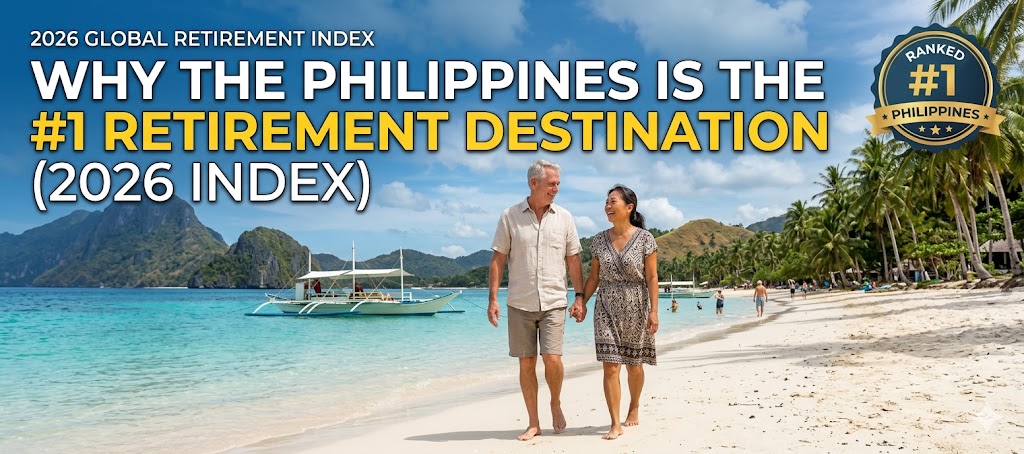
In June 2026, the Philippines received a title that many expats have long suspected was true: the world’s number one retirement destination.
The Retirement Abroad Index 2026, published by the UK-based Expatriate Group—a specialist provider of international health insurance serving expatriates and retirees across more than 180 countries—evaluated 20 countries across five critical categories. The Philippines came out on top with a winning score of 78 out of 100.
This wasn’t a narrow victory. The Philippines ranked first across all five categories, beating Thailand (77), Colombia (73), Portugal (71), South Africa (69), and Sri Lanka (69).
But what does this ranking actually mean? And more importantly, does it reflect reality for retirees on the ground?
This is an honest breakdown of why the Philippines took the top spot—and what the index’s own data reveals about where the country still falls short.
The Five Categories: How the Philippines Scored
The Retirement Abroad Index 2026 evaluated countries across five equally weighted pillars, each worth up to 20 points. Here is how the Philippines performed.
Cost of Living: 18 out of 20
This was the Philippines’ highest score. The index described affordability as “one of the country’s biggest strengths”. A retired couple can typically live comfortably on around £750 to £1,000 per month (approximately $998 to $1,330), though costs are generally higher in Manila than in smaller cities and coastal communities.
For context, this means the Philippines is 50 to 90 percent cheaper than the United States for many everyday expenses. Rent, food, transportation, and domestic help are all significantly more affordable than in Western countries.
Visa Accessibility: 17 out of 20
The index praised the Philippines’ Special Resident Retiree’s Visa (SRRV) as “among the most accessible retirement programmes we assessed”. Applicants aged 50 and over who receive a pension qualify with a fixed deposit of USD 15,000 (around £11,000). Successful applicants enjoy long-term residency without the burden of annual visa renewals. Processing times typically range from four to eight weeks.
This is significantly easier and cheaper than many competing destinations. Malaysia’s retirement programme, for comparison, requires around USD 200,000. Thailand’s OA visa requires health insurance and a police clearance from your home country.
Expat Community and Integration: 16 out of 20
The Philippines scored strongly here, and the reason is straightforward: English is widely spoken and is one of the country’s official languages. This “removes a common barrier to integration” for retirees.
Combined with a well-established expat population across Manila, Cebu, and popular island destinations, this makes the transition to life overseas “much easier than in many competing retirement destinations”. Expats consistently report that locals are friendly, social circles form quickly, and cultural barriers feel lower than in countries where language and formality often stand in the way.
Health Insurance Requirements: 15 out of 20
The Philippines received a mid-range score here. The index noted that while health insurance is available and accessible, retirees should ensure their coverage is “robust enough to bridge the gap” between excellent urban healthcare and more limited provision elsewhere.
Healthcare Quality: 12 out of 20
This was the Philippines’ lowest score—and the index was honest about why.
The major cities such as Manila and Cebu City offer access to modern private hospitals, internationally accredited facilities, and English-speaking medical professionals. However, the index noted a “significant gap” between urban and rural areas. Healthcare standards can vary considerably outside of these urban centres, so location is an important consideration for retirees.
This is a genuine weakness. If you retire in a remote province, you may need to travel hours—or fly—for serious treatment. The index explicitly warns expats to choose their location carefully and ensure their health insurance is sufficient.
The Philippines’ Winning Overall Score: 78 out of 100
What does 78 mean?
It means the Philippines is not perfect. A score of 78 leaves room for improvement, particularly in healthcare. But it also means the country outperformed every other destination when all five categories were combined.
Thailand scored 77—just one point behind. Thailand’s strength is healthcare (it scored joint-highest in the index). The Philippines’ strength is visa accessibility and cost of living. The choice between the two ultimately comes down to personal priorities.
Colombia scored 73, combining low living costs with one of the most accessible retirement visa pathways in the Americas.
Portugal scored 71, offering European infrastructure and healthcare but at a higher cost of living.
South Africa and Sri Lanka both scored 69.
Beyond the Numbers: What the Index Actually Says
The index’s written commentary is worth reading carefully. Here is what it says about the Philippines, in its own words:
On affordability: “Affordability remains one of the country’s biggest strengths”.
On the SRRV: “The country’s Special Resident Retiree’s Visa (SRRV) is among the most accessible retirement programmes we assessed”.
On integration: “English is widely spoken and is one of the country’s official languages, which removes a common barrier to integration for UK retirees. Combined with a well-established expat population across Manila, Cebu, and popular island destinations, this makes the transition to life overseas much easier than in many competing retirement destinations”.
On healthcare: “The major cities such as Manila and Cebu City offer access to modern private hospitals, internationally accredited facilities, and English-speaking medical professionals. However, healthcare standards can vary considerably outside of these urban centres, so location is an important consideration for retirees”.
On cost of living for a couple: “A retired couple can typically live comfortably on around £750 – £1,000 per month”.
The Honest Take: What the Index Doesn’t Tell You
The Retirement Abroad Index 2026 is a data-driven, evidence-based ranking. It is not marketing hype. The Philippines genuinely deserves the top spot based on the five categories evaluated.
But rankings are rankings. The index does not capture everything that matters in daily life.
It does not capture the frustration of bureaucracy. Opening a bank account requires multiple forms. Government processes are slow. Digital systems are often outdated. Patience is not optional—it is essential.
It does not capture the reality of traffic. Metro Manila and Cebu are notorious for congestion. A ten-kilometer drive can take over an hour during peak hours. This affects quality of life in ways that no index can fully measure.
It does not capture the variability of healthcare costs. While the index notes the urban-rural gap, it does not emphasize that private healthcare—while excellent in cities—is expensive. International health insurance is essential, not optional.
It does not capture the cultural adjustment. The Philippines is warm, welcoming, and English-speaking. But it is also different. Pace of life is slower. Systems are less efficient. If you need first-world infrastructure and seamless processes, you will struggle.
The Bottom Line
The Philippines is the world’s number one retirement destination for 2026 according to the Retirement Abroad Index. The ranking is based on real, measurable strengths: exceptionally low cost of living, one of the most accessible retirement visas in the world, and an English-speaking culture that makes integration genuinely easier than in most competing countries.
But the index is honest about the country’s biggest weakness: healthcare outside major cities is limited. If you retire in Cebu City or Metro Manila and have good health insurance, you can access quality private healthcare. If you retire in a remote province, you may need to travel for serious treatment.
The Philippines is a place of genuine warmth, stunning natural beauty, and remarkable affordability. It is also a place of frustrating bureaucracy, underdeveloped infrastructure, and significant healthcare disparities. The index captures the first set of facts. It leaves the second set for you to discover.
The honest verdict: The Philippines is a fantastic retirement destination for the right person. If you value affordability, community, and adventure over efficiency and predictability, this ranking reflects a reality you will experience. If you need first-world infrastructure and seamless systems, even a number one ranking will not make you happy.
Come with your eyes open. Choose your location carefully. Get robust health insurance. And enjoy the warmth, the beauty, and the affordability that made this country number one.
Disclaimer
This guide is intended for informational purposes only and does not constitute professional financial, legal, or medical advice. The Retirement Abroad Index 2026 is published by Expatriate Group; all scores and data cited are based on their published methodology. Retirement planning, visa requirements, and healthcare access are subject to change. You are strongly advised to consult with qualified professionals before making any retirement decisions. The author assumes no liability for any outcomes arising from the use of this information. Always verify current requirements directly with the Philippine Retirement Authority (PRA) and relevant government agencies.
Sources & Methodology: This guide is based on the Retirement Abroad Index 2026 published by the Expatriate Group, as reported by the Manila Bulletin, Daily Tribune, Manila Standard, and other verified news sources as of June 2026. All scores and data have been cross-referenced with multiple sources. This guide is intended for informational purposes only and does not constitute professional advice. Always consult with qualified professionals before making any retirement decisions.
Author
John Paul Ybañez Paquibot
Licensed Real Estate Broker | PRC No. 00014132 | DHSUD No. CVRFO-B-03/18-2672
Bachelors Realty and Brokerage, Inc. Cebu
G/F Cap Building, Brgy. Corner, Osmeña Blvd.
Arlington Pond St. Extension, Cebu City, 6000 Cebu
Leave a Reply