Ask five different people how fast a Cebu condo appreciates, and you will likely get five different answers. Some will tell you they doubled their money in five years; others will warn you that they are struggling just to break even.
The truth lies somewhere in between—and depends entirely on where and when you buy.
For years, the narrative surrounding real estate in the Queen City of the South has been overwhelmingly rosy: “Buy a condo, sit back, and watch your wealth double.” Marketing brochures consistently highlight booming IT parks, upcoming infrastructure, and skyrocketing values.
But if you are putting down your hard-earned money in 2026, you deserve the unvarnished truth. While Cebu’s market remains robust, the era of automatic, effortless wins is over. This is a realistic, data-backed look at how fast condos actually appreciate in Cebu, what recent trends mean for investors, and the hidden traps developers rarely mention.
The Hard Numbers: Average Growth Rates
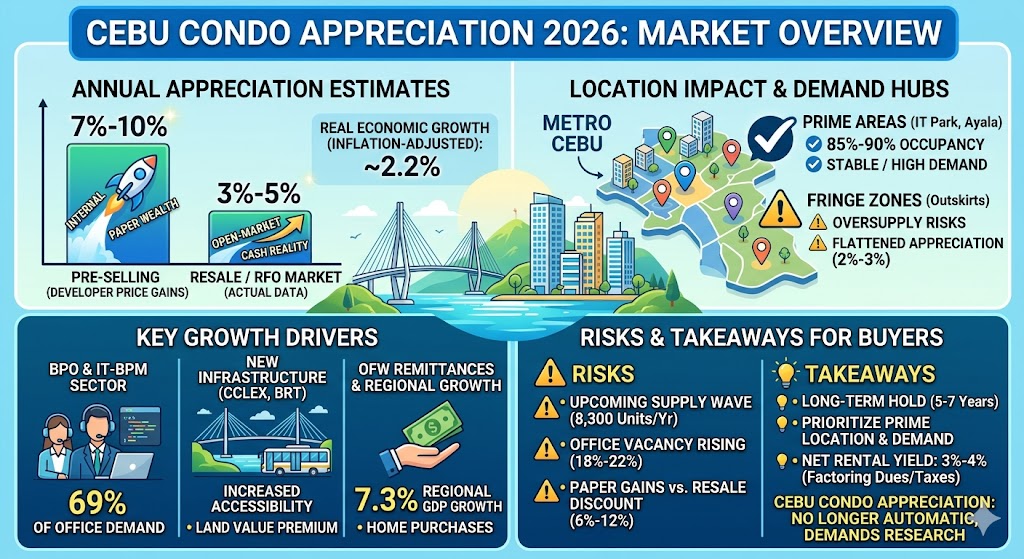
There is no single appreciation rate for Cebu condominiums. Recent market data shows actual annual increases ranging from 3% to 7% for well-located units. However, the rate depends heavily on whether you are looking at developer “paper gains” or real resale value.
Pre-Selling Units
Average Annual Appreciation: 7% to 10% (developer pricing)
Reality Check: This paper growth occurs during construction. It is driven by developers raising prices in tranches, not necessarily open-market demand.
Ready-for-Occupancy (RFO) / Secondary Market
Average Annual Appreciation: 3% to 5% (actual 2025 data)
Reality Check: This is the real market value when you try to sell. In non-prime or oversupplied zones, it can drop to 2–3% .
To put things in perspective: when you account for inflation, the real economic growth of Cebu property prices sat closer to 2.2% over the past year. Over the last decade, nominal housing prices in Cebu have risen an estimated 70% to 90%, driven by BPO job growth and limited prime land.
Those are the historical benchmarks, but as any seasoned investor will tell you: appreciation is not a straight line up.
Recent Performance: What the Data Actually Shows
The most reliable source of property price data in the Philippines is the Bangko Sentral ng Pilipinas (BSP) Residential Property Price Index (RPPI), calculated from actual bank housing loan data. The recent numbers reveal a bumpy ride:
- The Surge (Q2 2025): Metro Cebu posted one of the strongest increases outside the capital, with residential prices rising 11.5% year-on-year and 12.2% from the prior quarter—the strongest quarterly growth since 2019. Houses drove this increase, jumping 13.1%.
- The Correction (Q3 2025): Nationwide growth moderated to a mere 1.9% year-on-year. Condominium unit prices nationally dipped by 0.2%, though Metro Cebu managed to outperform most other regions and held relatively steady.
- Inflation-adjusted reality: That 11.5% surge looked exciting, but after stripping out inflation, real growth for the year was closer to 2.2% . Still positive, but far from the double-digit wealth creation marketing materials suggest.
These quarterly swings reveal an important reality: appreciation is not linear. Some quarters deliver double-digit gains; others produce stagnation or small declines. The trend over multiple years remains upward, but the ride is bumpy.
The “Paper Wealth” Trap (Read This Before Buying Pre-Selling)
This is the single most important section for any buyer.
When a developer tells you, “Your unit has already appreciated by 30% since you started paying the equity,” be very careful. That is internal developer pricing—the price at which they sell new units in later phases. It is not what a real cash buyer will pay you.
If you try to flip your contract or sell the unit immediately upon turnover, you will quickly discover:
- You are competing directly with the developer, who offers flexible, long-term payment terms (often zero interest).
- Real secondary market buyers expect a 6% to 12% discount off the developer’s latest list price, because they are taking on the risk of a used (even if new) unit.
- Many “appreciated” pre-selling units end up selling at or barely above the original purchase price when the owner needs liquidity.
The bottom line: Pre-selling can still work, but treat the developer’s appreciation claims as marketing, not market reality.
Why the Numbers Vary So Much
📍 Location Is Not Just Important—It Is Decisive
The Cebu condominium landscape is now deeply divided into distinct segments.
Condos in and around Cebu IT Park, Cebu Business Park (Ayala), and Lahug remain relatively stable. These areas host a massive chunk of the IT-BPM workforce, creating an ecosystem of thousands of young professionals and expats who need to live close to work. This concentration keeps occupancy rates healthy (roughly 85–90% in central hubs) and sustains secondary market values.
Outside these primary districts—in fringe areas of Mandaue, Talisay, or upper Lahug—the outlook changes. Developers have launched massive, multi-tower projects, leading to localized oversupply. When dozens of identical 22-square-meter studio units fight for the same small pool of renters, both rental yields and appreciation flatten to 2–3% annually, if that.
🏗️ New vs. Existing
New builds in Cebu typically cost 10% to 20% more than comparable existing homes due to modern amenities and marketing premiums. However, that premium does not translate directly to higher appreciation. Existing units in good locations can hold their value just as well—and sometimes better, because you are not paying the “new building premium.”
📊 Price Bracket Matters
Cebu condos average roughly ₱130,000 to ₱230,000 per square meter, depending on location and developer.
- The Sweet Spot (₱2.5M to ₱7M): Affordable to lower mid-income projects account for two-thirds of total units sold. This segment is largely driven by end-users—people who buy a condo to live in—making it a more stable investment.
- The Ultra-Luxury Segment: High-end projects account for a smaller market share but attract overseas investors seeking hedges against inflation. For context, the most expensive project in Cebu to date—Rockwell Land’s The Villas at Aruga—has a per-square-meter rate of ₱589,600.
Cebu vs. Metro Manila: A Tale of Two Markets
Comparing Cebu to Metro Manila highlights Cebu’s unique relative strength:
- Supply Health: Metro Manila’s condominium market is facing a historic oversupply, with an inventory life of approximately eight years. In stark contrast, Cebu’s remaining inventory life is only about 2.1 years, indicating a much healthier balance between supply and demand.
- Price Resilience: While Manila condo prices dipped 2.2% in Q2 2025, Cebu held its ground.
However, economists warn against complacency. As local economist Fernando “Perry” Fajardo notes:
“A lot of people still think condos automatically mean guaranteed appreciation… But today, the story is more nuanced.”
Key Drivers of Appreciation
When a Cebu condo does appreciate rapidly, it is usually riding the wave of specific macroeconomic factors:
- The BPO Engine: Provincial office markets collectively transacted 243,000 square meters of office space in 2025—a 70% year-on-year surge. Cebu alone accounted for 121,000 square meters of that demand. IT-BPM operators now account for 69% of provincial office space.
- Strategic Infrastructure: The Cebu-Cordova Link Expressway (CCLEX) drastically cut travel times between the mainland and Mactan. Land values in Cordova jumped 900% (from ₱500 to ₱5,000 per sqm) after the bridge opened. Meanwhile, the Cebu Bus Rapid Transit (BRT) system has begun driving price premiums for neighborhoods along its route.
- OFW Remittances & Regional Growth: Nearly 13% of OFW households now allocate funds to home purchases. This cash inflow is backed by Central Visayas posting a massive 7.3% GDP growth in 2024, making it the fastest-growing region in the country.
The Risks You Need to Know
An honest article cannot ignore the cracks in the foundation:
- The Upcoming Supply Wave: Colliers forecasts an average of 8,300 units delivered annually from 2025 to 2028, bringing total condo stock past 102,500 units by 2027. More supply inevitably puts downward pressure on resale prices, especially in non-prime locations.
- Office Market Softening: Cebu office demand fell 66% year-on-year in Q1 2026, and overall office vacancy is expected to rise to between 18% and 22% by end-2026. Since office employment directly drives residential rental demand, this is a metric investors must monitor closely.
- The “Shadow Supply” Risk: There is a growing disconnect between artificial “retail asking prices” pushed by developers on paper and the on-the-ground reality of physical occupancy. A building can look “sold out” on a developer’s spreadsheet while sitting half-empty at night.
- No Quick Gains: Investors hoping for rapid capital flipping are likely to be disappointed. Expect a 5- to 7-year holding period for meaningful returns.
Practical Takeaways for Buyers and Investors
Buyer Profile: First-Time End-User
What to Consider: Buy in established business districts (IT Park, Cebu Business Park) where long-term demand is stable. Don’t buy for “investment upside” if you need to live there.
Buyer Profile: Investment-Focused (Pre-selling)
What to Consider: Look at units in areas with confirmed infrastructure projects (e.g., BRT route). Be patient—hold for 5–7 years. Treat developer appreciation claims with skepticism.
Buyer Profile: Rental Income Seeker
What to Consider: Prime locations deliver gross yields of 5–7% annually. But deduct association dues (₱80–120 per sqm monthly), property taxes, and maintenance fees. Net yields often fall to 3–4%.
Buyer Profile: Secondary Market Buyer
What to Consider: This is a buyer’s market. Negotiate 6% to 12% off listing prices when buying directly from individual owners who need liquidity. You can often get a better deal than pre-selling.
The Verdict: Should You Buy?
A condo in Cebu remains a legitimate, wealth-building asset class, but only if you drop the expectation of making a quick, easy buck.
Pure investment hoping for rapid capital flipping is highly uncertain today. The real question you need to ask yourself is no longer “Should I buy a condo in Cebu?” but rather “Can this specific condo still hold tenant demand five or ten years from now?”
If you choose wisely—prioritizing prime locations with permanent, irreplaceable demand drivers (IT Park, Cebu Business Park), checking developer track records, and maintaining a long-term perspective—a Cebu condo can still be a rock-solid cornerstone of your portfolio.
But if you are buying in a fringe area hoping that “Cebu is booming” will lift all boats, you may be waiting a very long time.
Author
John Paul Ybañez Paquibot
Licensed Real Estate Broker | PRC No. 00014132 | DHSUD No. CVRFO-B-03/18-2672
Bachelors Realty and Brokerage, Inc. Cebu
G/F Cap Building, Brgy. Corner, Osmeña Blvd.
Arlington Pond St. Extension, Cebu City, 6000 Cebu
Leave a Reply