Cebu’s property market has entered a mature “recalibration” cycle. With over 93,000 condominium units saturating the vertical market and residential lot prices rising an average of 7 percent annually from 2016 to 2025—with some projects posting compound annual growth rates as high as 27 percent—the era of easy, market-wide gains is over. In 2026, success belongs to precision, not speculation.
The choice between buying a finished House-and-Lot (H&L) and purchasing raw Lot-Only land is not about which asset is objectively superior. It is a deliberate strategic decision that hinges entirely on your financial timeline, your need for liquidity, and your tolerance for risk.
This definitive guide merges hard data with battle-tested investor heuristics to give you the clearest path forward.
The 2026 Market Reality: Where Cebu Actually Stands
Before diving into asset classes, you must understand the ground beneath your feet. Central Visayas posted 7.3 percent GDP growth in 2024, the fastest of all 18 Philippine regions, which directly underpins housing demand. However, the price signals are mixed and require careful reading.
The median housing price in Cebu in 2026 sits at approximately ₱14.8 million. However, this figure is heavily skewed by luxury listings; the average price jumps to ₱25.5 million, while a typical family home in a middle-income subdivision is much closer to ₱7.8 million. This gap is your first warning: do not rely on averages. Know exactly which segment you are targeting.
Critically, the supply pipeline is constrained. More than 10,000 housing units in Cebu are currently awaiting License to Sell (LTS) approval from the HLURB. This backlog prevents developers from launching new pre-selling projects, tightening supply in the ₱3 million to ₱6 million segment—the very sweet spot where overseas Filipino workers and young families are most active. This supply crunch is putting upward pressure on prices for available properties, making 2026 a unique window for buyers who are ready to act.
The Strategic Case for House-and-Lot: The “Immediate Utility” Path
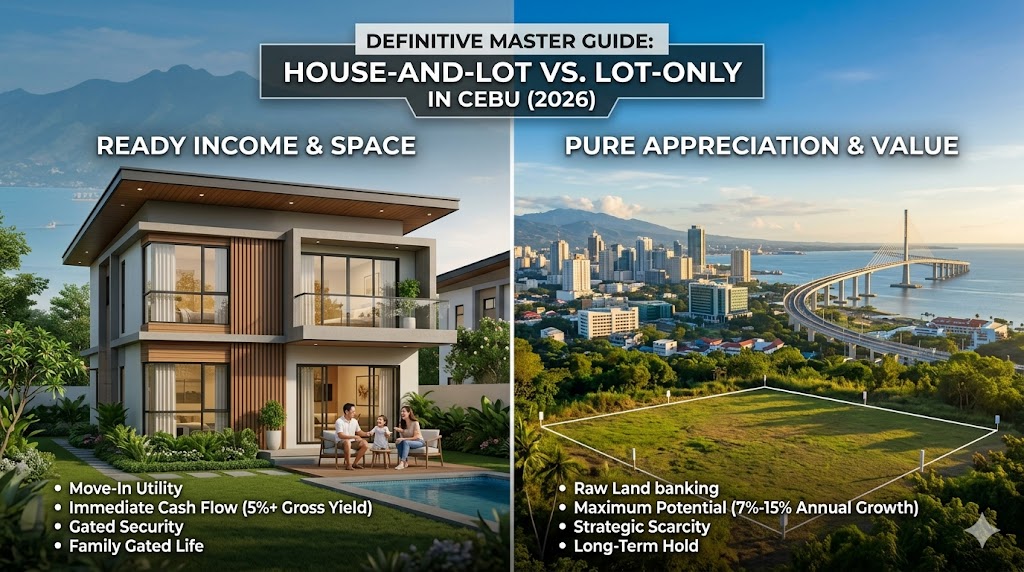
Choosing a House-and-Lot is a decision to acquire a functioning, productive asset from day one. You are buying a combination of appreciating land and a depreciating structure, but you are paying for the convenience of immediate utility.
The Appreciation Profile: House-and-lot products in Cebu are currently seeing robust 7 to 10 percent annual gains. In 2025, the Visayas and Mindanao region posted a 92 percent take-up rate for house-and-lot developments, indicating sustained, healthy demand from end-users. The top-selling segment was the middle-income range, accounting for 42 percent of total sales.
The Cash Flow Reality: You gain immediate rental income. Across Cebu, average gross rental yields for residential properties hover around 5.2 percent. In prime areas like IT Park and Cebu Business Park, gross yields sit near 4.9 to 5 percent. However, you must be brutally honest with your net yield—property taxes, insurance, and regular maintenance will shave off roughly 1.5 to 2 percentage points. The structure ages; roofs leak, paint fades, and plumbing requires attention. This is not passive income; it is active business management.
The Smart Heuristic for H&L Buyers: Pay close attention to the quality of the Homeowners Association (HOA). In Cebu’s gated subdivisions, the HOA is the leading indicator of your property’s future resale value. A well-managed community with enforced rules, proper security, and well-maintained common areas will always command a premium when it is time to exit. A dysfunctional HOA can sink your investment faster than a market downturn.
The Strategic Case for Lot-Only: The “Long-Term Appreciation” Path
Choosing Lot-Only—often called land banking—is a decision to capture the maximum potential of the land itself. It is an investment in pure flexibility and future value, unencumbered by a decaying structure.
The Appreciation Profile: This is where the numbers get compelling. From 2016 to 2023, lot-only developments saw annual price increases ranging from 7 to 15 percent. In 2025, Colliers data showed that average take-up for lot-only units in Cebu, priced at an average of ₱21,000 per square meter, was an astonishing 94 percent. Investors are actively voting with their wallets for land.
Consider the historical precedent: Cordova land values jumped a staggering 900 percent—from around ₱500 per square meter to ₱5,000 per square meter—after the Cebu-Cordova Link Expressway (CCLEX) opened. This is the upside of infrastructure-driven speculation. However, it also highlights the speculative nature of this play; you are betting on future development, not current utility.
The Brutal Drawbacks: You face zero monthly cash flow. While you wait for appreciation, you are paying property taxes, subdivision association dues, and incurring the opportunity cost of your frozen capital. Furthermore, vacant land is vulnerable to squatting, encroachment, and neglect. If you are not visiting the property regularly or paying a trusted caretaker, your asset can become a liability.
The Two Golden Rules for Lot-Only Buyers (Non-Negotiable):
First, strictly enforce the 5-Year Rule. Only enter a lot-only investment if you have the capital to hold the asset for a minimum of five years. This is the absolute minimum window required to weather market cycles and allow infrastructure projects to materialize. If you need liquidity within three years, do not buy raw land.
Second, rigorously verify “Build-Readiness.” Do not buy raw land without confirming access to a stable water supply, grid electricity, and legally titled subdivision roads. In Cebu’s competitive market, a “cheap” lot is almost always cheap for a reason—it lacks the utility connections required to legally build a home. Digging a deep well or pulling power lines from a kilometer away can cost millions, instantly wiping out your paper gains.
The Brutal Truth: Risks You Cannot Ignore in 2026
Both asset classes carry specific traps that inexperienced investors fall into.
For House-and-Lot, the greatest hidden risk is structural depreciation. While the land under your house appreciates at 7 to 10 percent, the building itself is losing value every year. After 15 to 20 years, a significant portion of your property’s value is tied to a structure that may require a full tear-down and rebuild. When calculating your total return on investment, you must amortize the cost of major capital expenditures—roof replacement, plumbing overhauls, electrical rewiring—across your holding period.
For Lot-Only, the risk is development stagnation. Not every growth corridor actually grows on schedule. Infrastructure projects face delays, commercial zones shift, and what looks like a prime location today could remain farmland for another decade. This is why the 5-Year Rule exists—it gives you a buffer against bureaucratic inertia. Additionally, raw land is highly sensitive to interest rate hikes; when borrowing costs rise, speculative land prices are the first to correct.
The Definitive Decision Matrix: Which Path Fits You?
There is no single right answer, but there is a right answer for you.
Choose House-and-Lot if: You are a first-time investor, an OFW seeking predictable monthly income to service a mortgage, or a family who needs a move-in-ready property without the complexities of construction management. You need your investment to generate cash flow today to offset your holding costs. You are willing to trade some long-term appreciation for the security of immediate utility and a deep tenant pool of BPO workers and young professionals.
Choose Lot-Only if: You are a patient, long-term investor with a five-to-ten-year horizon. You have significant capital to park and do not require monthly income from this asset. You are willing to bet on specific infrastructure corridors—such as areas along the Cebu Bus Rapid Transit (BRT) route, the southern expansion zones in Talisay, or northern corridors like Consolacion and Minglanilla. You understand that you are building wealth for the next decade, not paying for this month’s bills.
The Smart Money Playbook for 2026
Regardless of which path you choose, the 2026 market rewards tactical execution over blind faith.
For House-and-Lot Investors: Focus your search on the ₱3 million to ₱6 million middle-income segment. This is where demand is most robust and the housing backlog is most acute. In a buyer-leaning market, you should expect to negotiate 6 to 12 percent off listing prices. Developers are frequently offering incentives, better payment terms, and price discounts to move inventory. Never pay list price.
For Lot-Only Investors: Do not chase the already-saturated city center. Look for emerging growth nodes along the BRT route and areas directly benefiting from the CCLEX expansion. Secure larger parcels where possible, as the per-square-meter cost drops significantly with size. However, before signing any contract, demand to see the approved subdivision plan and verify the utility connection agreements. If the developer cannot produce a clear title and a water concessionaire’s commitment letter, walk away.
For Everyone: Verify the developer’s License to Sell with the HLURB before handing over a single peso. With over 10,000 units awaiting approval, the risk of buying into an unlicensed or delayed project is real. Work exclusively with a licensed PRC-accredited real estate broker who has a track record of closing deals in your target barangay.
Final Verdict
In 2026, the equation is clear: House-and-Lot for immediate income and utility; Lot-Only for long-term capital growth.
House-and-Lot offers the safety of cash flow, structural financing, and a known commodity, making it the superior choice for those who need their asset to work for them today. Lot-Only offers the superior appreciation ceiling, driven by the finite scarcity of land and the enduring “space shift” in Filipino housing preferences, but it demands patience, capital reserves, and the rigorous discipline of the 5-Year Rule and utility verification.
The era of easy money in Cebu real estate is definitively over. But for the discerning investor who aligns their asset choice with their personal financial timeline and conducts rigorous due diligence, Cebu’s land—whether with a house on it or waiting for one—remains one of the most powerful wealth-building tools in the Philippine archipelago.
Check our article for townhouse vs condo investment.
Disclaimer: This guide is for informational purposes only and does not constitute financial or legal advice. Real estate investments involve risk, including the potential loss of principal. Always verify developer License to Sell (LTS) documents, consult with a licensed PRC broker, perform thorough title verification, and conduct your own due diligence before committing your capital.
Author
John Paul Ybañez Paquibot
Licensed Real Estate Broker | PRC No. 00014132 | DHSUD No. CVRFO-B-03/18-2672
Bachelors Realty and Brokerage, Inc. Cebu
G/F Cap Building, Brgy. Corner, Osmeña Blvd.
Arlington Pond St. Extension, Cebu City, 6000 Cebu
Leave a Reply