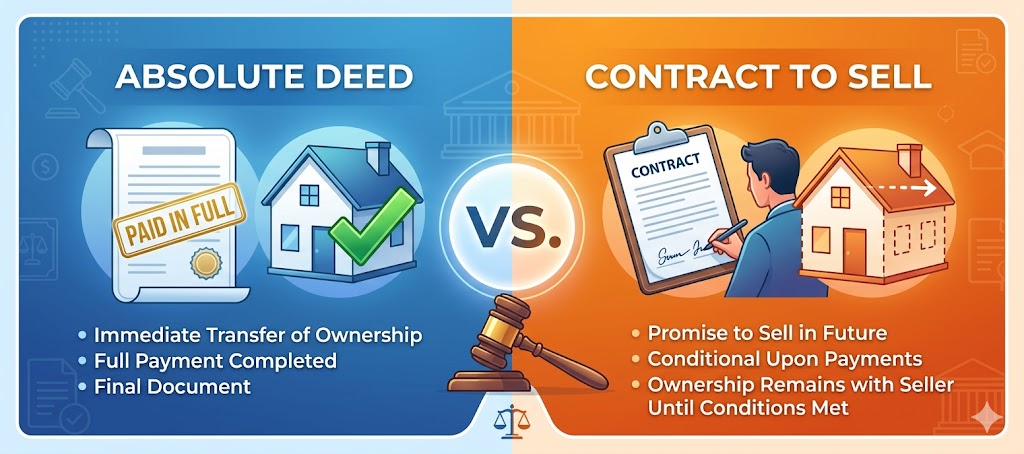
When purchasing real estate in Cebu—whether it is a condo unit, house and lot, or vacant land—you will encounter two key legal documents: the Contract to Sell and the Deed of Absolute Sale (DOAS) . While they may seem similar, they have very different legal effects. Understanding the difference is crucial for protecting your rights as a buyer.
What is a Contract to Sell?
A Contract to Sell is a conditional agreement between a buyer and seller. In this arrangement, the seller agrees to transfer ownership only after the buyer has fulfilled certain obligations—usually full payment of the purchase price. This document is commonly used in installment sales, such as in subdivisions, condominiums, or housing projects.
Key Characteristics of a Contract to Sell:
- The seller retains ownership until the condition (e.g., full payment) is met.
- The buyer does not acquire ownership immediately.
- If the buyer fails to pay in full, the seller may cancel the contract, and no title is transferred.
- This is not yet a sale in the strict legal sense—it is a promise to sell, subject to a condition precedent.
Legal Basis: Under Article 1475 of the Civil Code, a contract of sale is perfected by agreement on the object and price. A Contract to Sell, however, defers the actual sale until the agreed condition is met. In a Contract to Sell, the title to the property does not pass to the buyer until full payment of the purchase price.
What is a Deed of Absolute Sale (DOAS)?
A Deed of Absolute Sale (DOAS) is a final and binding contract that transfers ownership of the property from seller to buyer. This document is the definitive proof of the transfer of ownership.
Key Characteristics of a Deed of Absolute Sale:
- Ownership is transferred immediately upon signing and notarization.
- The buyer has paid the full purchase price, or the contract explicitly waives any remaining condition.
- The document is notarized and submitted to the Registry of Deeds to effect the title transfer.
- Both the BIR and the local Treasurer’s Office will require the notarized DOAS for tax clearance and computation.
Legal Basis: Governed by the Civil Code and the Property Registration Decree (PD 1529), the Deed of Sale is required for property registration with the Registry of Deeds.
Comparison of the Two Documents
Legal Effect:
A Contract to Sell is a conditional promise to sell, while a Deed of Absolute Sale is an outright transfer of ownership. The legal effect of the two documents is fundamentally different.
Ownership Transfer:
In a Contract to Sell, ownership is transferred only after full payment or the fulfillment of other conditions. In a Deed of Absolute Sale, ownership is transferred immediately upon signing and notarization.
Installment Terms:
A Contract to Sell is commonly used for installment purchases, and ownership is deferred until full payment. A Deed of Absolute Sale is generally used for lump sum payments or after full payment has been made.
Buyer’s Obligation:
Under a Contract to Sell, the buyer must pay in full to trigger title transfer. Under a Deed of Absolute Sale, the payment has already been completed, and the buyer has no further payment obligations.
Seller’s Obligation:
In a Contract to Sell, the seller must deliver the title only after the buyer complies with the conditions. In a Deed of Absolute Sale, the seller must deliver the title immediately.
Risk of Cancellation:
A Contract to Sell carries a risk of cancellation if the buyer fails to comply with the terms. A Deed of Absolute Sale is a completed contract and cannot be cancelled unless challenged in court.
Document Type:
A Contract to Sell is a private contract that can be notarized but is not registrable on its own. A Deed of Absolute Sale is a public document that is registrable with the BIR and the Registry of Deeds.
Notarization:
Notarization is optional but recommended for a Contract to Sell. For a Deed of Absolute Sale, notarization is mandatory for registration.
When Should You Use a Contract to Sell?
A Contract to Sell is appropriate in cases such as Pag-IBIG or bank-financed purchases, installment-based sales for subdivisions or condos, transactions where the buyer needs time to complete payments, and when the seller wants to retain legal control of the title until full payment.
When Should You Use a Deed of Absolute Sale?
A Deed of Absolute Sale is used when the buyer has paid the full purchase price, when there are no remaining conditions to be fulfilled, and when the parties are ready to transfer ownership immediately.
Author
John Paul Ybañez Paquibot
Licensed Real Estate Broker | PRC No. 00014132 | DHSUD No. CVRFO-B-03/18-2672
Bachelors Realty and Brokerage, Inc. Cebu
G/F Cap Building, Brgy. Corner, Osmeña Blvd.
Arlington Pond St. Extension, Cebu City, 6000 Cebu
Leave a Reply