Category: Articles

  • Airbnb vs. Long-Term Rental in Cebu: The Brutal ROI Reality Check (2026) – SeekCebu

    Airbnb vs. Long-Term Rental in Cebu

    Cebu’s real estate market is facing a fascinating paradox. On one side, property values are under steady upward pressure due to a growing IT-BPM sector, booming tourism, and a strict geographical constraint—only 7% of Cebu’s land is considered flat.

    On the other side, a massive wave of condominium developments has flooded the market with a sea of identical units. Cebu City added 982 new Airbnb listings in 2025 alone, a 27.7% year-over-year spike.

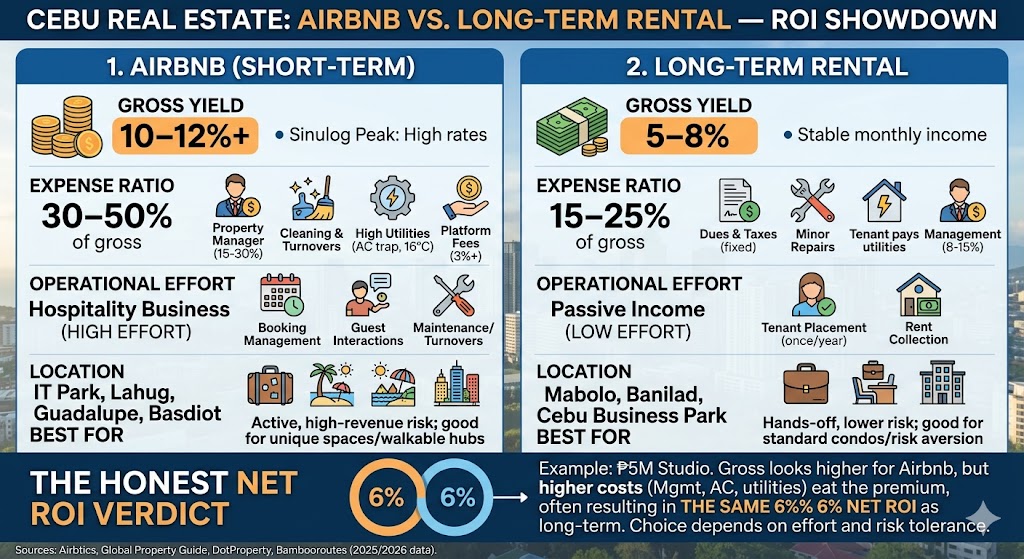
    If you own a property here—or are looking to buy—you’ve likely seen the headline numbers: short-term rentals boast an alluring 12.3% gross annual yield, while traditional long-term leases sit at a more modest 5–8%.

    But gross yield is a dangerous vanity metric. Let’s cut through the developer hype and calculate exactly what you keep after expenses.


    🏠 The ROI Showdown: Gross vs. Net

    Gross Rental Yield
    Airbnb (Short-Term): 10–12% (can exceed 12% in prime spots)
    Long-Term Rental: 5–8%

    Occupancy Rate
    Airbnb (Short-Term): 45–57% average
    Long-Term Rental: 80–90% (plus long-term security)

    Revenue Potential
    Airbnb (Short-Term): Higher ceiling, lower floor
    Long-Term Rental: Stable, predictable

    Management Effort
    Airbnb (Short-Term): High (guest turnover, cleaning, marketing)
    Long-Term Rental: Low (once tenant is placed)

    Expense Ratio
    Airbnb (Short-Term): 30–50% of gross income
    Long-Term Rental: 15–25% of gross income

    A ₱5M studio pulling ₱30k/month long-term generates ₱360k annual gross (7.2% gross). After dues, taxes, maintenance → net ~6%.
    The same unit on Airbnb at ₱387k annual gross (12% gross) incurs management fees, cleaning, utilities, platform fees, and higher wear-and-tear → often nets the same 6% – but you’re working full-time as a hotel operator.


    📍 Location & Strategy: Neighborhood Breakdown

    Your returns vary drastically by location. The market has segregated into highly specific sub-neighborhoods:

    IT Park (Lahug/Apas)

    • Optimal Strategy: Hybrid / Both
    • Expected Gross Yield: 5.5–8% (long-term) / 10–12% (short-term)
    • Market Dynamics: The most balanced hub. Strong BPO demand weekdays, tourists/digital nomads weekends. Over 1,200 active Airbnb listings.

    Mabolo

    • Optimal Strategy: Long-Term
    • Expected Gross Yield: 7.7–8.7%
    • Market Dynamics: Excellent local professional demand. Lower entry prices than IT Park mean superior long-term yields.

    Cebu Business Park

    • Optimal Strategy: Long-Term
    • Expected Gross Yield: 3.6–4.2%
    • Market Dynamics: Lower rental yields due to premium purchase prices. This is a play for capital appreciation, not monthly cash flow.

    Guadalupe

    • Optimal Strategy: Airbnb
    • Expected Gross Yield: 5–7%
    • Market Dynamics: 334 listings; lower nightly rates (₱1,616) but affordable entry prices.

    Mactan / Lapu-Lapu

    • Optimal Strategy: Long-Term (Premium)
    • Expected Gross Yield: 5.8%+ (net)
    • Market Dynamics: High expat premium. Crucial caveat: Many resort-condos here explicitly ban daily Airbnb rentals.

    Basdiot (South Cebu)

    • Optimal Strategy: Airbnb
    • Expected Gross Yield: 36.3% occupancy, $618/month
    • Market Dynamics: Higher revenue potential but less stable, seasonal.

    💸 The Hidden Expenses That Kill Airbnb Net Yields

    Airbnb can generate higher top-line revenue, but its operating costs generally eat 30–50% of gross income, compared to just 15–25% for a long-term lease. In Cebu, three specific drains catch investors off guard:

    1. The Aircon Trap 🥶

    Short-term guests pay a flat nightly fee – they have no incentive to conserve energy. It’s incredibly common for guests to leave the split-type AC running at 16°C while they head out on a 12-hour day trip to Oslob or Moalboal. With Cebu’s high electricity rates, this alone can drive a studio’s utility bill to ₱5,000–₱7,000 per month.

    2. The Hands-Off Management Tax

    Running an Airbnb is a hospitality business, not passive investing. If you’re an OFW or busy professional, you’ll need a property manager. In Cebu, full-service short-term management charges 15–30% of gross booking revenue. Long-term managers charge just 8–15%.

    3. The Rapid Wear-and-Tear Cycle

    To maintain the high ratings needed to survive among Cebu’s 4,000+ active listings, your unit must look flawless. Luggage scraping walls, heavy appliance use, constant linen laundering – budget roughly 10% of revenue for continuous maintenance and premium furnishing replacements.

    Other Costs (Don’t Ignore These)

    • Airbnb service fees: ~3% of booking subtotal + VAT
    • Condo association dues: ₱50–150 per sqm monthly (e.g., ₱1,500–₱4,500 for a 30 sqm unit)
    • Business permit & BIR registration – required by Cebu City LGU
    • Property insurance – often higher for short-term rentals

    📜 Regulations & Tax: The Gray Area You Can’t Ignore

    Cebu City’s rules are surprisingly lenient – but that doesn’t mean you can ignore them.

    Current requirements:

    • Business permit (Mayor’s Permit + Barangay Clearance)
    • BIR tax registration for all rental income
    • DOT accreditation – the Department of Tourism is actively pushing Airbnb operators to comply; even micro-accommodations can qualify
    • Condominium corporation approval – many buildings have bylaws explicitly banning short-term rentals or Airbnb. Check this before buying.

    The big hidden issue: Traditional hotels are lobbying for stricter regulation, citing unfair competition from unlicensed Airbnbs that sidestep taxes. That pressure could tighten at any time.

    For long-term rentals, the path is simpler: a standard lease agreement, security deposit handling, and registration with local authorities if required. Rent control only applies to units at ₱10,000/month or below – most investment condos are exempt.


    ⚠️ The Honest Risks: What Nobody Tells You

    Airbnb Risks

    • Oversupply is real. Revenue per listing declined 8.9% over three years while inventory surged.
    • Occupancy is lower than you think – 45–57% average means your property sits empty nearly half the year.
    • Foreigner ownership restrictions – you can own a condo as a foreigner, but land is off-limits.
    • Condo rules can ban Airbnb overnight – if your building changes bylaws, your strategy dies.
    • You’re competing with 4,000+ other listings. Standing out requires exceptional service and aggressive pricing.

    Long-Term Rental Risks

    • Eviction is slow and expensive – removing a non-paying tenant can take months and legal fees.
    • Corporate tenants may withhold tax directly from rent payments.
    • Rent control exists at lower price points (units under ₱10k/month).
    • Capital appreciation is steady not explosive – 5–7% annually, not 20%+.
    • Limited exit liquidity – selling a condo takes time.

    🎯 Practical Decision Matrix: Which Is Better for You?


    If you want… Higher potential gross income (and can handle the risk)
    Choose… Airbnb

    If you want… Passive, hands-off income with predictable cash flow
    Choose… Long-term rental

    If you want… To be close to tourist attractions or nightlife
    Choose… Airbnb (IT Park, Lahug, Basdiot)

    If you want… To be near BPO offices or business districts
    Choose… Long-term rental (IT Park, Mabolo, Banilad)

    If you want… To maximize net yield with minimal effort
    Choose… Long-term rental

    If you want… To actively manage your property as a business
    Choose… Airbnb

    If you want… To own in a building with restrictive condo rules
    Choose… Long-term rental (your only option)

    If you want… To avoid regulatory uncertainty
    Choose… Long-term rental

    Choose Airbnb IF:

    • Your unit is a highly styled, uniquely designed studio or 1-bedroom in a hyper-walkable location (IT Park or near Ayala Center Cebu)
    • You have local, low-cost trusted help to manage turnovers (not paying 25–30% to a manager)
    • You want the flexibility to stay in the unit yourself when visiting Cebu
    • Your building explicitly allows short-term rentals (get it in writing)

    Choose Long-Term Rental IF:

    • You want a completely passive investment
    • You prefer a 12-month contract where the tenant pays utilities and covers day-to-day care
    • Your vacancy risk drops close to zero
    • You value sleep and sanity over the slim chance of 2–3% extra net yield

    🔑 Best Strategy by Property Type

    • Studio condos (25–35 sqm): Sweet spot for both. In IT Park or Mabolo, try Airbnb first for a year – you can always convert to long-term.
    • 1-bedroom condos (35–50 sqm): Long-term tends to perform better. The higher monthly rent (₱20k–35k) from professionals offers better risk-adjusted returns.
    • 2-bedroom condos (50–70 sqm): Long-term wins. Less competition, attracts families or senior professionals who stay for years.
    • Houses/lots: Long-term only. Most residential houses restrict short-term rentals.

    📝 The Honest Verdict

    A ₱5 million studio condo renting long-term for ₱30,000 a month generates a net yield settling around 6% with almost zero monthly effort.
    The exact same unit optimized for Airbnb might bring in more gross cash, but after stripping out platform fees, high utilities, a 25% management cut, and seasonal vacancies, it will likely net out to the exact same 6% return – except you’re working full-time as a hotel operator.

    For most investors in Cebu City right now, long-term rental in a prime location (IT Park, Mabolo) is the safer, saner, more reliable wealth-building vehicle.

    That said, Airbnb can work for the right investor in the right location. If you own in IT Park or Lahug, can self-manage or have cheap help, are prepared for seasonal swings, and have building approval upfront – you might beat long-term by 2–3 percentage points in net yield. But you’ll earn every extra peso with your time and stress.

    Unless you enjoy running a hospitality business or have a deeply unfair advantage in low-cost property management, stick with long-term rental. You’ll sleep better. And your ROI will thank you.


    Sources: Airbtics 2026 Market Data, Bambooroutes Cebu Property Reports 2026, RichestPH Cebu Rental Yield Analysis 2025, Global Property Guide Q1 2026, DotProperty Cebu Listings 2025, Cebu Grand Realty 2025, Philippine Star 2025, SunStar Cebu 2025

    Contact Us

      Author
      John Paul Ybañez Paquibot
      Licensed Real Estate Broker | PRC No. 00014132 | DHSUD No. CVRFO-B-03/18-2672
      Bachelors Realty and Brokerage, Inc. Cebu
      G/F Cap Building, Brgy. Corner, Osmeña Blvd.
      Arlington Pond St. Extension, Cebu City, 6000 Cebu
    • Hidden Costs of Owning a Condo in the Philippines: Beyond the Brochure – SeekCebu

      Hidden Costs of Owning a Condo in the Philippines

      The brochures for high-rise developments in Metro Manila, Cebu, and Davao all promise the same enticing dream: resort-style amenities, prime locations, and a completely hassle-free lifestyle. They prominently highlight a neat monthly bank amortization figure, making property ownership feel easily attainable.

      What those glossy pamphlets rarely emphasize is that the purchase price is only the beginning. Owning a condominium in the Philippines comes with a recurring and occasional tail of expenses that can quietly fracture a household budget if you are caught off guard.

      This guide pulls back the curtain on the most significant hidden costs of condo ownership, providing you with real-world figures and practical, actionable strategies to help you budget like a professional.

      1. Upfront Closing Costs & Transaction Fees

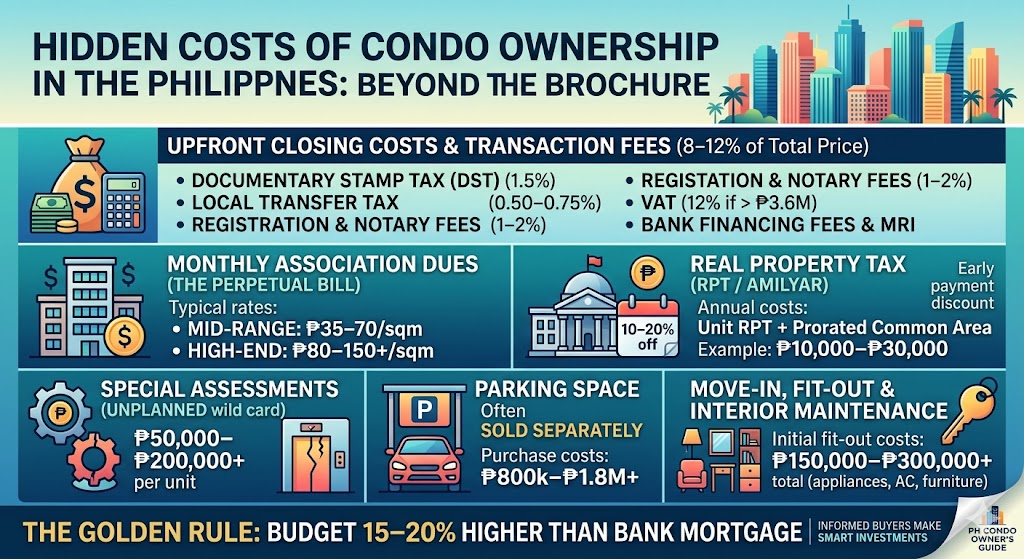
      When a developer says a unit is ₱5,000,000, your actual out-of-pocket cost to legally own it will be significantly higher. Closing fees are a massive, one-time surprise that typically add an extra 8% to 12% to the Total Contract Price (TCP).

      • Documentary Stamp Tax (DST): Charged by the Bureau of Internal Revenue (BIR) at 1.5% of the selling price or zonal value, whichever is higher.
      • Local Transfer Tax: Paid to the local government unit (LGU) to transfer ownership. It ranges from 0.50% in the provinces to 0.75% within Metro Manila cities.
      • Registration & Notary Fees: Expect to spend around 1% to 2% to have the Deed of Absolute Sale legally stamped, notarized, and processed by the Registry of Deeds.
      • Value-Added Tax (VAT): If you are buying a residential unit priced above the legal tax threshold (₱3,600,000), a heavy 12% VAT applies. Most developers quote new units as VAT-inclusive, but you must always confirm this in writing.
      • Bank Financing Fees: If you are financing through a bank, you will pay a one-time Appraisal Fee (₱3,000 to ₱5,000) and processing fees, alongside mandatory bank-required insurances like Fire Insurance and Mortgage Redemption Insurance (MRI)—which protects the loan balance if something happens to you.

      ⚠️ The Capital Gains Tax (CGT) Trap: By law, the 6% CGT on a property sale is strictly the seller’s financial responsibility. However, in private resale transactions, sneaky sellers often try to insert hidden clauses into the contract forcing the buyer to cover it. Always review your contract terms line-by-line before signing, or you could face an unexpected bill of hundreds of thousands of pesos.

      How to Prepare:

      Demand a full, written breakdown of the “Other Charges” or closing costs from the developer or broker before paying any reservation fee. Do not assume these fees are automatically bundled into your equity or down payment schedule.

      2. Monthly Association Dues (The Perpetual Bill)

      You never truly finish paying for a condo. Even after your 20-year mortgage drops to absolute zero, you will owe monthly association dues for as long as you own the unit. These dues fund the building’s operations, covering security guards, pool chemicals, gym maintenance, elevator repairs, and common area electricity.

      • Mid-range developments: ₱35 to ₱70 per square meter
      • High-end / Prime locations (BGC, Makati, Rockwell): ₱80 to ₱150+ per square meter

      The Math: If you own a modest 40-square-meter one-bedroom unit in a mid-tier building, you are looking at roughly ₱2,000 to ₱4,000+ per month. In luxury structures or prime business spots, annual dues can easily breach ₱80,000 to ₱120,000+ for larger spaces.

      How to Prepare:

      Before buying, request a look at the condo corporation’s latest financial statements and the size of its reserve fund (the emergency savings account for the building). A healthy reserve fund lowers the risk of sudden dues increases. Remember that if you fail to pay, the condo corp can legally strip your access to amenities, slap you with heavy interest penalties, and eventually declare your unit delinquent.

      3. Real Property Tax (RPT / Amilyar)

      In the Philippines, property owners must pay an annual Real Property Tax to the LGU. The rate is based on the property’s assessed value (which is determined by the local assessor’s office and is usually lower than the market value).

      • The Rates: Up to 2% of the assessed value in Metro Manila cities, and 1% in most provinces.
      • The Double Catch: You don’t just pay tax on your individual unit; you also pay a prorated share of the tax on the building’s common areas and the land it sits on. This common area tax is sometimes partially bundled into your monthly dues or billed as a separate, once-a-year invoice.

      Realistic Example: For a standard condo unit with a market value around ₱3 Million to ₱5 Million, your annual RPT will often fall in the ₱10,000 to ₱30,000 range depending entirely on the city and its specific assessment level.

      How to Prepare:

      Check the exact tax rates with the local assessor’s office. Most LGUs offer generous early bird discounts (10% to 20% off) if you pay the full year’s amilyar in advance, usually before December 31st or January 31st. Always pay on time; late payments accrue a punishing penalty of 2% interest per month (capping at 72%).

      4. Special Assessments (The True Wildcard)

      Regular monthly dues are meant for daily operational costs, not structural emergencies. If a building’s roof leaks, the elevators break down completely, or the exterior facade needs a massive structural upgrade, the condo corporation levies a Special Assessment.

      This is a mandatory, one-time bill distributed among all unit owners to cover major, unplanned capital improvements that the regular budget cannot absorb. These assessments can randomly demand anywhere from ₱50,000 to over ₱200,000 per unit, depending on the project’s scale. Older buildings or developments with poorly managed reserve funds carry the highest risk.

      How to Prepare:

      When buying a resale unit, request the last 2 to 3 years of Homeowners’ Association (HOA) meeting minutes. Current residents will actively voice concerns about upcoming repairs or structural defects in these meetings, giving you an insider look at potential looming assessments before you inherit them.

      5. Parking (A Premium for Convenience)

      A massive mistake first-time buyers make is assuming their condo automatically comes with a parking slot. It doesn’t.

      Parking slots in the Philippines are sold under a completely separate property title and are rarely included in the unit’s base price.

      • Separate Purchase: ₱800,000 to ₱1.8 Million+ per slot in highly urbanized business hubs.
      • Monthly Rental: ₱3,000 to ₱7,000 per month if you lease from another owner.

      How to Prepare:

      Clarify the parking situation early in the process. If you do not drive but plan to lease the property out as an investment, research the local area carefully—condo units in heavy business districts without parking slots can suffer from significantly reduced rental appeal to premium tenants.

      6. Move-In, Fit-Out & Ongoing Maintenance

      Condo homeownership completely shifts the burden of interior upkeep onto your shoulders. The financial pressure doesn’t stop once the keys are turned over to you.

      • Move-In / Turnover Fees: Developers frequently charge a one-time fee (ranging from ₱5,000 to ₱20,000+) to cover initial administrative setup, temporary elevator padding, and gate passes.
      • Utility Deposits: You must settle connection deposits to your local electric provider (like Meralco), the water district, and internet service providers to get your meters activated.
      • Initial Fit-Out Cost: Most units are delivered “bare” or “semi-furnished.” To make a studio or one-bedroom unit livable with basic appliances, an air conditioner, furniture, and closets, you need a liquid cash buffer of ₱150,000 to ₱300,000+ right at the start.
      • Ongoing Maintenance: Unlike renting, if an air conditioner breaks down, a pipe leaks behind your kitchen drywall, or pest control is needed, you have to pay for the professional labor and materials out of your own pocket.

      🧾 At-A-Glance Cost Summary

      Closing Costs / Taxes
      Frequency: One-Time (Upfront)
      Typical Cost Range: 8% to 12% of property price
      Key Buyer Advice: Get a written breakdown before paying a reservation; verify who pays the 6% CGT.

      Association Dues
      Frequency: Monthly (Recurring)
      Typical Cost Range: ₱35 to ₱150+ per sqm
      Key Buyer Advice: Review the building’s financial health report and the exact size of the reserve fund.

      Real Property Tax (RPT)
      Frequency: Annual (Recurring)
      Typical Cost Range: 1% to 2% of assessed value
      Key Buyer Advice: Pay early (usually by January) to claim local government discounts of up to 20%.

      Special Assessments
      Frequency: Unplanned (Occasional)
      Typical Cost Range: ₱50,000 to ₱200,000+ per unit
      Key Buyer Advice: Read historical HOA meeting minutes to check for upcoming structural repairs.

      Parking Slot
      Frequency: Upfront Buy / Monthly
      Typical Cost Range: ₱800k–₱1.8M buy / ₱3k–₱7k rent
      Key Buyer Advice: Clarify parking inclusion early; lack of parking can hurt future resale/rental appeal.

      Move-In & Fit-Out
      Frequency: Initial (One-Time)
      Typical Cost Range: ₱150,000 to ₱320,000+ total
      Key Buyer Advice: Budget conservatively for move-in fees, utility meter deposits, and basic furniture.

      The Golden Rule for Condo Buyers

      Condo living offers unparalleled benefits in terms of security, lifestyle, and proximity to major business districts. However, the shared nature of a high-rise building means you have less control over communal decisions and rising operational costs. To ensure your investment remains a financial sanctuary rather than a stressful trap, apply a rigid safety buffer to your math:

      The 15–20% Buffer Rule: When budgeting for a condominium purchase in the Philippines, assume your actual monthly cost of living will be 15% to 20% higher than your projected bank mortgage payment alone.

      If your monthly bank amortization is ₱25,000, your actual baseline cost to keep that lifestyle running smoothly—factoring in dues, taxes, and maintenance reserves—is closer to ₱29,000 to ₱30,000+.

      Establish a dedicated home emergency fund from day one, do your thorough due diligence on the Master Deed, and run your numbers with cold transparency. By budgeting with your eyes wide open, you can fully protect your hard-earned capital and truly enjoy your new modern home without any financial surprises.

      Contact Us

        Author
        John Paul Ybañez Paquibot
        Licensed Real Estate Broker | PRC No. 00014132 | DHSUD No. CVRFO-B-03/18-2672
        Bachelors Realty and Brokerage, Inc. Cebu
        G/F Cap Building, Brgy. Corner, Osmeña Blvd.
        Arlington Pond St. Extension, Cebu City, 6000 Cebu
      • How Fast Do Condos Appreciate in Cebu? (2026 Edition) – SeekCebu

        Ask five different people how fast a Cebu condo appreciates, and you will likely get five different answers. Some will tell you they doubled their money in five years; others will warn you that they are struggling just to break even.

        The truth lies somewhere in between—and depends entirely on where and when you buy.

        For years, the narrative surrounding real estate in the Queen City of the South has been overwhelmingly rosy: “Buy a condo, sit back, and watch your wealth double.” Marketing brochures consistently highlight booming IT parks, upcoming infrastructure, and skyrocketing values.

        But if you are putting down your hard-earned money in 2026, you deserve the unvarnished truth. While Cebu’s market remains robust, the era of automatic, effortless wins is over. This is a realistic, data-backed look at how fast condos actually appreciate in Cebu, what recent trends mean for investors, and the hidden traps developers rarely mention.


        The Hard Numbers: Average Growth Rates

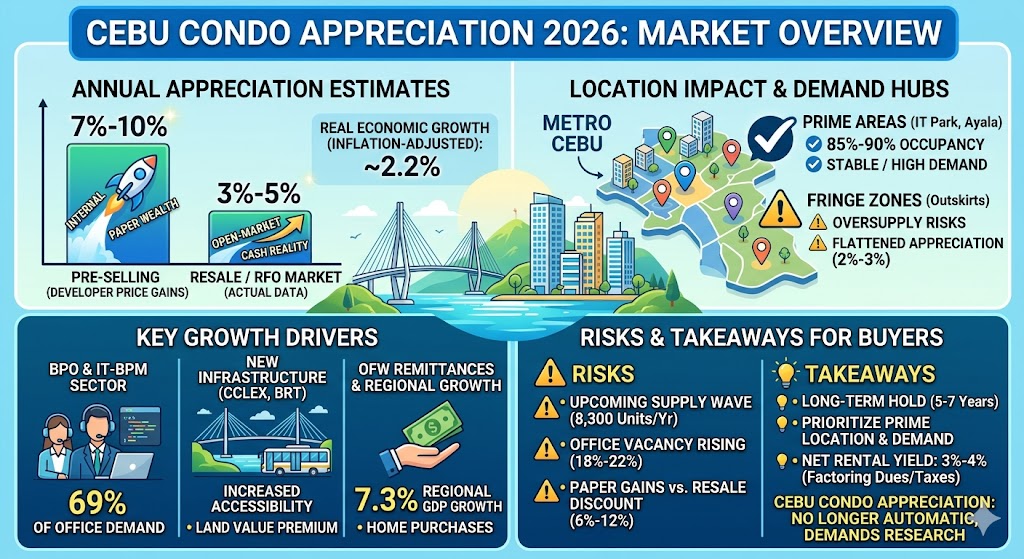
        There is no single appreciation rate for Cebu condominiums. Recent market data shows actual annual increases ranging from 3% to 7% for well-located units. However, the rate depends heavily on whether you are looking at developer “paper gains” or real resale value.

        Pre-Selling Units
        Average Annual Appreciation: 7% to 10% (developer pricing)
        Reality Check: This paper growth occurs during construction. It is driven by developers raising prices in tranches, not necessarily open-market demand.

        Ready-for-Occupancy (RFO) / Secondary Market
        Average Annual Appreciation: 3% to 5% (actual 2025 data)
        Reality Check: This is the real market value when you try to sell. In non-prime or oversupplied zones, it can drop to 2–3% .

        To put things in perspective: when you account for inflation, the real economic growth of Cebu property prices sat closer to 2.2% over the past year. Over the last decade, nominal housing prices in Cebu have risen an estimated 70% to 90%, driven by BPO job growth and limited prime land.

        Those are the historical benchmarks, but as any seasoned investor will tell you: appreciation is not a straight line up.


        Recent Performance: What the Data Actually Shows

        The most reliable source of property price data in the Philippines is the Bangko Sentral ng Pilipinas (BSP) Residential Property Price Index (RPPI), calculated from actual bank housing loan data. The recent numbers reveal a bumpy ride:

        • The Surge (Q2 2025): Metro Cebu posted one of the strongest increases outside the capital, with residential prices rising 11.5% year-on-year and 12.2% from the prior quarter—the strongest quarterly growth since 2019. Houses drove this increase, jumping 13.1%.
        • The Correction (Q3 2025): Nationwide growth moderated to a mere 1.9% year-on-year. Condominium unit prices nationally dipped by 0.2%, though Metro Cebu managed to outperform most other regions and held relatively steady.
        • Inflation-adjusted reality: That 11.5% surge looked exciting, but after stripping out inflation, real growth for the year was closer to 2.2% . Still positive, but far from the double-digit wealth creation marketing materials suggest.

        These quarterly swings reveal an important reality: appreciation is not linear. Some quarters deliver double-digit gains; others produce stagnation or small declines. The trend over multiple years remains upward, but the ride is bumpy.


        The “Paper Wealth” Trap (Read This Before Buying Pre-Selling)

        This is the single most important section for any buyer.

        When a developer tells you, “Your unit has already appreciated by 30% since you started paying the equity,” be very careful. That is internal developer pricing—the price at which they sell new units in later phases. It is not what a real cash buyer will pay you.

        If you try to flip your contract or sell the unit immediately upon turnover, you will quickly discover:

        • You are competing directly with the developer, who offers flexible, long-term payment terms (often zero interest).
        • Real secondary market buyers expect a 6% to 12% discount off the developer’s latest list price, because they are taking on the risk of a used (even if new) unit.
        • Many “appreciated” pre-selling units end up selling at or barely above the original purchase price when the owner needs liquidity.

        The bottom line: Pre-selling can still work, but treat the developer’s appreciation claims as marketing, not market reality.


        Why the Numbers Vary So Much

        📍 Location Is Not Just Important—It Is Decisive

        The Cebu condominium landscape is now deeply divided into distinct segments.

        Condos in and around Cebu IT Park, Cebu Business Park (Ayala), and Lahug remain relatively stable. These areas host a massive chunk of the IT-BPM workforce, creating an ecosystem of thousands of young professionals and expats who need to live close to work. This concentration keeps occupancy rates healthy (roughly 85–90% in central hubs) and sustains secondary market values.

        Outside these primary districts—in fringe areas of Mandaue, Talisay, or upper Lahug—the outlook changes. Developers have launched massive, multi-tower projects, leading to localized oversupply. When dozens of identical 22-square-meter studio units fight for the same small pool of renters, both rental yields and appreciation flatten to 2–3% annually, if that.

        🏗️ New vs. Existing

        New builds in Cebu typically cost 10% to 20% more than comparable existing homes due to modern amenities and marketing premiums. However, that premium does not translate directly to higher appreciation. Existing units in good locations can hold their value just as well—and sometimes better, because you are not paying the “new building premium.”

        📊 Price Bracket Matters

        Cebu condos average roughly ₱130,000 to ₱230,000 per square meter, depending on location and developer.

        • The Sweet Spot (₱2.5M to ₱7M): Affordable to lower mid-income projects account for two-thirds of total units sold. This segment is largely driven by end-users—people who buy a condo to live in—making it a more stable investment.
        • The Ultra-Luxury Segment: High-end projects account for a smaller market share but attract overseas investors seeking hedges against inflation. For context, the most expensive project in Cebu to date—Rockwell Land’s The Villas at Aruga—has a per-square-meter rate of ₱589,600.

        Cebu vs. Metro Manila: A Tale of Two Markets

        Comparing Cebu to Metro Manila highlights Cebu’s unique relative strength:

        • Supply Health: Metro Manila’s condominium market is facing a historic oversupply, with an inventory life of approximately eight years. In stark contrast, Cebu’s remaining inventory life is only about 2.1 years, indicating a much healthier balance between supply and demand.
        • Price Resilience: While Manila condo prices dipped 2.2% in Q2 2025, Cebu held its ground.

        However, economists warn against complacency. As local economist Fernando “Perry” Fajardo notes:

        “A lot of people still think condos automatically mean guaranteed appreciation… But today, the story is more nuanced.”


        Key Drivers of Appreciation

        When a Cebu condo does appreciate rapidly, it is usually riding the wave of specific macroeconomic factors:

        • The BPO Engine: Provincial office markets collectively transacted 243,000 square meters of office space in 2025—a 70% year-on-year surge. Cebu alone accounted for 121,000 square meters of that demand. IT-BPM operators now account for 69% of provincial office space.
        • Strategic Infrastructure: The Cebu-Cordova Link Expressway (CCLEX) drastically cut travel times between the mainland and Mactan. Land values in Cordova jumped 900% (from ₱500 to ₱5,000 per sqm) after the bridge opened. Meanwhile, the Cebu Bus Rapid Transit (BRT) system has begun driving price premiums for neighborhoods along its route.
        • OFW Remittances & Regional Growth: Nearly 13% of OFW households now allocate funds to home purchases. This cash inflow is backed by Central Visayas posting a massive 7.3% GDP growth in 2024, making it the fastest-growing region in the country.

        The Risks You Need to Know

        An honest article cannot ignore the cracks in the foundation:

        • The Upcoming Supply Wave: Colliers forecasts an average of 8,300 units delivered annually from 2025 to 2028, bringing total condo stock past 102,500 units by 2027. More supply inevitably puts downward pressure on resale prices, especially in non-prime locations.
        • Office Market Softening: Cebu office demand fell 66% year-on-year in Q1 2026, and overall office vacancy is expected to rise to between 18% and 22% by end-2026. Since office employment directly drives residential rental demand, this is a metric investors must monitor closely.
        • The “Shadow Supply” Risk: There is a growing disconnect between artificial “retail asking prices” pushed by developers on paper and the on-the-ground reality of physical occupancy. A building can look “sold out” on a developer’s spreadsheet while sitting half-empty at night.
        • No Quick Gains: Investors hoping for rapid capital flipping are likely to be disappointed. Expect a 5- to 7-year holding period for meaningful returns.

        Practical Takeaways for Buyers and Investors


        Buyer Profile: First-Time End-User
        What to Consider: Buy in established business districts (IT Park, Cebu Business Park) where long-term demand is stable. Don’t buy for “investment upside” if you need to live there.

        Buyer Profile: Investment-Focused (Pre-selling)
        What to Consider: Look at units in areas with confirmed infrastructure projects (e.g., BRT route). Be patient—hold for 5–7 years. Treat developer appreciation claims with skepticism.

        Buyer Profile: Rental Income Seeker
        What to Consider: Prime locations deliver gross yields of 5–7% annually. But deduct association dues (₱80–120 per sqm monthly), property taxes, and maintenance fees. Net yields often fall to 3–4%.

        Buyer Profile: Secondary Market Buyer
        What to Consider: This is a buyer’s market. Negotiate 6% to 12% off listing prices when buying directly from individual owners who need liquidity. You can often get a better deal than pre-selling.


        The Verdict: Should You Buy?

        A condo in Cebu remains a legitimate, wealth-building asset class, but only if you drop the expectation of making a quick, easy buck.

        Pure investment hoping for rapid capital flipping is highly uncertain today. The real question you need to ask yourself is no longer “Should I buy a condo in Cebu?” but rather “Can this specific condo still hold tenant demand five or ten years from now?”

        If you choose wisely—prioritizing prime locations with permanent, irreplaceable demand drivers (IT Park, Cebu Business Park), checking developer track records, and maintaining a long-term perspective—a Cebu condo can still be a rock-solid cornerstone of your portfolio.

        But if you are buying in a fringe area hoping that “Cebu is booming” will lift all boats, you may be waiting a very long time.

          Author
          John Paul Ybañez Paquibot
          Licensed Real Estate Broker | PRC No. 00014132 | DHSUD No. CVRFO-B-03/18-2672
          Bachelors Realty and Brokerage, Inc. Cebu
          G/F Cap Building, Brgy. Corner, Osmeña Blvd.
          Arlington Pond St. Extension, Cebu City, 6000 Cebu

        • Is Plumera Residences a Good Investment in 2026? An Honest, Data-Driven Review – SeekCebu

          If you are looking at the Cebu real estate market, Plumera Mactan by Johndorf Ventures Corporation (JVC) has likely popped up on your radar. Spanning 5 hectares in Barangay Basak, Lapu-Lapu City, it is heavily marketed as an affordable goldmine for Overseas Filipino Workers (OFWs), BPO employees, and young professionals.

          The project is highly decorated, having won Best Affordable Condo Development in Metro Cebu at the PropertyGuru Philippines Property Awards. But buying a condo isn’t just about celebrating developer trophies. To know if it’s a smart place to put your hard-earned money in 2026, we need to balance the marketing hype with raw market data and physical realities.

          The Core Numbers & Layout

          Plumera is a massive multi-building community featuring a mix of original 4-story walk-ups and newer, taller mid-rise structures (up to 10 storeys) that include elevators.


          Studio Unit (24 sqm)
          2026 Market Reality: Approx. ₱3.13 Million

          1-Bedroom Unit (36 sqm)
          2026 Market Reality: Approx. ₱5.10 Million

          Estimated Pag-IBIG Amortization
          2026 Market Reality: ~₱13,938/month (30 years) to ₱20,172/month (15 years)

          Target Tenants
          2026 Market Reality: MEPZ workers, aviation students, airport staff, BPO professionals

          The Green Lights: Why the Investment Holds Up

          1. The “Sweet Spot” Location & Infrastructure

          Plumera sits right next to Indiana Aerospace University and is minutes from Mactan Doctors’ Hospital and the Mactan Export Processing Zone (MEPZ). Furthermore, long-term capital appreciation is backed by major infrastructure: the CCLEX expressway is fully operational, and construction on the Fourth Cebu-Mactan Bridge is slated to begin in Q3 2026.

          2. High Financing Accessibility

          With standard studios sitting around ₱3.1M, Plumera remains highly accessible compared to Cebu IT Park, where studios regularly cross the ₱5M mark. Because Johndorf designs these units to fit Pag-IBIG housing loan brackets, the low barrier to entry makes it an attractive defensive asset class for first-time buyers.

          The Caution Flags: Honest Risks to Consider

          While the strengths are notable, an honest investment review requires looking at the structural, environmental, and market bottlenecks threatening 2026 investors.

          1. The “No Elevator” vs. Taller Tower Divide

          Plumera features a mix of buildings. The older, original buildings are 4-story walk-ups with no elevators.

          The Real Estate Reality: Fourth-floor walk-up units are notoriously difficult to flip on the resale market or rent out to families with toddlers or elderly relatives. If you are buying a resale or an older inventory unit, ensure you aren’t stuck on the top floor of a walk-up unless you got it at a massive discount.

          2. A Massive Supply Avalanche & Office Vacancies

          This is the biggest red flag for rental investors in 2026. Colliers expects Metro Cebu’s total condo supply to reach 109,000 units by 2029, adding roughly 4,000 new units every year. Worse, Mactan’s office vacancy rate sat at a staggering 30.4% in early 2026.

          With thousands of highly uniform studio configurations in Plumera alone, you will be competing directly with your next-door neighbors for a narrower pool of commercial tenants. To survive, you cannot rely on a bare unit; you will have to spend extra capital on high-quality interior fit-outs (furnishing, smart appliances) to stand out.

          3. Tourism Headwinds & Realistic Yields

          While the newly opened Mactan Expo convention facility boosts local events, airport officials have warned that rising global jet fuel costs could dampen volatile tourism travel. Do not buy into Plumera expecting high-paying Airbnb tourists. It is a residential-focused community in Basak, not a luxury beachfront property in Punta Engaño. Your strategy must rely on steady, long-term local rentals yielding a realistic 5% to 7% gross annual return.

          4. Moderate Flood Risk

          Because the property sits in a lower-lying area relatively close to coastal zones, it carries a moderate flood risk. While Johndorf has engineered drainage systems into the 5-hectare village, this is a critical factor you or your representative must verify personally during heavy typhoon seasons.

          The 2026 Verdict: Who is Plumera For?

          Plumera Residences Mactan is a legitimate, award-winning project from an established developer, but it is not a get-rich-quick vehicle.

          • Skip it if: You are a short-term speculator (1–3 years) looking to flip the property quickly or expecting massive, immediate rental yields. The current Mactan supply glut and office vacancy rates will work against you.
          • Buy it if: You are a long-term investor (5+ years) or an end-user. The 5-to-10-year horizon allows time for the upcoming Fourth Bridge to finish, local supply to be absorbed, and the airport economy to mature.

          If you can secure a lower-floor unit (or one with elevator access), maximize Pag-IBIG financing, and format your budget around practical local rent prices (₱12,000 to ₱16,000/month) rather than speculative tourist rates, Plumera is a highly dependable, defensive asset to add to your portfolio.

          Which angle matters most to you?

          Are you looking at Plumera primarily to earn monthly rental income, or are you hoping to sell it for a profit down the road? Knowing your main goal can help narrow down which of these market risks deserves your closest attention.

          Contact Us

            Author
            John Paul Ybañez Paquibot
            Licensed Real Estate Broker | PRC No. 00014132 | DHSUD No. CVRFO-B-03/18-2672
            Bachelors Realty and Brokerage, Inc. Cebu
            G/F Cap Building, Brgy. Corner, Osmeña Blvd.
            Arlington Pond St. Extension, Cebu City, 6000 Cebu
          • Pag-IBIG Fund vs Bank Loan for Condo Buying in 2026: Which is Better for Plumera Residences in Mactan, Cebu?

            bank loan or pag-ibig loan

            Buying a condo remains a major milestone for many Filipinos. For those eyeing units at Plumera Residences in Mactan, Cebu (developed by Johndorf Ventures), choosing the right home financing option directly impacts your monthly budget and long-term financial health.

            plumera residences mactan

            In 2026, the two main choices are the Pag-IBIG Fund (government-backed) and traditional bank loans. They differ in interest rates, terms, down payment requirements, approval speed, and eligibility. This updated guide breaks down both options to help you decide what works best—whether you’re an OFW, first-time buyer, or young professional.

            Option 1: Pag-IBIG Fund (Government-Backed Housing Loan)
            Overview
            Pag-IBIG Fund continues to be the most affordable and accessible option for many middle-income earners and first-time homebuyers. In 2025, it released a record ₱140.54 billion in housing loans to nearly 91,000 borrowers, demonstrating strong support for Filipino homeownership.

            Key Interest Rates in 2026

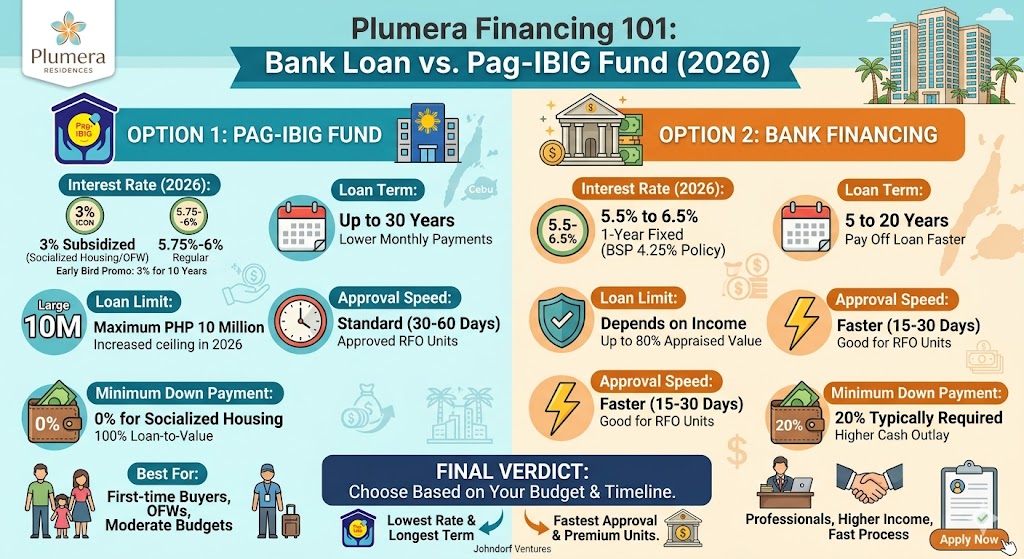
            • Subsidized 3% rate under the Expanded 4PH Program for qualified first-time homebuyers (gross monthly income below ₱34,686 outside NCR; ₱47,856 in NCR). All OFWs qualify regardless of income.
            • Early Bird Promo: The first 30,000 qualified borrowers can enjoy the 3% rate for the first 10 years (standard is 5 years).
            • Regular Pag-IBIG loans start at around 5.75% depending on the fixing period.
            • Additional perks: Up to ₱100,000 for home improvements and 100% loan-to-value (no down payment) for qualifying socialized housing units.

            Loan Terms and Limits

            • Maximum term: Up to 30 years (keeps amortizations low).
            • Maximum loan amount: Recently increased to ₱10 million (from ₱6 million) as of May 2026.

            Eligibility

            • At least 24 monthly contributions (lump sum allowed to catch up).
            • Age: Not more than 65 at application and 70 at loan maturity.
            • No existing unpaid Pag-IBIG housing loan.
            • Income threshold for 3% rate as noted above.

            Application Steps

            1. Verify membership and contributions via Virtual Pag-IBIG or a branch.
            2. Prepare documents and secure a Certificate of Eligibility.
            3. Submit the Housing Loan Application (HLA) form online or in-person with property and developer documents (e.g., License to Sell).

            Required Documents (summary)

            • Employed: Payslip, Certificate of Employment & Compensation, latest ITR.
            • Self-employed: Financial statements, DTI/SEC docs, bank statements.
            • OFW: POEA-certified contract, proof of remittances.

            Option 2: Bank Financing (Private Home Loans)
            Overview
            Private bank loans suit buyers needing faster processing, higher loan amounts, or more flexibility. Major banks (BDO, BPI, Metrobank, etc.) typically finance up to 80% of the appraised value.

            Interest Rates in 2026
            With BSP policy rates around 4.5%, bank home loan rates are competitive: 1-year fixed rates generally range from 5.5% to 6.5%+, depending on credit score, income, and bank promos. Rates can be higher for longer fixed periods.

            Loan Terms and Limits

            • Typical term: 5–20 years (some banks offer up to 30).
            • Loan amount: Based on income and property appraisal (no strict ₱10M cap like Pag-IBIG).

            Eligibility

            • Filipino citizen (or dual), 21–70 years old at maturity.
            • Stable income (often ₱40,000–50,000+ monthly gross).
            • Good credit history and at least 2 years continuous employment.

            Application Steps

            1. Check pre-approval to know your borrowing capacity.
            2. Compare bank offers.
            3. Submit full application with property documents once you choose a unit.

            Required Documents (summary)
            Application form, proof of income, IDs, employment certificate, and Contract to Sell.

            Head-to-Head Comparison: Pag-IBIG vs Bank Loan (2026)

            Feature
            Pag-IBIG Fund 3% subsidized (qualified), ~5.75% regular
            Bank Financing 5.5%–6.5%+ (1-year fixed)

            Max Loan Term
            Pag-IBIG Fund Up to 30 years
            Bank Financing 5–20 years (some up to 30)

            Approval Speed
            Pag-IBIG Fund 30–60 days
            Bank Financing Faster (15–30 days)

            Down Payment
            Pag-IBIG Fund 0% for qualifying socialized units
            Bank Financing Typically 20%

            Max Loan
            Pag-IBIG Fund ₱10 million
            Bank Financing Higher potential based on income

            Best For
            Pag-IBIG Fund First-time buyers, OFWs, lower budgets
            Bank Financing Strong credit, higher-value units, speed

            Paperwork
            Pag-IBIG Fund Moderate
            Bank Financing Stricter credit & income checks

            Sample Monthly Amortization Examples (Approximate, for ₱4M loan)

            • Pag-IBIG at 3% for 30 years: ~₱16,800–17,500/month.
            • Bank at 6% for 20 years: ~₱28,600/month.

            (Use official Pag-IBIG calculator or bank tools for precise quotes based on your profile.)

            Final Verdict: Which One Should You Choose?
            Choose Pag-IBIG if you:

            • Want the lowest possible rate and longest term for affordable payments.
            • Are a first-time buyer, OFW, or have moderate income.
            • Prefer zero or low down payment.

            Choose a Bank Loan if you:

            • Need faster approval (especially for Ready-for-Occupancy units).
            • Have strong income/credit and want to buy a higher-priced unit.
            • Prefer shorter terms to pay off the loan faster.

            Many buyers combine both (e.g., Pag-IBIG for part of the amount) or use bank bridging if needed.

            Conclusion
            Start by checking your Pag-IBIG eligibility online or visiting a branch. For banks, get pre-approvals from 2–3 institutions. Contact the Johndorf Ventures sales team for current Plumera unit pricing, availability, and any developer financing promos that can complement these loans.

            Secure your financing early to lock in rates and move forward with your Contract to Sell.


            Disclaimer: This article is for general information only and not financial advice. Rates and programs change—consult Pag-IBIG, a bank loan officer, or licensed advisor for personalized guidance based on your situation.

            Contact Us

              Author
              John Paul Ybañez Paquibot
              Licensed Real Estate Broker | PRC No. 00014132 | DHSUD No. CVRFO-B-03/18-2672
              Bachelors Realty and Brokerage, Inc. Cebu
              G/F Cap Building, Brgy. Corner, Osmeña Blvd.
              Arlington Pond St. Extension, Cebu City, 6000 Cebu
            • The 5 Documents You Must Check Before Paying a Reservation Fee

              (Because a Non-Refundable Fee Is No Joke)

              5 documents to check before reservation

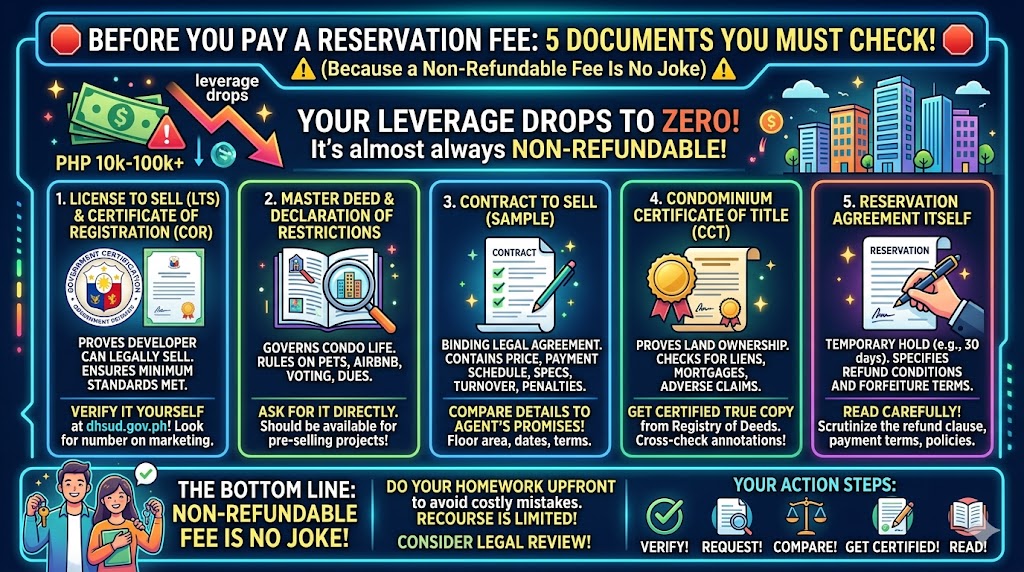
              A reservation fee locks in your chosen unit, typically costs PHP 10,000 to PHP 100,000, and is almost always non-refundable. Before you part with that money, you need to see and scrutinize these five documents.

              1. The Certificate of Registration and License to Sell

              No valid License to Sell (LTS) means the developer has no legal right to sell you anything. Without it, you have very little legal protection if the project collapses or is never completed.

              The LTS proves that the developer’s plan for the project has passed the government’s minimum standards on everything from lot sizes to drainage. And the Certificate of Registration (COR) confirms that the developer is a legitimate business entity. Both are issued by the Department of Human Settlements and Urban Development (DHSUD).

              Verify it yourself. Never just accept a photocopy from the agent. Look for the LTS number on all marketing materials—legitimate projects are required to display it. Then cross-check it on the official DHSUD list at dhsud.gov.ph/services/list-of-license-to-sell/. If the LTS isn’t found or doesn’t match the developer’s name, consider it a serious red flag. Any hesitation or delay from the developer in showing you these documents is a major warning sign.

              2. The Master Deed and Declaration of Restrictions

              The Master Deed with Declaration of Restrictions is the foundational document that establishes a condominium project and governs everything about living there. It’s registered with the Registry of Deeds and is part of the public record. Yet many buyers never read it.

              This document outlines what you can and cannot do with your unit. It will tell you if pets are allowed, if short-term rentals (like Airbnb) are prohibited, what percentage of the building you own for voting and dues purposes, and who pays for what when repairs are needed. It also creates the condominium corporation that manages the building. If you plan to rent out your unit, look closely for any clause that restricts leasing.

              Ask for it directly. Request a copy of the Master Deed from the developer before paying the reservation fee. If you’re told it’s “not available yet” for a pre-selling project, that’s a red flag—developers are required to secure an approved Master Deed as part of the registration process with DHSUD.

              3. The Contract to Sell

              The reservation agreement is temporary. The Contract to Sell is the real deal—the binding legal agreement that governs the entire transaction. The reservation agreement typically holds the unit for you for about 30 days, and you’ll need to sign the Contract to Sell within that period.

              Before paying the reservation fee, you should have seen a draft or sample of the Contract to Sell. This document contains the total contract price, the exact payment schedule, the unit specifications (floor area, unit number, parking slot if applicable), the target turnover date, the penalties for late payments, and the developer’s cancellation policies.

              Verify every detail. Compare the contract to what the agent promised. If the floor area is smaller, the payment schedule is tighter, or the turnover date is later than advertised, those differences become legally binding once you sign.

              4. The Condominium Certificate of Title

              You’re not buying just a unit; you’re buying a share of the land the building stands on. The Condominium Certificate of Title (CCT) proves that the developer actually owns the land and has the legal right to sell units in that project.

              For a pre-selling project, the developer holds the master title. Before you pay anything, you need to see that the land is free from any liens, mortgages, or adverse claims that could get in the way of your ownership. These encumbrances are annotated on the back of the title.

              Get a certified true copy. Request a certified true copy of the title from the Registry of Deeds yourself—don’t rely on the seller’s copy. Then check the annotation section for any claims, mortgages, or notices of pending litigation. Then hire a geodetic engineer to verify the property boundaries, and have an independent lawyer review the title. If you’re buying a ready-for-occupancy (RFO) unit, make sure your individual CCT has already been issued.

              5. The Reservation Agreement Itself

              This is the document you’ll be asked to sign right before paying the fee. Read it carefully. Pay special attention to the refund clause: does it explicitly state that the fee is non-refundable? Under what circumstances, if any, can you get it back? If the developer fails to obtain the necessary permits or misrepresents the property, you may have grounds for a refund regardless of the clause, but having it in writing is better.

              Also check the reservation period (typically 30 days), the exact payment terms, what happens if you fail to complete the purchase within that period, and whether the developer has the right to cancel the reservation and keep your fee if certain conditions aren’t met.

              Don’t sign without a review. If the reservation agreement says the fee is non-refundable “absolutely” or “under any circumstances,” know exactly what you’re getting into before you sign. A quick review by a lawyer at this stage can save you from a costly mistake later.

              The Bottom Line

              Reservation fees range from PHP 10,000 to over PHP 100,000. That’s a lot of money to lose if something goes wrong. The developer has no legal obligation to refund you if you change your mind or your financing falls through. Once you pay, your recourse is limited.

              Your action steps:

              • Verify the LTS and COR on the DHSUD website before paying anything.
              • Request and review the Master Deed. Ask for a copy.
              • Get a draft of the Contract to Sell and compare it to what was promised.
              • Pull a certified true copy of the title from the Registry of Deeds.
              • Read the reservation agreement carefully—don’t just skim it.
              • Consider having a lawyer review all documents before you sign anything.
              • Check the developer’s track record on past projects, including delivery timelines and build quality.

              These steps take time. But the cost of skipping them is much higher than the cost of doing the work upfront.

              Contact Us

              • Is Mactan Still a Good Investment? An Honest Look at Lapu-Lapu City Real Estate in 2026

                mactan investment

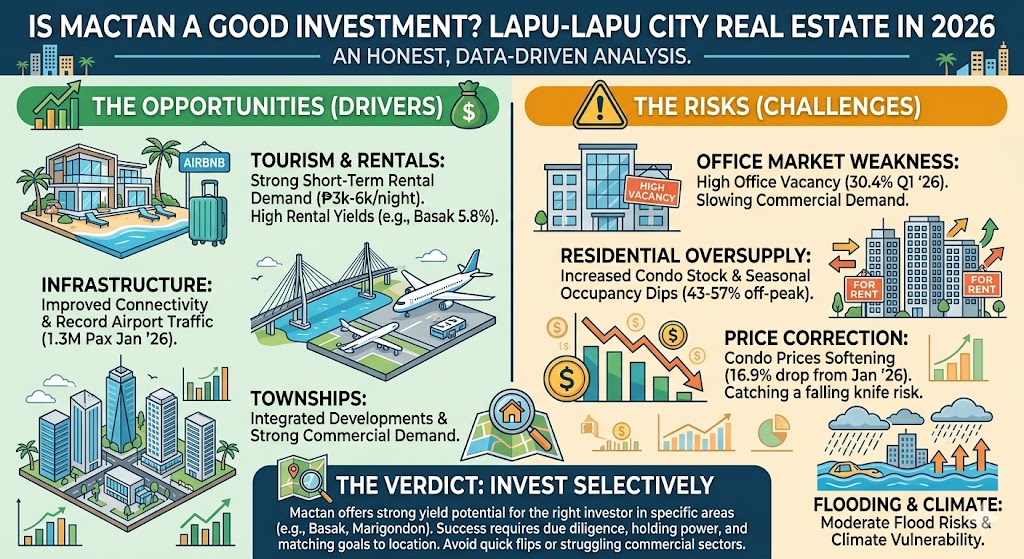
                Mactan has long been one of the Philippines’ most hyped real estate markets. And to be fair, the numbers in 2026 are genuinely impressive. Lapu-Lapu City on Mactan Island has all the elements of a growth story—rising tourist arrivals, major infrastructure projects, and clear signs of economic demand

                But hype isn’t a strategy. The question you need to answer is: is Mactan a good investment for you right now? The honest answer depends on exactly where you buy, what you buy, and what you’re trying to achieve.

                Here’s the data-driven reality of investing in Mactan real estate in 2026.

                The Good: What’s Driving Mactan Real Estate
                Strong demand for short-term rentals and vacation properties

                Mactan’s beachfront scarcity and resort proximity attract strong demand from expats and vacation buyers, with Punta Engaño being the most sought-after area for short-term rentals. Beachfront condos now range between ₱84,000 to ₱250,000 per square meter, while median land prices on Mactan Island sit at around ₱19,812 per sqm.

                Short-term rentals in Mactan typically earn ₱3,000 to ₱6,000 per night, ranking among the best in Cebu. Investors targeting tourists can achieve strong nightly rates, particularly during peak months.

                Record airport traffic driving connectivity

                Mactan-Cebu International Airport (MCIA) continues to shatter records. In January 2026 alone, MCIA handled 1.3 million passengers—a 15% increase year-on-year and its highest monthly record ever. The second runway is now operational, expanding annual capacity to 12.5 million passengers, and new direct international routes have launched to Kuala Lumpur, Brisbane, and Macau.

                This level of connectivity directly fuels the hospitality sector and short-term rental demand. More tourists and business travelers arriving means more people needing a place to stay, and Mactan is the most directly exposed area to this growth.

                Infrastructure projects improving accessibility

                The Cebu-Cordova Link Expressway (CCLEX) continues to improve access between Mactan and Cebu City. The Guadalupe ramp is expected to be completed in 2026, which will further reduce travel times and raise land values along those routes. The CCLEX has already lifted land and condo values in Cordova and parts of Mactan by improving connectivity to the mainland.

                New supply is coming online with strong features

                Several major residential projects have recently completed or are currently leasing in 2026. Aruga Resort and Residences Mactan, a beachfront resort development by Cebu Landmasters, is now built and offering units for sale. Saekyung Ocean Residences has opened Towers 3 and 4 for reservation. Meanwhile, Megaworld posted full occupancy across 24 office towers in Q1 2026, including those at The Mactan Newtown, signaling sustained demand for commercial and mixed-use spaces within integrated developments.

                Improving rental yields in specific neighborhoods

                In 2026, Lapu-Lapu’s Basak and Marigondon areas offer some of the strongest rental yields in all of Cebu, with studios achieving an estimated net yield of 5.8% and 1-bedroom units at 5.7% . To put that in perspective, premium districts like Cebu Business Park yield only around 3.7% for 2-bedroom units despite much higher absolute rents.

                The Not-So-Good: Risks and Challenges
                Office market weakness and high vacancy

                The office market in Mactan is currently struggling. Vacancy rates in Mactan reached 30.4% in the first quarter of 2026, far above the 9.3% vacancy in Cebu Business Park and 11.1% in Cebu IT Park. CBRE expects overall Cebu office vacancy to rise to between 18% and 22% by end-2026.

                While this primarily affects commercial real estate investors, it also signals that certain submarkets are oversupplied. Demand for office space fell 66% year-on-year in Q1 2026, and “shadow supply” (leased but unused spaces) is starting to weigh on rental rates.

                Mactan Newtown carries specific rental risks

                For investors considering units at The Mactan Newtown specifically, the rental market is highly seasonal. Occupancy can drop to as low as 43–57% during off-peak months. Additionally, the township already has over 2,540 units across 10+ towers, creating genuine competition for tenants.

                Oversupply concerns in residential condos

                Across Metro Cebu, condominium stock is expected to reach 93,100 units by 2026, with new completions averaging 5,000 units annually from 2024 to 2026. Lapu-Lapu City, Cebu City, and Mandaue will account for 97% of new supply from 2024 to 2028.

                POGO-related oversupply has also left its mark. While NEDA claims the ban’s impact is minimal, some economists note reduced demand for real estate rentals, office space, and residential condominium purchases following the POGO exit.

                Flooding and climate risks

                Lapu-Lapu City has a moderate flood risk index, but the climate is becoming more volatile. Some areas, like Sitio Suba-Masulog, experience flooding even with light rain, and no permanent solution is yet in place. As an island, Mactan is also vulnerable to sea level rise and storm surges—an important but often overlooked factor for coastal property investments.

                Pricing may have further to fall

                Condominium prices in Lapu-Lapu City dropped 5.7% from March to April 2026 and are down 16.9% from January 2026. While falling prices can present buying opportunities, they can also signal a market still searching for a bottom. The median list price for condos is now around ₱6.1 million, with a median price per square meter of ₱146,130 per sqm.

                Foreign ownership restrictions remain strict

                Foreigners cannot own land in the Philippines—only condominium units, and even then, capped at 40% per building. Land ownership requires a Filipino citizen or a corporation at least 60% Filipino-owned. However, foreigners can lease land for up to 50 years, with renewals possible. Land leasing has recently been extended to up to 99 years for qualifying foreign investors.

                What You Need to Know Before Investing


                Know your exit strategy. If you’re buying a beachfront condo in Punta Engaño, your exit will be selling to another investor or vacation-home buyer. If you’re buying a unit in the Marigondon area for rental yield, your exit will be finding a tenant—but competition from oversupply could make that harder.

                Match the location to your goal.

                Goal Target Area Key Metric
                Short-term rental yield Punta Engaño, Marigondon ₱3k–₆k/night, 5.8% net yield
                Long-term rental yield Basak / Marigondon 5.7–5.8% net yield
                Capital appreciation Beachfront zones ₱84k–250k/sqm (limited supply)
                Commercial/office lease Mactan Newtown, MEZ 30.4% vacancy (high risk)
                Watch infrastructure timing. The Guadalupe ramp on CCLEX is set to complete in 2026. MCIA continues to add routes. If you’re buying ahead of infrastructure completion, ensure you can carry the holding costs until the full benefits materialize.

                Buy with a margin of safety. Prices are falling, not rising in many submarkets. That doesn’t mean it’s a bad time to buy, but it does mean you shouldn’t chase properties that are already priced for perfection.

                The Verdict: Is Mactan Still a Good Investment?
                Yes, for the right investor in the right location. Mactan offers strong yield opportunities in specific neighborhoods like Basak and Marigondon, where net yields approach 6%—higher than most developed Asian property markets. The tourism and infrastructure story is real, backed by record airport traffic and improving connectivity.

                But no, not for everyone. If you’re looking for quick appreciation, rising vacancies in both office and select residential segments suggest that’s not the current market. If you’re considering commercial space in Mactan, the 30%+ vacancy rate should give you serious pause. And if you’re buying purely on hype, the falling prices in recent months suggest you might be catching a falling knife rather than a rising tide.

                The most honest conclusion is this: invest selectively, do your own due diligence on specific buildings and locations, and ensure your holding power is strong enough to weather seasonal dips in demand.

                Mactan isn’t a slam dunk anymore—but for disciplined investors, the opportunities are still very much there.

                Contact Us

                • OFW Guide: How to Buy a House in Cebu Without Getting Scammed (Updated for 2026)

                  How to Buy a House in Cebu Without Getting Scammed

                  Buying a house in Cebu is a massive milestone for Overseas Filipino Workers (OFWs) investing years of hard-earned money. Cebu offers strong rental demand, growing infrastructure, and excellent options—from pre-selling condominiums in IT Park to house-and-lot subdivisions in Mactan and the South

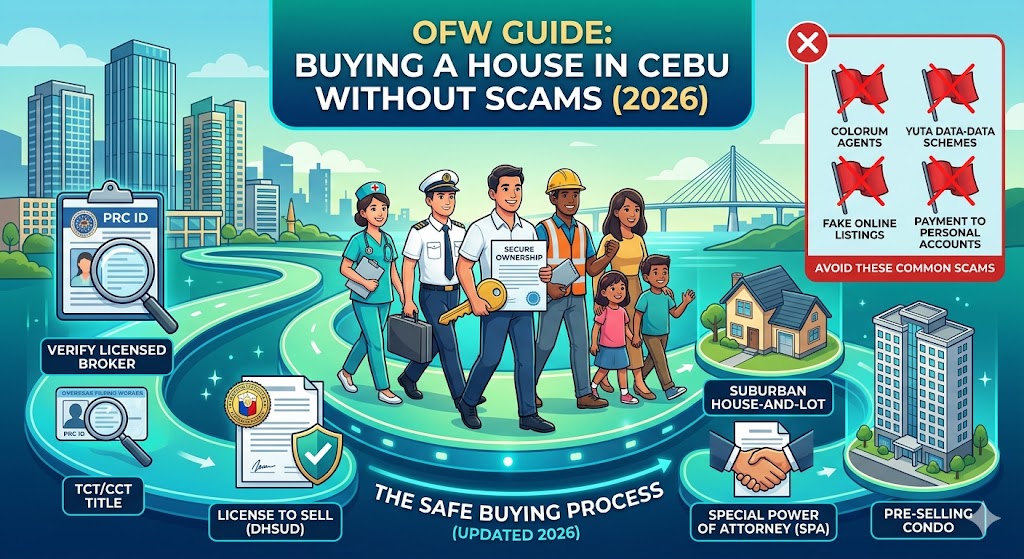
                  However, distance makes OFWs vulnerable. Because you are out of the country, you are prime targets for fake titles, unlicensed agents, and unregulated installment schemes. Success depends on strict verification, not shortcuts.

                  1. What You Can Legally Buy
                    Before looking at properties, understand your legal standing under Philippine law:

                  Filipino Citizens: If you hold a valid Philippine passport, you can own land, houses, condos, and commercial properties outright. Dual citizens enjoy these same rights.
                  Foreign Spouses: If you are married to a foreigner, the land and house must be titled in the Filipino spouse’s name to avoid constitutional complications.
                  Foreigners (Non-Filipinos): Cannot own land. They can only own condominium units (subject to the 40% foreign ownership cap per building) or lease land long-term.

                  1. Choosing the Right Property Type
                    Cebu’s market is diverse. Your choice dictates your payment structure and risk level:

                  Property Type: Pre-selling (Under Construction), Ready-for-Occupancy (RFO), Resale (Existing Properties)
                  The Appeal: Lower entry prices, flexible equity payments (e.g., 24-36 months); Immediate move-in or rental income generation; Often negotiable prices, established neighborhoods
                  The Risks: High risk of construction delays or stalled projects; Higher upfront costs, requires immediate financing; Requires heavy title verification, higher maintenance

                  Cebu Market Reality: Pre-selling suits many OFWs because of staggered payments, but be mindful of an oversupply in certain Cebu City condo segments. Research the developer’s track record of actually finishing projects on time.

                  1. The Remote Buying Process
                    You do not need to fly home to buy property. If you follow this exact sequence, you can safely manage the transaction from abroad.

                  1. Set Your Budget:Keep housing costs under 30% of your income.

                  Factor in the down payment, monthly amortizations, closing costs (taxes and fees run 5-10% of the price), and ongoing expenses like HOA dues.

                  2. Hire a PRC-Licensed Broker:Do not use unverified agents.

                  Under the Philippine RESA Law, only licensed professionals can sell real estate. Ask for their Professional Regulation Commission (PRC) ID and verify their active status on the official PRC website.

                  3. Verify the Paperwork:The golden standard of legitimacy.

                  For new projects, demand the License to Sell (LTS) issued by DHSUD. For existing properties, get a Certified True Copy of the Transfer Certificate of Title (TCT) or Condo Certificate (CCT) from the Registry of Deeds to ensure there are no hidden mortgages or liens.

                  4. Execute a Special Power of Attorney (SPA):Empower your representative.

                  Since you cannot physically sign documents, authorize a highly trusted family member or a hired independent lawyer in Cebu via an SPA. You must notarize and apostille (or consularize) this document in your host country.

                  5. Secure Financing:Pag-IBIG vs. Bank Loans.

                  Pag-IBIG offers affordable rates and leniency but processes slowly. Commercial banks process faster but have stricter approval requirements.

                  6. Pay Through Official Channels:Never use personal accounts.

                  Send reservation fees and down payments strictly to the developer’s official corporate bank account or through a bank escrow. Never send money via remittance centers to an agent’s personal account.

                  1. The Biggest Cebu Real Estate Scams
                    No matter how much you love the location, walk away immediately if you encounter any of these traps:

                  Raw Land or “Yuta Data-Data” Schemes: This is incredibly common in Cebu. Sellers subdivide agricultural land and offer it on cheap installments without proper DHSUD permits, road rights-of-way, or drainage plans. It is high risk, and you often cannot get a title for years—if ever.


                  Fake or Forged Titles: Scammers show impressive-looking photocopies of titles. Avoid this by having your SPA representative pull the original records directly from the Registry of Deeds.
                  Double Selling: The same property (usually a resale lot) is sold to multiple buyers. Avoid this by ensuring the title is clean and immediately registering your Deed of Absolute Sale.


                  Extreme High-Pressure Tactics: Statements like, “This is the last unit, you need to send the reservation fee today,” are designed to make you panic and skip your due diligence.


                  Non-Existent Properties: Scammers steal photos of legitimate properties and post them on Facebook at unrealistically low prices. If a price seems too good to be true for a prime spot in Mactan or Cebu City, it usually is. Have your representative do a physical site visit.


                  Treat this like any major investment: verify everything, use licensed professionals, and never rush. Your hard-earned money deserves protection.

                  Frequently Asked Questions (FAQs)
                  Can an OFW buy a house in the Philippines without going home?

                  Yes. The entire real estate purchasing process can be handled remotely. As an OFW, you can view properties via virtual tours, attend online briefings, and pay equity through bank transfers. To handle the physical paperwork in Cebu, you must execute a Special Power of Attorney (SPA) to authorize a trusted family member, licensed broker, or lawyer to sign documents and process the title transfer on your behalf.

                  How much is the reservation fee for a condo in Cebu?

                  Reservation fees for pre-selling and ready-for-occupancy (RFO) condos in Cebu typically range from ₱15,000 to ₱50,000, depending on the developer and the total contract price of the property. This fee temporarily takes the unit off the market and is usually deducted from your total down payment. Crucial rule: Never send a reservation fee to a real estate agent’s personal bank account or e-wallet. Always deposit directly into the developer’s official corporate account.

                  What is a Special Power of Attorney (SPA) for OFWs?

                  A Special Power of Attorney (SPA) is a legal document that grants a designated person the authority to act on your behalf for specific transactions in the Philippines. In real estate, your representative needs an SPA to sign the Contract to Sell, apply for Pag-IBIG or bank home loans, and receive the official property title. To be legally recognized in the Philippines, an OFW must have the SPA notarized and then apostilled (or consularized) at the Philippine Embassy or Consulate in their host country.

                  Contact Us

                    Author
                    John Paul Ybañez Paquibot
                    Licensed Real Estate Broker | PRC No. 00014132 | DHSUD No. CVRFO-B-03/18-2672
                    Bachelors Realty and Brokerage, Inc. Cebu
                    G/F Cap Building, Brgy. Corner, Osmeña Blvd.
                    Arlington Pond St. Extension, Cebu City, 6000 Cebu