Category: Articles

  • Definitive Master Guide: Foreclosed Properties in Cebu (2026) – SeekCebu

    Foreclosed Properties in Cebu

    Buying a foreclosed property in Cebu can be a lucrative investment strategy—but it is not a shortcut to wealth. While these assets often come with significant discounts ranging from 20 to 50 percent below market value, they demand rigorous due diligence, patience, and a high tolerance for uncertainty.

    This guide merges the sharp, scannable structure of a quick reference with the deep, actionable intelligence you need to actually protect your capital. It walks you through the entire process: where to find these properties, how to evaluate them, how the bidding works, and—most importantly—how to avoid the traps that swallow inexperienced buyers.


    The Brutal Truth Upfront

    Foreclosed properties are sold on an “as-is, where-is” basis. This means the seller makes no warranties about the property’s condition. If you discover a major structural defect, a hidden lien, or an illegal occupant after purchase, you have no legal recourse against the bank or government agency. The property is yours, problems and all.

    The low price tag is compensation for these risks. In 2026, with Cebu’s real estate market becoming more selective and interest rates still elevated, the margin for error is thinner than ever. Success belongs to those who do their homework.


    Where to Find Foreclosed Properties in Cebu

    In 2026, you can locate foreclosed listings through the following primary channels.

    Government Sources

    Pag-IBIG Fund is the largest source of acquired assets in the country. Their inventory includes residential lots, townhouses, condominiums, and house-and-lot properties across Cebu. Pag-IBIG conducts public auctions through their Online Public Auction (OPA) portal, where you can bid remotely without visiting a physical office. Listings are updated regularly, and properties are categorized as “1st Public Auction” (newly listed, first time offered) or subsequent auctions (properties that didn’t sell previously). Bidding windows are typically short—for example, a Cebu property might accept bids from June 22 to June 26, 2026.

    The Philippine Deposit Insurance Corporation (PDIC) sells properties acquired from closed banks. In 2026, PDIC has been actively disposing of assets through electronic bidding (e-bidding), with recent sales covering 44 properties across Visayas and Mindanao. Their online portal at assetsforsale.pdic.gov.ph allows prospective buyers to register, view the complete property catalogue, and submit bids from any location.

    Other government agencies like the Social Security System (SSS) also sell foreclosed properties, typically through negotiated sale rather than public auction.

    Private Banks

    Major Philippine banks maintain regularly updated lists of their acquired assets—often called ROPA (Real and Other Properties Acquired). Banks like BDO, BPI, Metrobank, Security Bank, EastWest Bank, and Maybank all publish these lists on their websites.

    In Cebu, recent bank listings include:

    • Maybank foreclosed condominium units in Casa Mira Tower, Labangon
    • EastWest Bank residential lots in Alta Vista Subdivision, Bulacao
    • Metrobank properties with improvements in Midori Plains Subdivision, Minglanilla

    Negotiated Sales

    If a property does not sell at auction, banks often move it to a “negotiated sale” list. This can offer more flexibility in pricing and payment terms, as you are dealing directly with the bank rather than competing in a public auction.

    Aggregator Platforms

    Websites like ForeclosurePhilippines.com consolidate listings from multiple banks and government institutions, making it easier to search across sources in one place. Lamudi and other real estate portals also feature foreclosed property sections.


    Evaluating a Foreclosed Property: The Due Diligence Checklist

    This is where most inexperienced buyers lose money. A low price is meaningless if the property comes with hidden costs, legal entanglements, or structural nightmares. Do not skip a single step on this checklist.

    Physical Inspection

    Never buy a foreclosed property sight unseen. Listings provide basic information—price, lot size, floor area, and location—but they will not tell you if the roof is collapsing, if the plumbing is corroded, or if the property is located in a flood-prone area.

    Schedule a visit as soon as possible. Good deals don’t stay available for long. During your inspection:

    • Check for structural damage: cracks in walls, water stains on ceilings, sagging floors, signs of pest infestation. These may indicate underlying structural issues that will be expensive to repair.
    • Test utilities: does the property have working electricity, water, and sewage connections? In Cebu’s competitive market, a “cheap” property is often inexpensive precisely because it lacks the utility connections required to live or build legally.
    • Look for signs of neglect: foreclosed homes are often left vacant for months or years, leading to significant deterioration.
    • Visit at different times of day to assess the neighborhood’s character, noise levels, security, and flood risk.
    • Talk to neighbors if possible. They may know about problems the listing doesn’t mention—legal disputes, boundary issues, or informal settlers.

    Occupancy Status

    This is a potential deal-breaker. Is the property vacant or occupied?

    If occupied, you are buying the structure but not necessarily the right to occupy it immediately. Evicting informal settlers or former owners can take months or years and cost a fortune in legal fees. Some listings explicitly state “occupied,” while others are vacant. Treat occupied properties with extreme caution unless you have the resources and patience for a lengthy legal eviction process.

    Title and Legal Verification

    This is the single most important step. A property might look perfect, but if the title is clouded, you are buying a lawsuit.

    • Obtain a Certified True Copy of the title from the Registry of Deeds. This ensures the seller is the registered owner.
    • Check for encumbrances: are there existing mortgages, liens, adverse claims, or court cases attached to the property? Some foreclosed properties have pending legal disputes, and you may inherit these issues.
    • Confirm the property’s classification: is it residential, agricultural, or commercial? Zoning matters. Check local zoning ordinances to ensure the property is suitable for your intended use.
    • Check for boundary issues: has the property been surveyed recently? Boundary disputes are common and expensive to resolve.

    Unpaid Liabilities

    You are responsible for all outstanding debts attached to the property. These can include:

    • Real property taxes (back taxes can accumulate significantly over years of non-payment)
    • Association dues (if in a subdivision or condominium, these can be substantial)
    • Utility bills (electricity and water bills left unpaid by the previous owner)
    • Other liens (mechanic’s liens, court-ordered judgments)

    Get a full accounting of these liabilities before you bid. They can add tens of thousands of pesos to your total cost.

    Hidden Costs

    The purchase price is just the beginning. Factor in the full acquisition cost:

    • Capital gains tax (typically 6 percent of the selling price or zonal value, whichever is higher)
    • Documentary stamp tax
    • Transfer tax and registration fees
    • Real property taxes (current and back taxes)
    • Association dues (if applicable)
    • Repair and renovation costs (often substantial for neglected properties—budget 10 to 20 percent of the purchase price as a rule of thumb)

    A property that looks like a bargain at 30 percent below market value can quickly become a money pit once these costs are added.


    The Bidding and Purchase Process

    The specific process varies depending on the seller. Here is how each works.

    For Pag-IBIG Public Auction (OPA Portal)

    1. Browse listings on the Pag-IBIG OPA portal or their official website.
    2. Register on the OPA platform. Both individual buyers and companies can register.
    3. Select properties of interest and conduct your due diligence—inspection, title verification, cost assessment.
    4. Submit your bid during the specified acceptance period. Bids are submitted online. Bidding windows are typically short—for example, a Cebu property might accept bids from June 22 to June 26, 2026.
    5. Wait for the results. Pag-IBIG typically announces winning bidders after the bidding period closes.
    6. Complete the payment and transfer documents. If you win, you will need to pay the full amount within a specified period.

    For PDIC E-Bidding

    1. Register on the PDIC portal at assetsforsale.pdic.gov.ph.
    2. Review the property catalogue, which includes detailed descriptions and bidding procedures.
    3. Submit your bid electronically during the scheduled e-bidding dates.
    4. Complete the purchase if your bid is successful.

    For Bank ROPA (Negotiated Sale)

    Banks typically sell their acquired assets through negotiated sale rather than public auction. This means you make an offer directly to the bank, and they accept or reject it. The process is more flexible but also less transparent—you won’t know if other buyers are offering more.

    1. Review the bank’s ROPA list on their website.
    2. Submit a formal “Offer to Buy” form. The bank will evaluate your offer.
    3. Negotiate price and terms if your offer is not immediately accepted.
    4. Complete the purchase if an agreement is reached.

    The Real Risks: What the Brochures Don’t Tell You

    Foreclosed properties are not for everyone. Here are the risks that get downplayed in marketing materials.

    You are buying someone else’s problem. The previous owner defaulted for a reason—often because they could not afford the property. That same financial distress may have led to neglect, deferred maintenance, or even deliberate damage.

    “As-is, where-is” means no recourse. If you discover a major structural defect after purchase, you cannot go back to the bank and ask for repairs or a refund. The property is yours, problems and all.

    Eviction can be a nightmare. If the property is occupied, you are not just buying a house—you are buying a legal battle. Evicting occupants can take years and cost hundreds of thousands of pesos in legal fees.

    Title issues can be buried. Some foreclosed properties have pending court cases, unclear documentation, or disputes over boundaries. These may not surface until after you have paid.

    Low appraisal = low financing. Banks may appraise foreclosed properties at their purchase price, not their market value. This can limit your ability to get financing or refinance later.

    Competition is real. Good deals attract multiple bidders. In a competitive auction, it is easy to get caught up and overbid. Know your maximum price before you start.


    Who Should Buy Foreclosed Properties?

    Foreclosed Properties Are Best Suited For:

    • Experienced investors who have capital for repairs and the patience for legal processes.
    • Buyers with cash who can avoid the delays and uncertainties of bank financing.
    • Those with construction or renovation expertise who can accurately assess repair costs.
    • People who can visit the property in person and conduct thorough inspections.
    • Investors who understand the legal process of eviction and title transfer.

    Foreclosed Properties Are NOT Ideal For:

    • First-time buyers with limited capital and no renovation experience.
    • Anyone who needs to move in immediately (occupied properties and repair delays will frustrate you).
    • Buyers relying on 100 percent financing (banks are cautious about lending on foreclosed assets).
    • Anyone unwilling to invest time in physical inspections and title verification.
    • Emotional buyers who might overbid in a competitive auction.

    The Smart Money Approach for 2026

    If you are serious about buying a foreclosed property in Cebu this year, here is a realistic, disciplined strategy.

    Start small. Consider a lot-only purchase or a smaller unit rather than a large, complex property. This limits your downside while you learn the process.

    Build a team. Work with a licensed real estate broker who specializes in foreclosed properties. They have access to databases and can help you navigate the process. Also engage a lawyer for title verification and a contractor for inspection.

    Secure financing pre-approval before bidding. Banks favor bidders who demonstrate clear financial capacity. If you are financing the purchase, have your pre-approval ready.

    Be patient. The best deals don’t appear overnight. Monitor listings regularly—new properties are added weekly. Pag-IBIG’s 1st Public Auction listings, in particular, offer “first dibs” at properties that haven’t been passed over by other buyers.

    Budget for repairs. Assume you will need to spend at least 10 to 20 percent of the purchase price on renovations. If you are wrong and the property is in better condition, that’s a pleasant surprise. If you are right, you are prepared.

    Know your walk-away point. Set a maximum bid and a maximum repair budget before you start. Emotional bidding is how people overpay for problems. Stick to your numbers.

    Document everything. Keep records of all communications, bids, and due diligence findings. This will protect you if disputes arise.


    Final Verdict

    Foreclosed properties in Cebu can be excellent investments—but they are not passive investments. They demand time, money, and a willingness to get your hands dirty. The 20 to 50 percent discount is real, but so are the risks: structural neglect, legal entanglements, occupied units, and hidden costs.

    In 2026, with Cebu’s market becoming more discerning, the days of buying any foreclosed property and automatically making money are over. Success belongs to those who do their homework—who inspect the property, verify the title, check occupancy status, and budget realistically for repairs.

    If you are willing to put in that work, foreclosed properties offer a genuine path to below-market acquisition. If you are looking for a simple, hassle-free purchase, buy a traditional property and pay the premium for peace of mind.

    The choice is yours. Just make it with your eyes open.

    You might want to read about
    Condotel investment in Cebu
    House and lot vs Lot Only Investment


    Disclaimer: This guide is for informational purposes only and does not constitute financial, legal, or investment advice. Foreclosed property investments involve substantial risk, including the potential loss of principal. Always obtain Certified True Copies of titles from the Registry of Deeds, conduct physical inspections, consult with licensed real estate professionals and legal counsel, and perform thorough due diligence before making any purchase. The specific properties, bidding dates, and platforms mentioned are provided as examples and may change without notice.

      Author
      John Paul Ybañez Paquibot
      Licensed Real Estate Broker | PRC No. 00014132 | DHSUD No. CVRFO-B-03/18-2672
      Bachelors Realty and Brokerage, Inc. Cebu
      G/F Cap Building, Brgy. Corner, Osmeña Blvd.
      Arlington Pond St. Extension, Cebu City, 6000 Cebu
    • Definitive Master Guide: Condotel Investment in Cebu (2026) – SeekCebu

      Condotel Investment in Cebu

      Picture this: you buy a condominium unit in a prime Cebu location, hand the keys to a professional management company, and collect guaranteed rental income every month without lifting a finger. It sounds like the perfect passive investment.

      This is the promise of the condotel—a hybrid between a condominium and a hotel that has captured the imagination of investors across the Philippines. But in Cebu’s 2026 market, with over 92,300 condominium units already standing and thousands more on the way, the question demands an honest answer:

      Are those guaranteed rental returns actually a realistic bet?

      The short answer is no. In 2026, success requires looking past the marketing brochures and understanding a fundamental truth: a condotel is a direct trade-off between convenience and control.


      What Exactly Is a Condotel?

      A condotel is a unit you own outright—complete with a Condominium Certificate of Title (CCT)—but instead of managing it yourself, you enroll it in a rental pool system run by a professional hotel operator.

      The management handles marketing, bookings, cleaning, guest interactions, and day-to-day operations. All the rental income from the units is pooled together. After deducting operating expenses and management fees, the remaining profit is distributed among owners based on unit size.

      In Cebu, these properties are typically concentrated in tourist-heavy areas like Mactan, Lapu-Lapu, and other leisure-oriented destinations where resort-style living and airport proximity attract both domestic and international visitors.

      While the convenience is real, the price you pay is substantial loss of control. You do not choose your tenants. You do not control daily rental rates. You do not decide when renovations happen. You are a silent partner in a hospitality business—and like any business partnership, your returns depend entirely on the competence and honesty of your partners.


      The Allure of “Guaranteed” Returns

      Developers marketing Cebu condotels often dangle attractive numbers. Some promise gross returns of 10 to 12 percent, especially in key tourism hubs like Mactan. For comparison, traditional Cebu residential condos typically yield 5 to 7 percent gross annually, but net yields drop to 3 to 5 percent once you factor in dues, taxes, and management fees.

      To bridge this gap and ease investor anxiety, developers frequently offer “guaranteed rental returns” fixed for 5 to 15 years, often with automatic renewal clauses. For overseas Filipino workers (OFWs), expatriate Filipinos, and foreign investors who cannot easily manage a property from abroad, this feels like an absolute sure thing.

      But here is the uncomfortable truth: there is no such thing as a legally guaranteed rental return in Philippine condotels.


      The Brutal Reality: What “Guaranteed” Actually Means

      The Securities and Exchange Commission (SEC) has been crystal clear on this point. Under its regulatory framework for rental pool agreements, the SEC explicitly cites the “Lack of guaranteed returns” as a primary risk. Because a rental pool’s income is shared among all unit owners, your returns are fundamentally tied to the property’s real-world occupancy rates, the volatile tourism market, and the competence of the management company.

      When a developer promises a “guaranteed” return, they are offering a projection—an estimate based on optimistic assumptions about occupancy, rental rates, and operating costs. If those assumptions prove wrong, the “guarantee” often dissolves into fine print.

      The SEC explicitly warns that when an investor participates in a rental pool, they “relinquish direct control over the management and operation of their property”, making the investment highly susceptible to market fluctuations that no developer can fully control.


      The Regulatory Landscape Has Tightened

      Following the implementation of SEC Memorandum Circular No. 12, Series of 2024 (SEC RENT) , rental pool agreements are now regulated as securities rather than simple real estate purchases. These are investment contracts that must be registered with the SEC before being offered to the public.

      If a developer offers a rental pool program without SEC registration, the offer is illegal and your investment is unprotected. This is not a technicality—it is a fundamental protection for investors.

      The SEC also requires annual registration renewal, adding ongoing compliance risk. Developers who cannot maintain their registration may be forced to suspend their rental pool programs, leaving you with a unit you cannot rent out through the promised system.


      The Hidden Costs and the Occupancy Trap

      Even if the tourism market performs well, two structural hurdles frequently devastate investor returns.

      The Fee Structure. Condotel management fees are significantly higher than standard condo association dues. While a typical 30-square-meter Cebu condo costs 1,500 to 3,600 pesos monthly in association dues, a hotel operator’s cut can consume a massive slice of your gross revenue before you ever see a cent. You also remain responsible for rising property taxes, specialized insurance, and building-wide special assessments.

      The Occupancy Gap. Cebu’s tourism economy is thriving. Mactan-Cebu International Airport hit an all-time monthly passenger record in January 2026, welcoming 1.3 million passengers—a robust 15 percent increase from January 2025. Domestic traffic rose 12 percent year-on-year, while international passenger volume surged 25 percent.

      But peak travel seasons do not last all year. Real-world data shows that short-term rentals in Cebu City maintain only 45 to 55 percent average occupancy over a full 12-month cycle. If a developer’s brochure bases its 12 percent “guaranteed” return on an assumed 80 percent occupancy year-round, the math collapses.

      The Supply Wave. Cebu’s condominium supply is expanding rapidly. Colliers expects total supply to reach 109,000 units by end 2029, with an average annual completion of 4,000 new units during the period. This means fierce competition for the transient tourist market.

      Illiquidity. A condotel unit is an inherently illiquid asset. It cannot be easily or quickly converted into cash without a significant reduction in price. This is a critical point that many investors overlook: you are not buying a liquid investment you can exit quickly if circumstances change.


      What Real SEC-Approved Programs Actually Look Like

      To understand what a legitimate, SEC-registered condotel rental pool actually offers, look at recent approvals.

      In December 2025, the SEC approved Cebu Landmasters Inc.’s rental pool program for its Citadines Cebu City project, which has been operational since September 2019. Under the program, unit owners receive 40 percent of net room revenue, distributed quarterly. Owners also receive 10 to 15 complimentary nights of stay with breakfast annually, subject to availability.

      Notice the key details: 40 percent of net room revenue (not gross), distributed quarterly (not monthly), with complimentary stays (not cash). The SEC approved this program because it was properly registered and disclosed. But the 40 percent net revenue share is far lower than the 10 to 12 percent gross yields that developers often advertise.

      This is the reality of legitimate condotel investments: your share of the revenue is significantly lower than marketing materials suggest, and your payout is subject to the operator’s deductions.


      The Three Traps That Will Destroy Your Returns

      Trap One: The “Baked-In” Pricing Scam

      Developers often inflate the purchase price of condotel units by 15 to 20 percent compared to standard condos in the same neighborhood. If you are paying a massive premium upfront, you are essentially pre-paying for your own “guaranteed” checks. The developer isn’t paying you out of hotel profits; they are simply returning your own inflated purchase price to you over 5 to 15 years.

      Trap Two: Gross Revenue vs. Net Profit

      If your payout is based on “Net Profit” —revenue after the hotel operator deducts all operating expenses, administrative overhead, marketing fees, corporate allocations, and depreciation—you are at significant risk. A hotel operator can manipulate “Net Profit” down to zero through creative accounting. The management company still gets paid. The corporate overhead still gets allocated. But your “share” becomes nothing.

      If your payout is based on “Gross Room Revenue” —a percentage of the actual room revenue before expenses—you have far more protection. The operator cannot deduct their way to zero because your share is calculated on top-line revenue, not bottom-line profit.

      Trap Three: Unverified Management Track Record

      Who is actually operating the hotel? A reputable international brand (like Citadines, Ascott, or Wyndham) has proven systems, international standards, and accountability. An unknown local operator with no track record is a much higher risk. If the management company fails or underperforms, your returns disappear—and you have no recourse.


      The Smart Money Playbook: Due Diligence Pro-Tips

      If the convenience of a condotel still fits your investment profile, you must protect your capital by applying these strict rules before signing any contract.

      Verify SEC Registration. Under SEC Memorandum Circular No. 12, Series of 2024, rental pool programs must be registered with the SEC. Ask for the SEC registration number. Verify it directly with the SEC. If it is not registered, the offer is illegal and your investment is unprotected.

      Audit the “Baked-In” Pricing. Compare the condotel’s price per square meter to standard condos in the same neighborhood. If you are paying a 15 to 20 percent premium, recognize that your “guaranteed” returns are likely your own money being returned to you. Ask the developer directly: “What is the price premium compared to a non-condotel unit in this building?” If they cannot or will not answer, walk away.

      Demand Three Years of Historical Data. If the project is already operational, do not accept pro forma projections. Demand to see audited financial statements showing actual occupancy rates, actual operating expenses, and the actual net payouts distributed to existing owners over the past three years. If the developer refuses to show you historical data, that is a red flag. Walk away immediately.

      Stress-Test the Projections. Take the developer’s marketing brochure and manually cut the projected occupancy rate to 50 percent. Simultaneously, increase the projected maintenance and management fees by 15 percent. If the property cannot generate a positive net return under this conservative scenario, the project is a gamble, not an investment.

      Read the Revenue-Sharing Fine Print. Have a lawyer review the exact wording of the contract. Ensure your payout is calculated based on Gross Room Revenue rather than “Net Profit.” Net profit can easily be manipulated down to zero through creative hotel accounting.

      Check the Management Track Record. Research who is actually operating the hotel. International brands with multi-property track records are safer than unknown local operators. Ask for references. Contact existing unit owners if possible.

      Understand Illiquidity. A condotel unit cannot be easily sold if you need cash. Be prepared to hold for the long term—five years minimum, ten years ideally.


      Final Verdict

      In 2026, guaranteed rental returns in Cebu condotels are a marketing illusion. They are projections, not promises.

      This does not mean condotels are inherently bad investments. A well-located, well-managed condotel in a prime Cebu tourist destination—particularly in Mactan’s leisure-oriented corridor—can generate attractive returns. Cebu’s tourism fundamentals are strong, with MCIA setting passenger records and Central Visayas posting 7.3 percent GDP growth.

      But those returns are not guaranteed. They are subject to occupancy rates, management competence, operating costs, and market competition. The 10 to 12 percent gross yields that developers advertise are gross—before management fees, taxes, insurance, and repairs. Your net yield will be significantly lower.

      A condotel should never be purchased under the assumption of low risk or guaranteed fixed income. It is a highly specialized, medium-risk investment in a hospitality business. If you are an absentee owner or an OFW who values convenience above all else and is willing to surrender control of your asset to a proven, top-tier international hotel brand with an SEC-registered rental pool program, a condotel can be a viable, hands-off addition to a diversified portfolio.

      However, if your priority is maximizing your net rental yields, maintaining legal flexibility, or building long-term capital growth, you will find far better returns by purchasing a traditional condominium or a townhouse where you retain absolute control over your property’s destiny.

      As economist Fernando Fajardo put it: “Cebu condos aren’t a bad asset… But they’re no longer automatic winners.” The winners in 2026 will be those who do their homework, read the fine print, and invest with realistic expectations—not those who chase marketing promises.


      Disclaimer: This guide is for informational purposes only and does not constitute financial, legal, or investment advice. Real estate and hospitality investments involve substantial risk, including the potential loss of principal. Always verify developer License to Sell (LTS) documents, confirm SEC registration of rental pool programs, consult with a licensed PRC broker and a qualified legal professional, and perform rigorous due diligence before committing your capital.

        Author
        John Paul Ybañez Paquibot
        Licensed Real Estate Broker | PRC No. 00014132 | DHSUD No. CVRFO-B-03/18-2672
        Bachelors Realty and Brokerage, Inc. Cebu
        G/F Cap Building, Brgy. Corner, Osmeña Blvd.
        Arlington Pond St. Extension, Cebu City, 6000 Cebu
      • Definitive Master Guide: House-and-Lot vs. Lot-Only Investment in Cebu (2026) – SeekCebu

        House-and-Lot vs. Lot-Only Investment in Cebu

        Cebu’s property market has entered a mature “recalibration” cycle. With over 93,000 condominium units saturating the vertical market and residential lot prices rising an average of 7 percent annually from 2016 to 2025—with some projects posting compound annual growth rates as high as 27 percent—the era of easy, market-wide gains is over. In 2026, success belongs to precision, not speculation.

        The choice between buying a finished House-and-Lot (H&L) and purchasing raw Lot-Only land is not about which asset is objectively superior. It is a deliberate strategic decision that hinges entirely on your financial timeline, your need for liquidity, and your tolerance for risk.

        This definitive guide merges hard data with battle-tested investor heuristics to give you the clearest path forward.


        The 2026 Market Reality: Where Cebu Actually Stands

        Before diving into asset classes, you must understand the ground beneath your feet. Central Visayas posted 7.3 percent GDP growth in 2024, the fastest of all 18 Philippine regions, which directly underpins housing demand. However, the price signals are mixed and require careful reading.

        The median housing price in Cebu in 2026 sits at approximately ₱14.8 million. However, this figure is heavily skewed by luxury listings; the average price jumps to ₱25.5 million, while a typical family home in a middle-income subdivision is much closer to ₱7.8 million. This gap is your first warning: do not rely on averages. Know exactly which segment you are targeting.

        Critically, the supply pipeline is constrained. More than 10,000 housing units in Cebu are currently awaiting License to Sell (LTS) approval from the HLURB. This backlog prevents developers from launching new pre-selling projects, tightening supply in the ₱3 million to ₱6 million segment—the very sweet spot where overseas Filipino workers and young families are most active. This supply crunch is putting upward pressure on prices for available properties, making 2026 a unique window for buyers who are ready to act.


        The Strategic Case for House-and-Lot: The “Immediate Utility” Path

        Choosing a House-and-Lot is a decision to acquire a functioning, productive asset from day one. You are buying a combination of appreciating land and a depreciating structure, but you are paying for the convenience of immediate utility.

        The Appreciation Profile: House-and-lot products in Cebu are currently seeing robust 7 to 10 percent annual gains. In 2025, the Visayas and Mindanao region posted a 92 percent take-up rate for house-and-lot developments, indicating sustained, healthy demand from end-users. The top-selling segment was the middle-income range, accounting for 42 percent of total sales.

        The Cash Flow Reality: You gain immediate rental income. Across Cebu, average gross rental yields for residential properties hover around 5.2 percent. In prime areas like IT Park and Cebu Business Park, gross yields sit near 4.9 to 5 percent. However, you must be brutally honest with your net yield—property taxes, insurance, and regular maintenance will shave off roughly 1.5 to 2 percentage points. The structure ages; roofs leak, paint fades, and plumbing requires attention. This is not passive income; it is active business management.

        The Smart Heuristic for H&L Buyers: Pay close attention to the quality of the Homeowners Association (HOA). In Cebu’s gated subdivisions, the HOA is the leading indicator of your property’s future resale value. A well-managed community with enforced rules, proper security, and well-maintained common areas will always command a premium when it is time to exit. A dysfunctional HOA can sink your investment faster than a market downturn.


        The Strategic Case for Lot-Only: The “Long-Term Appreciation” Path

        Choosing Lot-Only—often called land banking—is a decision to capture the maximum potential of the land itself. It is an investment in pure flexibility and future value, unencumbered by a decaying structure.

        The Appreciation Profile: This is where the numbers get compelling. From 2016 to 2023, lot-only developments saw annual price increases ranging from 7 to 15 percent. In 2025, Colliers data showed that average take-up for lot-only units in Cebu, priced at an average of ₱21,000 per square meter, was an astonishing 94 percent. Investors are actively voting with their wallets for land.

        Consider the historical precedent: Cordova land values jumped a staggering 900 percent—from around ₱500 per square meter to ₱5,000 per square meter—after the Cebu-Cordova Link Expressway (CCLEX) opened. This is the upside of infrastructure-driven speculation. However, it also highlights the speculative nature of this play; you are betting on future development, not current utility.

        The Brutal Drawbacks: You face zero monthly cash flow. While you wait for appreciation, you are paying property taxes, subdivision association dues, and incurring the opportunity cost of your frozen capital. Furthermore, vacant land is vulnerable to squatting, encroachment, and neglect. If you are not visiting the property regularly or paying a trusted caretaker, your asset can become a liability.

        The Two Golden Rules for Lot-Only Buyers (Non-Negotiable):
        First, strictly enforce the 5-Year Rule. Only enter a lot-only investment if you have the capital to hold the asset for a minimum of five years. This is the absolute minimum window required to weather market cycles and allow infrastructure projects to materialize. If you need liquidity within three years, do not buy raw land.

        Second, rigorously verify “Build-Readiness.” Do not buy raw land without confirming access to a stable water supply, grid electricity, and legally titled subdivision roads. In Cebu’s competitive market, a “cheap” lot is almost always cheap for a reason—it lacks the utility connections required to legally build a home. Digging a deep well or pulling power lines from a kilometer away can cost millions, instantly wiping out your paper gains.


        The Brutal Truth: Risks You Cannot Ignore in 2026

        Both asset classes carry specific traps that inexperienced investors fall into.

        For House-and-Lot, the greatest hidden risk is structural depreciation. While the land under your house appreciates at 7 to 10 percent, the building itself is losing value every year. After 15 to 20 years, a significant portion of your property’s value is tied to a structure that may require a full tear-down and rebuild. When calculating your total return on investment, you must amortize the cost of major capital expenditures—roof replacement, plumbing overhauls, electrical rewiring—across your holding period.

        For Lot-Only, the risk is development stagnation. Not every growth corridor actually grows on schedule. Infrastructure projects face delays, commercial zones shift, and what looks like a prime location today could remain farmland for another decade. This is why the 5-Year Rule exists—it gives you a buffer against bureaucratic inertia. Additionally, raw land is highly sensitive to interest rate hikes; when borrowing costs rise, speculative land prices are the first to correct.


        The Definitive Decision Matrix: Which Path Fits You?

        There is no single right answer, but there is a right answer for you.

        Choose House-and-Lot if: You are a first-time investor, an OFW seeking predictable monthly income to service a mortgage, or a family who needs a move-in-ready property without the complexities of construction management. You need your investment to generate cash flow today to offset your holding costs. You are willing to trade some long-term appreciation for the security of immediate utility and a deep tenant pool of BPO workers and young professionals.

        Choose Lot-Only if: You are a patient, long-term investor with a five-to-ten-year horizon. You have significant capital to park and do not require monthly income from this asset. You are willing to bet on specific infrastructure corridors—such as areas along the Cebu Bus Rapid Transit (BRT) route, the southern expansion zones in Talisay, or northern corridors like Consolacion and Minglanilla. You understand that you are building wealth for the next decade, not paying for this month’s bills.


        The Smart Money Playbook for 2026

        Regardless of which path you choose, the 2026 market rewards tactical execution over blind faith.

        For House-and-Lot Investors: Focus your search on the ₱3 million to ₱6 million middle-income segment. This is where demand is most robust and the housing backlog is most acute. In a buyer-leaning market, you should expect to negotiate 6 to 12 percent off listing prices. Developers are frequently offering incentives, better payment terms, and price discounts to move inventory. Never pay list price.

        For Lot-Only Investors: Do not chase the already-saturated city center. Look for emerging growth nodes along the BRT route and areas directly benefiting from the CCLEX expansion. Secure larger parcels where possible, as the per-square-meter cost drops significantly with size. However, before signing any contract, demand to see the approved subdivision plan and verify the utility connection agreements. If the developer cannot produce a clear title and a water concessionaire’s commitment letter, walk away.

        For Everyone: Verify the developer’s License to Sell with the HLURB before handing over a single peso. With over 10,000 units awaiting approval, the risk of buying into an unlicensed or delayed project is real. Work exclusively with a licensed PRC-accredited real estate broker who has a track record of closing deals in your target barangay.


        Final Verdict

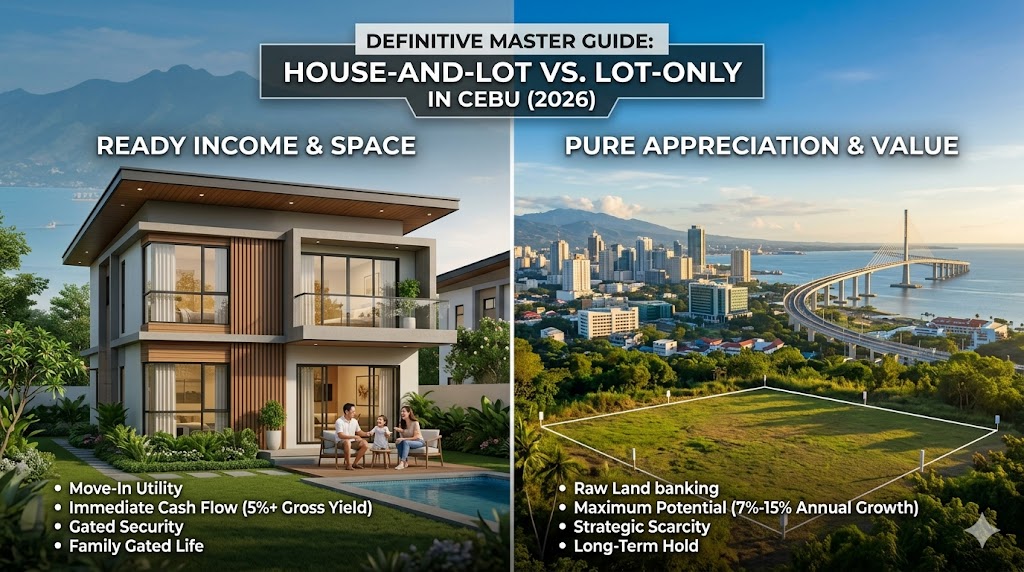
        In 2026, the equation is clear: House-and-Lot for immediate income and utility; Lot-Only for long-term capital growth.

        House-and-Lot offers the safety of cash flow, structural financing, and a known commodity, making it the superior choice for those who need their asset to work for them today. Lot-Only offers the superior appreciation ceiling, driven by the finite scarcity of land and the enduring “space shift” in Filipino housing preferences, but it demands patience, capital reserves, and the rigorous discipline of the 5-Year Rule and utility verification.

        The era of easy money in Cebu real estate is definitively over. But for the discerning investor who aligns their asset choice with their personal financial timeline and conducts rigorous due diligence, Cebu’s land—whether with a house on it or waiting for one—remains one of the most powerful wealth-building tools in the Philippine archipelago.

        Check our article for townhouse vs condo investment.


        Disclaimer: This guide is for informational purposes only and does not constitute financial or legal advice. Real estate investments involve risk, including the potential loss of principal. Always verify developer License to Sell (LTS) documents, consult with a licensed PRC broker, perform thorough title verification, and conduct your own due diligence before committing your capital.

          Author
          John Paul Ybañez Paquibot
          Licensed Real Estate Broker | PRC No. 00014132 | DHSUD No. CVRFO-B-03/18-2672
          Bachelors Realty and Brokerage, Inc. Cebu
          G/F Cap Building, Brgy. Corner, Osmeña Blvd.
          Arlington Pond St. Extension, Cebu City, 6000 Cebu
        • Townhouse vs. Condo Investment in Cebu: Which Delivers Better Returns in 2026? – SeekCebu

          Townhouse vs. Condo Investment in Cebu

          Cebu has long been the Philippines’ second-most important property market after Metro Manila, and 2026 presents a particularly interesting—and nuanced—moment for investors. The days of automatic gains are over. Today, the question isn’t whether Cebu real estate is a good investment, but which property type—and which specific location—will deliver the best returns.

          Here’s an honest, data-driven look at townhouses versus condominiums in Cebu in 2026.


          The 5-Second Snapshot: Summary Table

          Before diving into the nuance, here is the bird’s-eye view of how these two assets stack up against each other in the current Cebu market:


          Entry Capital
          Condominium (Prime Locations): Lower (Avg. ₱4.2M – ₱5.6M for studio/1BR)
          Townhouse / House & Lot: Higher (Avg. ₱8M – ₱15M+)

          Net Rental Yield (2026)
          Condominium (Prime Locations): 4.8% – 5.5% (Studios in Lahug/IT Park)
          Townhouse / House & Lot: 3.5% – 4.0% (Variable by suburb)

          Projected Annual Appreciation
          Condominium (Prime Locations): 3% – 7% (Stabilizing, selective)
          Townhouse / House & Lot: 7% – 12% (Driven by land scarcity)

          Primary Demand Driver
          Condominium (Prime Locations): Proximity to BPO offices, universities, walkability
          Townhouse / House & Lot: Privacy, space, and long-term family living

          Liquidity (Ease of Sale)
          Condominium (Prime Locations): High (Deep tenant/buyer pool in business hubs)
          Townhouse / House & Lot: Moderate (Narrower buyer pool, longer marketing time)

          Foreign Ownership
          Condominium (Prime Locations): Direct (Up to 40% building cap, CCT title)
          Townhouse / House & Lot: No direct land ownership (Requires complex 50-year lease)

          Ongoing Costs
          Condominium (Prime Locations): Monthly assoc. dues (₱1.5k–₱3.6k) + insurance
          Townhouse / House & Lot: Full maintenance, repairs, and property tax


          The Big Picture: Cebu’s 2026 Market in Context

          Before comparing asset classes, it’s worth understanding where the market stands.

          Metro Cebu now has the largest condominium stock outside Metro Manila, with approximately 92,300 units as of end-2025. Colliers projects total supply to reach 109,000 units by end-2029, with an average of 4,000 new units completed annually. That’s a lot of new inventory coming online.

          At the same time, demand remains robust. The Visayas and Mindanao region posted an 87% condominium take-up rate in Q1 2026, while house-and-lot developments hit 92%. Residential lot prices in Cebu rose by an average of 7% annually from 2016 to 2025, with some projects posting compound annual growth rates as high as 27%.

          Cebu is also benefiting from a broader shift toward provincial markets. IT-BPM operators accounted for 121,000 square meters of office space transactions in Cebu alone in 2025, and the decentralization trend is expected to persist beyond 2026.

          The bottom line: Cebu’s fundamentals are strong, but the market is becoming more selective. Location matters more than ever.


          The Elephant in the Room: The “Space Shift” is Reshaping Demand

          Here is the single most important macro-trend driving returns in 2026: The post-pandemic preference for space is no longer a fleeting fad—it is a permanent re-calibration of how Filipinos want to live.

          While condos thrived during the BPO boom of the 2010s, the 2020s belong to the “space seekers.” Families who spent years in 30-sqm condos are trading density for the privacy of horizontal developments. Hybrid work arrangements mean fewer employees need to live within walking distance of IT Park every single day.

          This shift is directly impacting appreciation rates: Nationally, BSP data shows houses are appreciating nearly seven times faster than condos (houses up 13.1% vs. condos down 0.2% in recent quarters). In Cebu, the effect is visible in suburban corridors where townhouse developments are seeing bidding wars, while some condo projects in secondary locations are offering heavy discounts to move inventory.

          This does not mean condos are dead—it means their success is now hyper-localized. Condos in walkable, irreplaceable hubs (Lahug, IT Park) will continue to perform. Condos in oversupplied or car-dependent zones will stagnate.


          Rental Yields: The Numbers You Actually Need

          Condominiums

          Cebu condos typically yield 5% to 7% gross annually, but net yields drop significantly once you factor in association dues, property taxes, and management fees.

          Here’s the breakdown by neighborhood in 2026:


          Lahug
          Studio Net Yield: ~5.5%
          1-Bedroom Net Yield: ~5.0%

          Cebu IT Park
          Studio Net Yield: ~5.0%
          1-Bedroom Net Yield: ~5.0%

          Mabolo
          Studio Net Yield: ~5.0–5.2%
          1-Bedroom Net Yield: ~5.0–5.2%

          Banilad
          Studio Net Yield: ~4.8%
          1-Bedroom Net Yield: ~5.0%

          Cebu Business Park
          Studio Net Yield: Weaker
          1-Bedroom Net Yield: Weaker

          Source: Bamboo Routes Cebu rental yield data, 2026

          Lahug stands out as the strongest all-around performer, combining solid yields with deep tenant demand near IT Park, schools, hospitals, and the upper Cebu City area. Studios remain the most capital-efficient rental product, offering roughly 4.8% net yield on average with less capital required than larger units.

          The weakest income profiles are in South Road Properties, Cebu Business Park, and Mactan Newtown—high purchase prices and high amenity costs eat into returns.

          The average net yield across Metro Cebu sits at approximately 3.5%, though prime locations outperform significantly.

          Townhouses

          Townhouse rental data in Cebu is less widely published, but available figures suggest a different profile. A 3-bedroom townhouse in Talamban shows approximately 5.2% gross yield and 3.7% net yield. A 3-bedroom villa in Cebu City averages around 6.35% gross yield.

          The key difference? Townhouses typically attract families and longer-term tenants, which can mean lower turnover (saving you vacancy costs) but also a narrower tenant pool.

          Verdict on rental yields: Condos in prime locations (Lahug, IT Park) offer comparable or slightly better net yields than townhouses, with studios providing the best capital efficiency. However, yields vary dramatically by location—a condo outside prime districts may underperform a well-located townhouse.


          Capital Appreciation: Where the Real Money Is Made

          Condominiums

          Condo prices in Metro Cebu are forecast to grow at 3% to 7% annually through 2028, with a central projection of approximately 5% for well-located units in prime districts. Pre-selling units are appreciating at 7–10% per year.

          However, the market has become more complex. Economist Fernando Fajardo notes that while prime locations like IT Park, Ayala Business Park, and Lahug remain stable, some areas are beginning to show signs of oversupply, with growing numbers of similar units competing for tenants and buyers. Pure speculation hoping for quick gains is “much more uncertain now”.

          Townhouses and House-and-Lot

          Historical data shows residential lot prices in Cebu rose 7% annually from 2016 to 2025. Nationally, houses are appreciating significantly faster than condos—BSP data shows houses up 13.1% versus condominiums down 0.2% in recent quarters.

          In Metro Manila, houses are appreciating nearly seven times faster than condos. While Cebu-specific data isn’t as granular, the pattern likely holds: horizontal properties tend to outperform vertical ones on price appreciation due to land scarcity and Filipino families’ enduring preference for space—a preference that has only intensified in the post-pandemic era.

          Verdict on appreciation: Townhouses and house-and-lot properties likely offer stronger capital appreciation over the medium-to-long term, driven by land value growth and the enduring “Space Shift” that shows no signs of reversing.


          The Critical Differences: What the Numbers Don’t Tell You

          Entry Price and Capital Requirements

          Condos offer a lower entry point. A studio in Banilad averages ₱4.2 million, while a 1-bedroom goes for ₱5.6 million. Townhouses typically require more capital—median Cebu housing prices sit around ₱14.8 million, though more affordable options exist in suburban areas.

          For foreign investors, this is crucial: foreigners can directly own condominium units under the Condominium Act (RA 4726), but cannot own land—which means no direct freehold ownership of townhouses or house-and-lot properties. Foreigners can lease land for up to 50 years with renewal options, but this adds complexity and risk.

          Operating Costs

          Condo owners face monthly association dues—typically ₱1,500 to ₱3,600 for a 30-square-meter unit, before adding repairs, insurance, and management fees. These costs can reduce net yields by 1.5 to 2 percentage points.

          Townhouse owners face fewer recurring fees but bear full responsibility for maintenance, repairs, and property management. As one analysis notes, “maintaining a house requires more oversight than a condo unit”.

          Liquidity and Tenant Pool

          Condos in prime locations offer better liquidity—it’s easier to find buyers and tenants. The tenant pool includes BPO employees, young professionals, and students. Furnished condos in IT Park typically rent 2 to 3 weeks faster than unfurnished units.

          Townhouses have a narrower tenant pool—primarily families and long-term renters—and lower liquidity in the resale market. However, they also face less competition from new supply.

          Supply Dynamics

          This is where 2026 gets interesting. Cebu’s condo supply is expanding rapidly—4,000 new units annually through 2029. This creates buyer opportunities (developers offering promos and discounts) but also rental competition.

          Meanwhile, more than 10,000 housing units in Cebu are awaiting license-to-sell approval, tightening supply in the ₱3 million to ₱6 million segment. This shortage is particularly evident in the price range popular among OFWs seeking long-term investments.


          The 2026 Verdict: Which Delivers Better Returns?

          The honest answer: it depends on your investment profile.

          Choose a Condo If:

          • You’re a foreign investor. Direct ownership is straightforward under the Condominium Act. Townhouses require land lease arrangements.
          • You want rental income. Prime-location condos (Lahug, IT Park) offer reliable tenant demand and net yields of 4.8–5.5%.
          • You have limited capital. Studios start around ₱4.2 million, making condos more accessible.
          • You value liquidity. Condos are easier to sell and rent in prime districts.
          • You’re a passive investor. Condo association management handles building maintenance; you just manage your unit.

          But be selective. As Fajardo warns, “Cebu condos aren’t a bad asset… But they’re no longer automatic winners”. Avoid oversupplied areas, focus on proven tenant zones, and negotiate hard on price.

          Choose a Townhouse If:

          • You’re a Filipino citizen or have a reliable land-lease structure. Direct land ownership isn’t available to foreigners.
          • You’re prioritizing capital appreciation. Historical data suggests horizontal properties outperform condos on price growth—a trend supercharged by the post-pandemic “Space Shift.”
          • You have higher capital. Townhouses typically require ₱10 million+.
          • You want long-term, stable tenants. Families tend to stay longer than transient professionals.
          • You’re willing to manage maintenance. Townhouses require more hands-on oversight.

          The Smart Money Strategy for 2026

          1. Focus on location above all else. In both categories, location determines returns. Prime districts (IT Park, Lahug, Ayala Business Park) consistently outperform.
          2. For condos: Target studios in Lahug or IT Park. They offer the best capital efficiency and tenant depth. Expect net yields around 5% and price appreciation of 5–7% annually.
          3. For townhouses: Look at emerging suburban areas like Talamban, Minglanilla, or Consolacion. These areas benefit from infrastructure development and offer better value than central Cebu City—plus they are the primary beneficiaries of the flight to space.
          4. Negotiate. 2026 is a buyer-leaning market for condos, with developers offering promos and incentives. Foreign buyers can typically negotiate 6–12% off listing prices.
          5. Think long-term. “The real question today isn’t ‘Should I buy a condo?’ but ‘Can this specific condo still hold demand five or 10 years from now?’”. The same applies to townhouses.

          Final Take

          In 2026, condos offer better rental yields and accessibility, while townhouses offer stronger long-term appreciation potential.

          Neither is objectively “better.” The right choice depends on your citizenship, capital, risk tolerance, and investment horizon. What’s clear is that the era of easy money in Cebu real estate is over. Success now requires research, selectivity, and a willingness to hold for the long term—and an acute awareness that the market’s gravitational center has shifted decisively toward space and land.


          Disclaimer: This article is for informational purposes only and does not constitute financial or investment advice. Real estate markets are subject to change, and individual results will vary. Always conduct your own due diligence and consult qualified professionals before making investment decisions.

            Author
            John Paul Ybañez Paquibot
            Licensed Real Estate Broker | PRC No. 00014132 | DHSUD No. CVRFO-B-03/18-2672
            Bachelors Realty and Brokerage, Inc. Cebu
            G/F Cap Building, Brgy. Corner, Osmeña Blvd.
            Arlington Pond St. Extension, Cebu City, 6000 Cebu

          • Can Foreigners Buy a Condo in the Philippines? – SeekCebu

            Can Foreigners Buy a Condo in the Philippines

            Yes, with important restrictions. Foreigners can fully own a condominium unit in their own name, but cannot own land. The 1987 Philippine Constitution reserves land ownership for Filipino citizens, creating a hard legal line between land and what sits on it. This guide explains exactly how condo ownership works, what the 40% rule really means, and the pitfalls to avoid before you sign anything.


            Can a Foreigner Buy a Condo in the Philippines?

            The short answer is yes. Foreign nationals can legally purchase and fully own condominium units in the Philippines. You receive a Condominium Certificate of Title (CCT) in your name—a full ownership document equivalent to a land title for your unit.

            However, there is one critical, non‑negotiable limit: no more than 40% of the total units in any single condominium project can be owned by foreigners.

            Why Does This 40% Rule Exist?

            The Condominium Act (Republic Act No. 4726) creates a legal structure that separates ownership of the unit (“air space”) from ownership of the land beneath it. When you buy a condo, you do not buy the land; you buy your unit plus an undivided interest in the common areas (hallways, pool, gardens). The land itself is held by the condominium corporation, which must remain majority Filipino‑owned. This satisfies the constitutional prohibition while still allowing you full ownership of your unit.

            The 40% cap on foreign unit owners is the operational safeguard that prevents condominium arrangements from becoming an indirect method for foreigners to control land beyond what Philippine law allows. It is strictly enforced.

            How the 40% Cap Works in Practice

            The rule applies to the entire condominium project, not to you individually. You can own 100% of your unit. The 40% limit is a building‑level restriction.

            Here is how it works:

            • If a building has 100 total units, a maximum of 40 units can be owned by foreigners.
            • If a building has 200 total units, a maximum of 80 units can be owned by foreigners.

            Developers and the Registry of Deeds track this quota. Once the building hits the 40% foreign ownership cap, no additional foreigner can buy a unit—regardless of price, visa status, or willingness to pay cash. A slot only opens when an existing foreign‑owned unit is sold back to a Filipino citizen.

            Local Reality: What Happens When a Popular Building Hits the Cap?

            In prime Cebu areas like IT Park, several iconic residential towers reached their 40% foreign quota years ago. You may fall in love with a specific floor plan, view the model unit, and start planning your move—only to discover that no foreign ownership slot remains. Always check the current status of the project before you get emotionally or financially committed. Your broker or the developer’s sales team can provide a current foreign ownership count. If they hesitate or give vague answers, treat it as a warning sign.


            What You Can and Cannot Buy as a Foreigner

            What You CAN Buy

            Condominium units – Full ownership with a Condominium Certificate of Title in your name. Ownership is effectively lifetime, though tied to the condominium corporation’s existence (typically 50 years, renewable).

            Long‑term land leases – As of September 2025, Republic Act 12252 extended long‑term land leases for foreign investors from 50 years (25 + 25 renewal) to up to 99 years for qualifying projects. This gives you contractual use rights, not ownership, but allows you to build a house on leased land.

            Corporation ownership – You can form a Philippine corporation that is at least 60% Filipino‑owned to hold land. You can own up to 40% equity in that corporation. This is legally complex and not recommended for most individual buyers.

            What You CANNOT Buy

            Land outright – Foreigners cannot directly own land under any circumstances.

            House‑and‑lot property – Because house‑and‑lot includes the land beneath it, outright purchase is prohibited. If you see house‑and‑lot deals marketed to foreigners, treat them with extreme caution and have a lawyer review the structure.

            More than 40% of a condominium project – The cap applies collectively to all foreigners in that building.


            The Step‑by‑Step Buying Process

            Step 1: Verify the 40% Cap

            Before you do anything else, ask the developer or your real estate broker for the current foreign ownership count for the building. Confirm that there is still available capacity within the 40% limit. This one step prevents wasted time and potential legal disputes.

            Step 2: Sign a Reservation Agreement

            Once you have selected a unit, you will sign a reservation agreement and pay a reservation fee (typically ₱20,000–₱50,000). This takes the unit off the market while you complete due diligence.

            Step 3: Review Critical Documents

            Before signing a purchase agreement, request and review copies of:

            • The Master Deed with Declaration of Restrictions – This is the constitution of the condominium. It describes the land, buildings, common areas, and all rules governing the property. It must be registered with the Register of Deeds.
            • The Articles of Incorporation and By‑Laws of the condominium corporation – These outline how the building is governed.
            • The Condominium Certificate of Title (CCT) for the unit – Verify that the seller has clean title.

            Step 4: Sign the Contract to Sell

            This document outlines the full purchase price, payment schedule, and delivery date. Have a Philippine lawyer review every page before signing.

            Step 5: Make Payments

            Payment schedules vary:

            • Pre‑selling units – Typically paid in installments over 12–48 months with a small down payment (10–20%), followed by a lump sum upon turnover.
            • Ready‑for‑occupancy (RFO) units – Usually require a larger down payment (20–30%) with the balance due within 30–90 days.

            Step 6: Execute the Deed of Absolute Sale

            Once full payment has been made, the seller executes a Deed of Absolute Sale. This document must be notarized to be valid for registration.

            Step 7: Register the Transfer

            The Deed of Absolute Sale, along with supporting documents, is submitted to the Register of Deeds to transfer the Condominium Certificate of Title into your name. You will also need to secure a Tax Identification Number (TIN) from the Bureau of Internal Revenue, as it is required for processing documentary stamp tax and transfer taxes.

            Timeline: The full end‑to‑end process from accepted offer to completed title transfer typically runs 60 to 120 days, assuming no title issues or disputes arise.


            Costs and Taxes You Must Budget For

            Many foreign buyers focus on the purchase price and forget about the significant closing costs. Expect to pay an additional 3% to 11% of the purchase price in taxes and fees, depending on whether you or the seller shoulders the capital gains tax.

            Capital Gains Tax – Usually paid by the seller (often negotiated). Typical rate: 6% of sale price or fair market value, whichever is higher.

            Documentary Stamp Tax – Paid by the buyer. Typical rate: 1.5% of sale price.

            Transfer Tax – Paid by the buyer. Typical rate: 0.5%–0.75% of sale price.

            Registration Fees – Paid by the buyer. Typical rate: 0.25%–0.5% of sale price.

            Legal Fees – Paid by the buyer. Typical range: ₱50,000–₱150,000 ($880–2,640) depending on complexity.

            Ongoing Ownership Costs

            Annual Real Property Tax – Typically 0.4% to 0.8% of the assessed market value, paid annually.

            Association Dues – Monthly fees for building maintenance, security, amenities, and common area utilities. Typically ₱60–₱150 per square meter.

            Insurance – Fire and general liability insurance for the building is typically included in association dues, but you may want additional contents insurance.


            Can You Finance a Condo Purchase as a Foreigner?

            Mortgage financing is more difficult for foreigners than for Filipino citizens.

            Philippine bank loans for foreigners:

            • Loan‑to‑value ratio typically 50–70% of appraised value
            • Interest rates range from 6.5% to 9.5% per year
            • Foreign borrowers often pay toward the higher end of that band
            • Requirements typically include proof of foreign income, valid visa status, and a substantial down payment

            Developer financing:
            Many developers offer in‑house payment plans for pre‑selling units, typically 0% interest over 12–48 months. This is often the most accessible option for foreign buyers.

            Alternative: Cash purchase – Most foreign buyers pay in cash, as arranging financing can be complex and expensive.


            Reselling Your Condo: What You Need to Know

            The 40% foreign ownership cap affects not only buying but also resale.

            • Selling to a foreigner – You can only sell to another foreigner if the building’s 40% cap has not yet been reached. If the cap is full, you must sell to a Filipino citizen or a Filipino‑controlled entity.
            • Selling to a Filipino – This is always allowed and actually opens up a foreign ownership slot for someone else.
            • Pricing – Resale values in premium areas have appreciated significantly, but buyers should be aware that a property in a building that has hit its 40% cap may have a more limited pool of potential buyers (Filipinos only).

            Alternatives to Buying: Long‑Term Leasing

            If you want more space than a condo provides or prefer a house, leasing land long‑term is a legitimate alternative.

            The 99‑Year Lease (2026 Update)

            As of September 2025, Republic Act 12252 extended long‑term land leases for foreign investors from the previous 50‑year maximum (25+25 renewal) to up to 99 years for qualifying projects. This provides significantly more security for foreigners who want to build or occupy a house without owning the land.

            How it works:

            • You enter a lease agreement with a Filipino landowner.
            • You can build a house on the leased land, and you own the house.
            • You do not own the land.
            • The lease is registrable and provides long‑term security of tenure.

            Common Scams and Pitfalls to Avoid

            1. The “You Can Own Land” Scam

            Any agent who tells you a foreigner can directly own land is either misinformed or dishonest. Land ownership is constitutionally reserved for Filipinos.

            2. The Over‑40% Building

            A dishonest developer may sell you a unit even though the building has already hit the 40% foreign ownership cap. Your title registration will be rejected, and you will face lengthy legal battles. Verify the foreign ownership count directly with the developer and the Register of Deeds.

            3. The Unregistered Condominium

            Some buildings are marketed as condominiums but have never registered a Master Deed with the Declaration of Restrictions. Without this registration, you cannot obtain a Condominium Certificate of Title. Verify that the project is legally constituted as a condominium before buying.

            4. The Anti‑Dummy Law Trap

            Common workarounds—like having a Filipino “nominee” hold title on your behalf—are criminal offenses under the Anti‑Dummy Law (Commonwealth Act 108). Do not attempt nominee arrangements. They can result in imprisonment, deportation, and forfeiture of the property.


            Which Documents Do You Need?

            As a foreign buyer, you will need:

            • Valid passport with current visa stamp
            • Tax Identification Number (TIN) – Required for tax payments and title registration

            TIN Tip: Getting a TIN as a foreigner can be a multi‑day process involving local tax offices. You may need to visit the Bureau of Internal Revenue district office that has jurisdiction over your address, present your passport and visa, and complete several forms. Your lawyer or a professional document services firm can often expedite this for a small fee (typically ₱2,000–₱5,000). If you are already in the Philippines, ask your real estate broker for a referral to a reliable fixer or law firm.

            • Proof of remittance – Bank records showing funds transferred into the Philippines from abroad
            • Marriage certificate (if applicable)
            • Special Power of Attorney (SPA) – If you cannot be physically present for signing, a notarized and apostilled SPA authorizes a trusted representative to sign on your behalf

            Do You Need a Visa to Buy a Condo?

            No. You do not need a special visa just to purchase property. Many foreigners sign purchase documents while on a tourist visa or short‑term stay. However, if you plan to live in the Philippines long‑term, you will need appropriate visa status (such as an SRRV retirement visa or a working visa).


            Summary: Quick Reference Checklist

            Before you buy:

            • [ ] Confirm the building has not yet reached the 40% foreign ownership cap. In Cebu IT Park, ask specifically about the project’s current foreign quota status.
            • [ ] Verify the project has a registered Master Deed with Declaration of Restrictions.
            • [ ] Hire a licensed Philippine lawyer to review all documents.
            • [ ] Request a certified true copy of the Condominium Certificate of Title for the unit.
            • [ ] Budget for closing costs (3–11% of purchase price).
            • [ ] Arrange financing or confirm cash availability.

            Closing costs to budget for:

            • Documentary Stamp Tax (1.5%)
            • Transfer Tax (0.5–0.75%)
            • Registration Fees (0.25–0.5%)
            • Legal Fees

            Ongoing costs:

            • Annual Real Property Tax (0.4–0.8% of assessed value)
            • Monthly Association Dues

            Final Honest Summary

            Buying a condominium in the Philippines as a foreigner is legal, straightforward when done correctly, and can be an excellent investment. The Condominium Act creates a clear path to full ownership, and the Condominium Certificate of Title you receive is genuine, registrable property ownership.

            But the 40% foreign ownership cap is non‑negotiable and strictly enforced. In popular buildings, especially in prime Cebu areas like IT Park, you may find that no foreign slots remain—and no amount of money can change that. Always verify the cap before you pay a single peso.

            Do not attempt shortcuts. Nominee arrangements violate the Anti‑Dummy Law and can cost you your property, your freedom, and your ability to remain in the country. Hire a licensed Philippine lawyer, work with a reputable broker, and follow the legal process.

            The Philippines offers genuine opportunity for foreign property buyers—but opportunity favors those who do their homework first.


            Ready to Find Your Condo in Cebu?

            I help foreign buyers navigate Cebu’s property market—verifying foreign ownership caps, checking building documentation, and finding condos that are actually available for foreign ownership.

            Explore properties that fit your budget: SeekCebu.com

            Contact me directly for a personalized consultation on your condominium purchase in Cebu.


            This guide is for informational purposes only and does not constitute legal advice. Property laws may change, and individual circumstances vary. Always consult a licensed Philippine attorney before making any property purchase.

              Author
              John Paul Ybañez Paquibot
              Licensed Real Estate Broker | PRC No. 00014132 | DHSUD No. CVRFO-B-03/18-2672
              Bachelors Realty and Brokerage, Inc. Cebu
              G/F Cap Building, Brgy. Corner, Osmeña Blvd.
              Arlington Pond St. Extension, Cebu City, 6000 Cebu

            • How to Flip a Condo in Cebu for Profit in 2026 (Flipping 101) – SeekCebu

              How to Flip a Condo in Cebu for Profit in 2026

              Flipping a condo is one of the most popular yet misunderstood strategies in Cebu real estate. Done right, it can produce strong returns. Done wrong, it can wipe out your savings.

              This guide strips away the hype and lays out exactly what flipping looks like in Cebu in 2026 — the numbers, the legal mechanics, the hidden costs, and the very real risks.


              ⚡ Your 30-Second Verdict

              Method: Assignment of Rights (Pre‑selling)

              • Time Horizon: 1–4 years
              • Profit Potential: High (30–50% ROI possible)
              • Risk Level: Very High (delays, no license to sell, developer failure)
              • Best For: Experienced investors with patience and risk tolerance

              Method: RFO → Resale (Fix & Flip)

              • Time Horizon: 6–12 months
              • Profit Potential: Low to Moderate (5–15% net)
              • Risk Level: Moderate (carrying costs, market shifts)
              • Best For: Hands‑on investors with ready capital

              Method: Resale Assignment

              • Time Horizon: 3–9 months
              • Profit Potential: Low (0–10% net)
              • Risk Level: Moderate
              • Best For: Those finding distressed sellers

              🛑 The brutal truth for 2026: Flipping is significantly harder than it was five years ago. The market is no longer a rising tide that lifts all boats. Short-term profit is far from guaranteed. Proceed with caution and precise numbers, not optimism alone.


              Part 1: Who Can Flip? The Legal Foundation

              ✅ Who Legally Can Flip

              Philippine citizens can buy, sell, and flip condos freely anywhere in Cebu.

              Foreign nationals can also legally flip condos in Cebu under the Condominium Act (RA 4726), provided they respect the 40% foreign ownership cap per building. This means they can hold a Condominium Certificate of Title (CCT) in their name for a specific unit. However, there are key points to remember:

              • If you sell at a profit, the 6% capital gains tax (CGT) will apply.
              • To qualify for a long-term bank loan, you typically need an ACR I-Card and documented local income.
              • Direct land ownership is absolutely prohibited for foreign nationals, even through a corporation.

              ❌ Who Cannot Flip Smoothly

              • Foreigners flipping properties for quick profit may face restrictions on extending their stay via tourist visas without proper documentation.
              • Anyone relying on a developer without a valid DHSUD License to Sell (LTS) — this is a non‑negotiable legal requirement for pre‑selling projects.

              Part 2: The Two Main Flipping Models

              Flipping in Cebu generally falls into two categories: pre‑selling (assignment of rights) and RFO flipping.

              Model 1: Assignment of Rights (Pre‑selling Flipping)

              This is the classic “buy low, sell higher before turnover” strategy.

              How it works: You purchase a unit from a developer during the pre‑construction phase. Before the building is completed and officially turned over to you, you “assign” your rights to buy the unit to a new buyer. The developer officially transfers the contract, and you pocket the difference.

              Why it was popular: Historically, units were sold at a discount of 20% to 40% below RFO prices. If the market rose significantly during construction, flippers could capture a healthy profit without ever needing full financing.

              Why it is riskier today: In 2026, Cebu is approaching a buyer’s market due to abundant supply. A pre‑selling condo is at least 30% cheaper than an RFO unit, and you can often choose the best units. However, demand from end‑users now dominates, not speculative buyers, which keeps prices stable. With 92,300 condo units as of end‑2025 and projections up to 109,000 by 2029, quick profits can evaporate quickly.

              Typical timeline: 3–4 years from reservation to theoretical turnover, plus potential delays.

              Model 2: RFO (Ready‑for‑Occupancy) to Resale Flipping

              This is the more traditional “fix and flip” approach, but applied to condo units.

              How it works: You purchase a finished, unsold RFO unit (sometimes called “distressed inventory”) or a pre‑owned unit directly from an owner. You make minor improvements (cosmetic upgrades, new appliances, staging), and then resell it typically within 6–9 months.

              Why in 2026 this model is tough: RFO units cost significantly more than their pre‑selling counterparts for the same project. In a crowded market, developers are offering aggressive payment terms for RFO units, making it harder for you to compete. Furthermore, your capital must be tied up while you hold the unit, unlike the “paper profit” of an assignment.

              Typical timeline: 6–12 months, but units can sit on the market for 45 to 150 days.


              Part 3: The Numbers That Matter

              📊 The True Cost of Flipping: A Detailed Breakdown

              Let’s walk through a realistic example in 2026 to understand profit erosion.

              Imagine you find a reasonably priced studio in a secondary location in Cebu City for ₱3,500,000.

              Purchase Price: ₱3,500,000

              Closing Costs (As Seller):

              • Capital Gains Tax (CGT): ₱210,000 (6% of selling price or zonal value, whichever is higher – seller’s responsibility)
              • Documentary Stamp Tax (DST): ₱52,500 (1.5% of selling price – typically buyer pays, but sometimes negotiated)
              • Broker’s Commission (if any): ₱105,000 to ₱175,000 (3% to 5% of selling price)

              Holding Costs (6 months):

              • Association Dues: ₱12,000 to ₱21,000 (ranges from ₱50 to ₱100 per square meter)
              • Real Property Tax (annual): ₱5,000 to ₱10,000
              • Minor Upgrades (painting, etc.): ₱30,000 to ₱50,000

              Total Estimated Cost to Breakeven: Approximately ₱3,929,500 to ₱4,043,500

              With this example, even if you sold for ₱4,000,000, you would clear a profit of only around ₱25,000. A single month of a vacant unit can push you into the red.

              The golden rule: You need a significant spread to make flipping viable.

              💵 How to Hunt for a Genuine Deal

              Strategy 1 – “Distressed” RFO Units

              • Where to look: Directly ask developers for their “Inventory List” of unsold units from completed towers.
              • Expected discount: 10–20% off original RFO price

              Strategy 2 – Motivated Resellers

              • Where to look: Property portals, Facebook groups (search “Rush Sale,” “Assumable Loan”).
              • Expected discount: 5–10% below market

              Strategy 3 – Bank Foreclosures

              • Where to look: Check websites of BDO, Metrobank, PAG-IBIG (acquired assets).
              • Expected discount: 10–20% below market, but often cash sale

              Strategy 4 – Assignment of Rights

              • Where to look: Facebook groups, developer admin offices, real estate forums.
              • Expected discount/markup: 10–20% markup over original price (you are the seller here)

              In Cebu, the average sale-to-asking price ratio is around 92% to 97%. In other words, a price of ₱4,000,000 will likely sell for closer to ₱3,800,000. Your profit margins will be smaller than they seem.

              ⚖️ The True Cost of a Flip: Post-Sale Expenses

              When you sell, you must ensure the 6% CGT is paid to the BIR. The CGT is based on the higher of the selling price or the zonal value. You will also incur legal fees, notarization, and other transfer costs, which can quickly eat up small margins.


              Part 4: The Risks That Can Destroy Your Flip

              🚫 Risk 1: The Legal Risk – Pre‑selling Without a License to Sell

              The single biggest risk today is the DHSUD License-to-Sell bottleneck. Developers in Cebu are facing months-long delays in securing their LTS. Any sale without an LTS is effectively illegal. If you pay a reservation fee for a unit in a project without an LTS and the project is delayed or never materializes, you may not be able to enforce any rights.

              📉 Risk 2: The Price Risk – The Buyer’s Market

              Cebu is no longer the “easy money” market. End‑users are becoming more demanding and price‑sensitive. Many developers are offering aggressive promos and payment terms, a sign that the market is adjusting to a higher supply.

              🏢 Risk 3: The Oversupply Risk – Location, Location, Location

              Oversupply is a significant risk. Some areas in Cebu are beginning to see a growing number of similar units competing for tenants and buyers. If you choose a project in an area that is not a prime business district, you face longer vacancy periods, fierce competition, and extended waiting times to resell.

              🏦 Risk 4: The Financing Risk

              If you pre‑sell, your buyer must qualify for a bank loan at turnover. Banks are becoming stricter, especially with a potential oversupply. A deal that falls through at the last minute due to financing can completely unravel your timeline and costs.

              🤷 Risk 5: The Scam & Fraud Risk

              The real estate world has its share of predators. Be aware of schemes like “double selling” (selling the same property to multiple buyers), fake land titles, and pre‑selling scams where developers collect payments and never build. In Rizal, a woman was arrested for an elaborate “Sangla-Tira-Benta” scheme, where she posed as an owner, rented out, and then tried to sell a condo she had no legal right to. Always conduct thorough due diligence.


              Part 5: Is It Worth It? A Final Honest Checklist

              ✅ The 2026 Flipper’s Checklist

              Before you commit, ask yourself these six questions:

              1. Can you buy at least 15% below market value? (Ideally 20%+ for pre‑selling assignments or distressed RFO)

              2. After all costs (CGT, dues, taxes, commission, holding), is your projected net profit at least ₱200,000?

              3. Can you afford to hold the unit for 6–12 months if it doesn’t sell quickly?

              4. For assignment deals: Is the developer’s LTS active and verified with DHSUD‑7?

              5. Is the unit in a prime rental area (IT Park, Ayala Business Park, Lahug) or a fast‑appreciating zone (Mandaue near new malls)?

              6. Does your exit strategy survive a 10% drop in market prices?

              If you answer “No” to any of the first three questions, the numbers likely do not work for a flip.

              If you are a foreigner and answered “Yes” to all, your final step is to ensure the building’s foreign ownership cap allows you to hold title. Otherwise, you will only be able to assign your contract, which is a much narrower market.


              Part 6: Step‑by‑Step Execution for a Pre‑selling Flip

              If you decide to proceed, here is the exact workflow.

              Step 1: Identify a high‑potential project
              Look for projects in Lahug, IT Park, or near the new Mandaue commercial hubs. Avoid fringe areas with no BPO anchor.

              Step 2: Verify DHSUD LTS
              Call DHSUD Central Visayas (032) 412-3521. Confirm the developer has a valid LTS for the specific tower you are buying.

              Step 3: Negotiate the best possible pre‑selling price
              Ask for discounts, waived fees, or extended payment terms. Every peso saved is direct profit later.

              Step 4: Sign the Contract to Sell (CTS)
              Review the assignment clause carefully. Some developers charge a steep fee (₱50,000–₱200,000) to process an assignment. Others forbid assignment altogether.

              Step 5: Pay the required equity over the payment term
              Typically 10–20% spread over 12–36 months.

              Step 6: Market your assignment rights
              About 1–2 years before expected turnover, list your rights on Facebook groups, property portals, and through licensed brokers.

              Step 7: Find a buyer and execute the Deed of Assignment
              The developer must approve the transfer. Pay any assignment fees. The buyer then continues payments directly to the developer.

              Step 8: Collect your profit
              Your profit is the difference between what you paid (plus fees) and what the buyer pays you for the assignment rights.


              Part 7: Step‑by‑Step Execution for an RFO Flip

              Step 1: Find a genuinely distressed RFO unit
              Look for developers clearing last units in completed buildings, or bank foreclosures.

              Step 2: Inspect the unit personally
              Check for needed repairs, damages, or building issues.

              Step 3: Secure financing (or pay cash)
              If using a loan, get pre‑approval. Cash buyers have stronger negotiation power.

              Step 4: Close the purchase
              Pay the CGT (if buying from an individual), transfer tax, and registration fees.

              Step 5: Make strategic cosmetic upgrades
              Fresh paint, new light fixtures, cabinet refacing, professional cleaning. Avoid major renovations – they rarely pay off in a flip.

              Step 6: Stage the unit and list it
              Professional photos matter. List on Lamudi, Carousell, Facebook Marketplace, and through brokers.

              Step 7: Negotiate and close
              Be prepared to wait 2–5 months. Accept that the final price will be 3–8% below your asking.


              🧭 Final Honest Word

              Flipping a condo in Cebu in 2026 is a specialist’s game. The margins are thinner, the risks are higher, and the easy gains are gone.

              Most people are better off investing in a quality, well-located RFO unit with a high rental yield (5–7%) and holding for the long term.

              However, if you have the capital, the patience, and the skills to negotiate a genuinely undervalued property, there are still opportunities for profit. Just go in with your eyes wide open, run the real numbers, and never trust the hype.

              The bottom line: If you cannot buy at least 15% below market value, walk away. If you cannot hold for 6–12 months without rental income, walk away. If the developer’s LTS is not verified, run away.


              Disclaimer: This article is for informational purposes only and does not constitute financial, legal, or tax advice. Real estate markets carry inherent risks, and past performance does not guarantee future results. For specific investment decisions, consult a licensed financial advisor, real estate broker, and/or attorney.


              Related reads on SeekCebu:

              Contact us

                Author
                John Paul Ybañez Paquibot
                Licensed Real Estate Broker | PRC No. 00014132 | DHSUD No. CVRFO-B-03/18-2672
                Bachelors Realty and Brokerage, Inc. Cebu
                G/F Cap Building, Brgy. Corner, Osmeña Blvd.
                Arlington Pond St. Extension, Cebu City, 6000 Cebu

              • Cebu Real Estate Investment 2026: Is the Market Still a Smart Bet? – SeekCebu

                Cebu Real Estate Investment 2026

                This is not the “easy money” Cebu real estate market of five years ago. But ignoring it completely could be the more expensive mistake.

                In this guide, I will walk you through exactly where the numbers stand in 2026, where the real opportunities are, and—just as important—where to keep your hands off.


                ⚡ Executive Summary: The Two-Minute Verdict


                For whom: Long-term buy-and-hold investors (5+ years)
                Verdict: ✅ Yes, but be selective. Focus on prime locations with strong tenant demand, not speculative “next hot spot.”

                For whom: Short-term flippers (under 3 years)
                Verdict: ❌ Proceed with extreme caution. Transaction costs, slower appreciation, and a buyer-favorable market make quick profits unlikely.

                For whom: End-users (planning to live in the unit)
                Verdict: ✅ Yes. Especially if you can negotiate 6–12% off the asking price and secure a low-rate Pag‑IBIG loan.

                For whom: OFWs seeking a future retirement home
                Verdict: ✅ Yes with caveats. The ₱3M–₱6M segment is tight due to LTS delays, so be prepared to act fast when legitimate projects launch.

                📌 Bottom line: Cebu real estate in 2026 rewards patience, selectivity, and negotiation. If you are hunting for 20% annual returns in 12 months, look elsewhere. But if you are building wealth over the next 5 to 10 years, selective opportunities remain.


                📊 Step 1: The Current State of the Market

                Let’s start with facts, not feelings.

                📈 Supply: The largest condo inventory outside Metro Manila

                As of the end of 2025, Cebu’s condominium stock reached 92,300 units—the biggest supply outside the capital region. Between 2026 and 2029, Colliers expects average annual completions of around 4,000 units, bringing total supply to 109,000 units by end‑2029.

                Source: BusinessMirror, June 2026.

                At the same time, more than 10,000 housing units in Cebu alone are currently awaiting DHSUD License to Sell (LTS) approval, particularly in the ₱3 million to ₱6 million price range that OFWs typically target. That has created a strange dynamic: supply of ready-for-occupancy (RFO) units is rising, but new pre‑selling projects in the affordable segment are actually constrained—pushing some buyers toward more expensive RFO options.

                📉 Office Market: A canary in the coal mine

                The office sector often foreshadows residential rental demand. In Q1 2026, Cebu office demand fell 66% year‑on‑year, with average deal sizes shrinking from 1,886 sqm to just 445 sqm. CBRE described the market as “a busy but unproductive market”.

                More concerning: shadow supply—office space that is technically leased but sits empty—is building up, driven partly by AI adoption in the IT‑BPM sector that traditionally anchors Cebu’s commercial real estate. CBRE now expects overall office vacancy in Cebu to reach 18–22% by end‑2026.

                Q1 2026 office vacancy rates by submarket:


                Submarket: Mactan
                Q1 2026 Vacancy: 30.4%

                Submarket: Fringe areas
                Q1 2026 Vacancy: 23.3%

                Submarket: Cebu IT Park
                Q1 2026 Vacancy: 11.1%

                Submarket: Cebu Business Park
                Q1 2026 Vacancy: 9.3%

                Why does this matter for you as a condo investor? Rising office vacancies directly impact rental demand in surrounding residential areas. A softer office market means fewer BPO workers relocating, which means fewer tenants for your unit. This is one of the biggest hidden risks many investors overlook.

                🏠 Price Appreciation: Solid but slowing

                Despite these headwinds, prices have held up reasonably well. BSP data shows that residential property prices in Metro Cebu increased by 7% year‑on‑year in Q4 2025, outperforming all other regions outside NCR. Other estimates put 2025 appreciation at around 3.8%, which after adjusting for 2025 inflation of roughly 2.2% yields a real growth of about 2.2%.

                Going forward, analysts project annual price growth in the 3–5% range for well‑located units in prime districts. That is not the double‑digit boom of the past decade, but it remains positive real growth.

                The median housing price in Cebu in 2026 sits at around ₱14.8 million, though entry‑level condos in areas like Tipolo or Mandaue start at ₱3.5 million to ₱6 million.


                💰 Step 2: The Real ROI Reality Check

                Here is where most glossy brochures mislead you.

                📈 Rental Yields: Gross vs. Net

                Gross rental yields in Cebu typically range from 5% to 7% annually. But net yields—after association dues, property taxes, insurance, management fees, and vacancy—drop significantly.


                Lahug (studio)
                Gross Yield: ~7.0%
                Net Yield: ~5.5%
                Notes: Best all‑rounder; strong tenant depth near IT Park, schools, hospitals

                Cebu IT Park (studio/1BR)
                Gross Yield: ~6.0%
                Net Yield: ~5.0%
                Notes: Easiest rental story; large BPO tenant base, but purchase prices are higher

                Mabolo / Mandaue City
                Gross Yield: ~5.8%
                Net Yield: ~5.0–5.2%
                Notes: Practical value areas; less prestige but solid yields

                Mactan Newtown
                Gross Yield: varies
                Net Yield: weakest
                Notes: High purchase prices + high amenity fees + narrower tenant pool = disappointing net yield

                Cebu Business Park
                Gross Yield: ~5.0–6.5%
                Net Yield: 1.5–2 pts lower
                Notes: Premium location, but high prices erode net returns

                Average across Metro Cebu: about 5.6% gross, ~3.5% net.

                A 30 sqm condo typically costs ₱1,500 to ₱3,600 per month in association dues before you add repairs, insurance and management fees.

                🧳 Short‑term rentals (Airbnb): Brutal reality

                Despite Cebu’s strong tourism (over 5 million visitors in 2024), short‑term rentals in Cebu City show only 45–55% average occupancy. That means your Airbnb income projections should assume nearly half the year vacant. Many investors discover this only after they have bought the unit.

                📈 Capital Appreciation Potential


                Timeframe
                Expected Annual Appreciation (well‑located units)

                Short‑term (1–3 years)
                2–4% (barely above inflation, if at all)

                Medium‑term (3–5 years)
                4–6%

                Long‑term (5–10 years)
                5–7% (CAGR)

                Historically, from 2016 to 2025, residential lot prices in Cebu rose an average of 7% annually, with some notable projects posting compound annual growth rates (CAGRs) ranging from 8% to 27%. However, the market has matured. Expecting that same level of growth going forward is unrealistic.

                🔁 Total Return Example (5‑year hold)

                Assume you buy a ₱4.5 million studio in Lahug:


                Component: Annual net rental income
                Calculation: ₱4.5M × 5.5% net yield
                Result: ~₱247,500 / year

                Component: 5‑year total net rent
                Calculation: ₱247,500 × 5
                Result: ~₱1,237,500

                Component: 5‑year appreciation (5% CAGR)
                Calculation: ₱4.5M × (1.05^5)
                Result: ~₱5,742,000

                Component: Gross sales value after 5 years
                Calculation: 
                Result: ~₱5,742,000

                Component: Net gain (rent + appreciation – purchase)
                Calculation: (₱1,237,500 + ₱5,742,000) – ₱4,500,000
                Result: ~₱2,479,500

                Component: Average annual return
                Calculation: 
                Result: ~11% on original investment

                Not a get‑rich‑quick scheme, but a solid long‑term wealth builder.

                ⚠️ Important: This example assumes no vacancies, no major repairs, and that you can sell at the projected price. In reality, you should discount these figures by 10–20% for contingencies.


                🚨 Step 3: The Risks You Cannot Afford to Ignore

                ⚖️ Rising Interest Rates & Inflation

                Inflation is no longer theoretical. May 2026 inflation came in at 6.8%, well above the BSP’s 2–4% target range, and forecasts for full‑year 2026 inflation range from 4.5% to 6.8%.

                The BSP is widely expected to raise the policy rate at its June 18, 2026 meeting, with economists split between a 25‑basis‑point and a 50‑basis‑point increase. A larger move would bring the policy rate to 5.0%, the highest level in over a year.

                Why this matters for you: If you are financing a condo purchase, higher interest rates will increase your monthly amortization, compress your net rental yield, and reduce what buyers can afford when you eventually sell.

                Bank financing rates currently hover around 5.5–6.5% for 1‑year fixed loans, though Pag‑IBIG remains a more affordable option for eligible buyers, with rates as low as 3% for socialized housing units under the Expanded 4PH Program.

                🏚️ Vacancy Risk

                Condo vacancy rates in Cebu currently hover between 6% and 10%, with prime furnished units staying closer to 4–7%. That may sound low, but note:

                • A 6% vacancy rate means your unit is empty for roughly 22 days per year.
                • In less desirable locations, vacancy could easily exceed 10%, meaning more than a month of lost rent annually.
                • Peak rental demand occurs from May to August and January to February (school cycles and job relocations). If your unit is not rented during those windows, you could face much longer vacancy periods.

                ⚠️ Warning: Units in fringe areas or older buildings may sit empty for 2–3 months or more, especially if competing against newer developments with better amenities.

                🛠️ Developer & LTS Delays

                As highlighted in our previous guides, more than 10,000 housing units in Cebu are awaiting LTS approval. If you are considering a pre‑selling unit:

                • Only buy from developers with an active, verified DHSUD License to Sell.
                • Factor in at least 6–12 months of potential delay beyond the stated turnover date.
                • Do not assume the project will be completed on time, even with major developers.

                🏛️ Foreign Ownership Constraints

                Foreigners can legally own condominium units in Cebu, but foreign ownership in any building cannot exceed 40% of total units. Many popular developments in IT Park and Mactan reach this cap quickly. Before you pay a reservation fee, ask the developer directly: “How many units are still available for foreign buyers in this building?”

                📉 Oversupply in Certain Segments

                The ₱2.5 million to ₱7 million segment dominated pre‑selling take‑up in 2025, capturing nearly two‑thirds of total sales. That means developers are churning out similar units in that price bracket, leading to direct competition among landlords in certain areas.

                Economist Fernando “Perry” Fajardo put it bluntly: “Cebu’s condominium landscape is now divided into distinct segments, with prime locations continuing to outperform projects in less established areas”.


                💳 Step 4: Financing Options – Where to Get Your Money

                🏦 Pag‑IBIG Fund (Best for first‑time buyers & OFWs)


                Maximum loan amount
                Details: ₱6,000,000 for regular housing; up to ₱1.8M for socialized condos under 3% rate

                Interest rate
                Details: As low as 3% for the first 5 years (socialized housing)

                Loan term
                Details: Up to 30 years

                Down payment
                Details: As low as 5% for properties under ₱2.5M; 10% for properties above

                OFW eligibility
                Details: Can apply while abroad using a Special Power of Attorney

                ⚠️ Important: The 3% subsidized rate applies to socialized house‑and‑lot units up to ₱950,000 and condominium units up to ₱1.8 million. For higher‑priced units, Pag‑IBIG rates start at around 4.5% for the first 3 years.

                🏢 Bank Financing (Better for mid‑to‑high‑end condos)


                Interest rate
                Details: 5.5–8% (1‑year fixed rates typically 5.5–6.5%)

                Loan term
                Details: Up to 20 years

                Processing time
                Details: Faster than Pag‑IBIG (15–30 days)

                Best for
                Details: Buyers with strong credit, stable income, or purchasing units above ₱6M

                📌 Recent context: The BSP cut the policy rate to 4.25% in February 2026, which lowered commercial bank rates. However, with the BSP now expected to raise rates again, bank financing costs may increase in the second half of 2026.


                🔍 Step 5: Where the Smart Money Is Going (And Where It Is Not)

                ✅ High‑Potential Investment Zones


                Area: Lahug
                Why It Works: Near IT Park, schools, hospitals; deep tenant pool
                Approx. Net Yield: ~5.5%
                Risk Level: Low

                Area: Cebu IT Park
                Why It Works: Largest BPO hub outside Metro Manila; easiest rental story
                Approx. Net Yield: ~5.0%
                Risk Level: Low–Moderate

                Area: Mabolo
                Why It Works: Access to malls, offices, hospitals; lower entry price than IT Park
                Approx. Net Yield: ~5.0–5.2%
                Risk Level: Moderate

                Area: Mandaue City
                Why It Works: Emerging commercial hub; Ayala Malls Gatewalk opening Q4 2026
                Approx. Net Yield: ~5.0–5.2%
                Risk Level: Moderate

                Area: Seagrove (Mactan)
                Why It Works: Ayala Land’s first leisure estate in Cebu; strong long‑term potential
                Approx. Net Yield: Pre‑selling only
                Risk Level: Moderate–High (speculative)

                ❌ Areas to Approach with Caution


                Area: Mactan Newtown
                Why Caution Is Needed: High purchase prices, high condo dues, narrow tenant pool, weak net yield

                Area: South Road Properties (SRP)
                Why Caution Is Needed: Similar issues: high prices, limited tenant demand, slower appreciation

                Area: Cebu Business Park
                Why Caution Is Needed: Premium location but purchase prices so high that net yields are compressed

                Area: Any fringe area with no BPO or university anchor
                Why Caution Is Needed: Risk of extended vacancy and slow resale


                📉 Step 6: Expert Warnings for 2026 – Listen Carefully

                Cebu condos aren’t a bad asset… But they’re no longer automatic winners. The real question today isn’t ‘Should I buy a condo?’ but ‘Can this specific condo still hold demand five or 10 years from now?’”
                — Fernando “Perry” Fajardo, Economist

                After the bull run, a reckoning.
                — CBRE Philippines, describing the Q1 2026 Cebu office market

                The issue is already alarming because there are fewer projects available for sale. Without LTS approvals, developers cannot launch pre‑selling projects, leaving buyers with limited options.
                — Anthony Gerard Leuterio, President, A Better Real Estate Philippines (Abrep) Movement

                Pure investment hoping for quick gains is much more uncertain now.
                — Fernando “Perry” Fajardo

                These are not scare tactics. These are direct quotes from people who watch this market daily.


                ✅ Step 7: Your Decision Framework – The 5‑Point Investor’s Scorecard

                Before you commit a single peso, run your potential purchase through this scorecard:


                Factor: Location
                Question: Is the property within 1–2 km of a major employment hub (BPO park, business district, or university)?
                Weight: Critical

                Factor: Developer reputation
                Question: Does the developer have a verified track record of delivering projects in Cebu on time?
                Weight: Critical

                Factor: DHSUD compliance
                Question: Is the LTS active and verified with DHSUD‑7?
                Weight: Critical

                Factor: Net yield
                Question: After all fees, does the projected net rental yield exceed 4.5%?
                Weight: Important

                Factor: Exit strategy
                Question: Can you realistically sell within 90 days at a price at or above your purchase cost?
                Weight: Important

                If you score “No” on any of the three Critical factors, walk away. No exceptions.

                📍 For OFWs specifically: If you are buying from abroad and cannot physically visit the site, hire a licensed real estate broker (verify via PRC portal) to inspect the property, document its condition, and confirm that the developer’s LTS is active.


                📚 Final Honest Answer: So, Is Cebu Real Estate a Smart Bet in 2026?

                Yes, but the days of blind investing are over. The market is no longer a rising tide that lifts all boats. You now need to be strategic, selective, and patient.

                ✅ Do invest if:

                • You are planning to hold for 5+ years and can weather short‑term market fluctuations.
                • You focus on prime locations (Lahug, IT Park, Mabolo, Mandaue City) with strong tenant demand.
                • You negotiate at least 6–10% off the listing price (buyers have leverage in 2026).
                • You qualify for Pag‑IBIG financing at 3–4.5% rates.
                • You are buying for end‑use or long‑term rental income, not short‑term flipping.

                ❌ Avoid investing if:

                • You are looking for quick appreciation (under 3 years).
                • You are considering a unit in a fringe area with no established tenant base.
                • You are relying on optimistic Airbnb occupancy projections (assume 50% or less).
                • You have not personally verified the developer’s LTS and track record.
                • You cannot comfortably cover 6–12 months of mortgage payments without rental income.

                The bottom line: Cebu remains one of the Philippines’ most dynamic property markets, supported by a fast‑growing economy (Central Visayas grew 7.3% in 2024), strong OFW remittances, and ongoing infrastructure development. But the easy money has been made. Today’s winners will be investors who do their homework, focus on location, and play the long game.

                Disclaimer: This article is for informational purposes only and does not constitute financial or legal advice. Real estate markets carry inherent risks, and past performance does not guarantee future results. For specific investment decisions, consult a licensed financial advisor or real estate professional.

                Contact us

                  Author
                  John Paul Ybañez Paquibot
                  Licensed Real Estate Broker | PRC No. 00014132 | DHSUD No. CVRFO-B-03/18-2672
                  Bachelors Realty and Brokerage, Inc. Cebu
                  G/F Cap Building, Brgy. Corner, Osmeña Blvd.
                  Arlington Pond St. Extension, Cebu City, 6000 Cebu
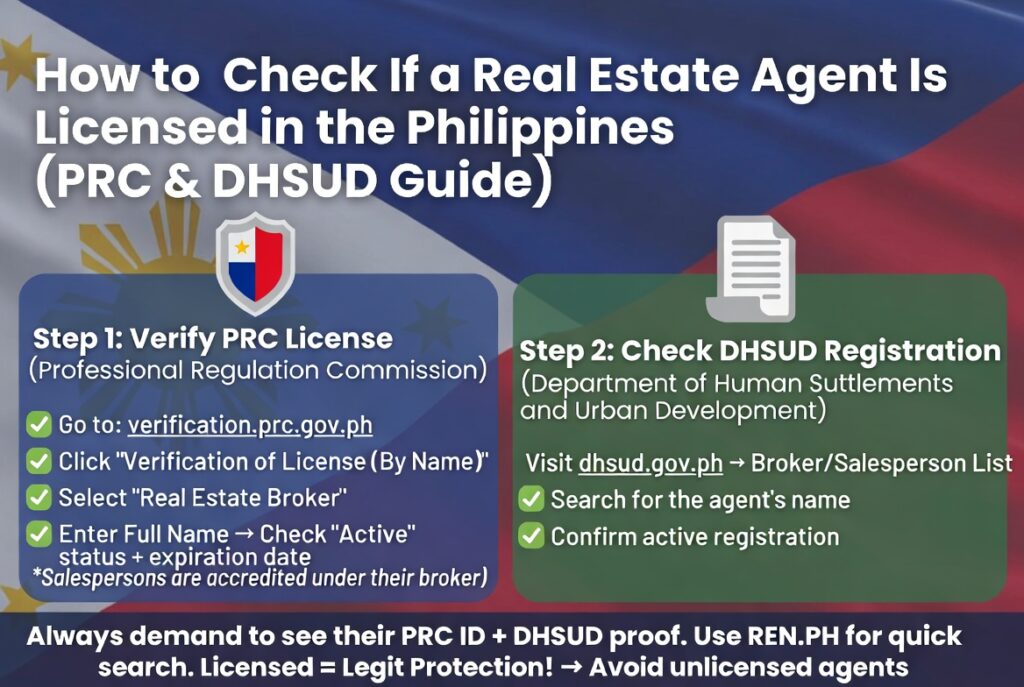
                • How to Check If a Real Estate Agent Is Licensed in the Philippines (PRC & DSHUD Guide) – SeekCebu

                  How to Check If a Real Estate Agent Is Licensed in the Philippines

                  It’s a hard truth that many Filipinos, especially OFWs, only discover a real estate agent‘s lack of license after losing their hard-earned savings. A single transaction with an unlicensed “colorum” agent can lead to financial ruin and zero legal protection. This guide shows you exactly how to protect yourself by verifying credentials through the PRC and DHSUD in 2026.


                  ⚡ At-a-Glance: The 5-Minute Verification Checklist

                  Before paying a single peso for any property, run this checklist on every agent you meet:

                  #1
                  Action: Ask for their PRC license number (for brokers) or PRC accreditation number (for salespersons)
                  Where to Check: Agent must provide

                  #2
                  Action: Verify online via PRC Verification Portal
                  Where to Check: verification.prc.gov.ph

                  #3
                  Action: Check license status: ACTIVE (not expired/suspended)
                  Where to Check: PRC portal

                  #4
                  Action: Ask for their DHSUD Certificate of Registration
                  Where to Check: Agent must provide

                  #5
                  Action: Verify registration with DHSUD Regional Office
                  Where to Check: DHSUD Central Visayas: (032) 412-3521

                  #6
                  Action: Ask which licensed broker they are affiliated with (for salespersons)
                  Where to Check: Agent must provide broker’s name & PRC license

                  #7
                  Action: Verify the supervising broker’s license
                  Where to Check: PRC portal

                  #8
                  Action: Get everything in writing before paying
                  Where to Check: N/A

                  Let’s break down each step in detail—because skipping any of them could cost you everything.


                  👥 First, Understand Who You’re Dealing With

                  The first step in protecting yourself is understanding the difference between a Real Estate Broker and a Real Estate Salesperson (Agent). Many people use these terms interchangeably, but under Republic Act No. 9646 (Real Estate Service Act or RESA) , they have distinct roles, requirements, and legal authorities.

                  Real Estate Broker vs. Salesperson: Key Differences

                  PRC Exam Required?
                  Real Estate Broker: ✅ YES. Must pass REBLE (Real Estate Brokers Licensure Examination)
                  Real Estate Salesperson (Agent): ❌ NO. No PRC exam required

                  Minimum Education
                  Real Estate Broker: BS in Real Estate Management (4-year degree)
                  Real Estate Salesperson (Agent): At least 2 years of college + 12-hour training

                  Can Operate Independently?
                  Real Estate Broker: ✅ YES. Licensed to run own real estate business
                  Real Estate Salesperson (Agent): ❌ NO. Must work under a licensed broker

                  Can Sign Contracts & Close Deals?
                  Real Estate Broker: ✅ YES
                  Real Estate Salesperson (Agent): ❌ NO. Cannot sign legal documents independently

                  DHSUD Registration Fee
                  Real Estate Broker: ₱720.00 (renewal) + ₱5,000 bond
                  Real Estate Salesperson (Agent): ₱288.00 (renewal) + ₱1,000 bond

                  ⚠️ Critical Warning: A real estate salesperson cannot legally operate a real estate service independently, sign contracts, or offer services without PRC accreditation and DHSUD registration. Anyone doing so is engaging in illegal practice under Philippine law.

                  Here is the official definition of a real estate salesperson under RA 9646:

                  A real estate salesperson is a duly accredited natural person who performs service for, and in behalf of, a real estate broker who is registered and licensed by the Professional Regulatory Board of Real Estate Service for or in expectation of a share in the commission, professional fee, compensation or other valuable consideration.


                  🛡️ Why This Matters: The Real Cost of Unlicensed Agents

                  Dealing with an unlicensed agent is not a harmless shortcut. It is a direct violation of Philippine law that carries both financial risks and potential criminal liability for the agent.

                  Financial & Legal Risks for Buyers

                  Risk: No Legal Accountability
                  What Could Happen: Licensed brokers answer to PRC and can be sanctioned. Unlicensed individuals do not

                  Risk: Scams & Double-Selling
                  What Could Happen: Unlicensed agents are a primary vehicle for property fraud

                  Risk: Invalid Transactions
                  What Could Happen: The entire sale may be legally questionable, leaving you without ownership rights

                  Risk: Misrepresentation
                  What Could Happen: No training means higher risk of false property details, title issues, or undisclosed problems

                  Risk: Unauthorized Fee Collection
                  What Could Happen: “Agents” may collect reservation fees with no legal authority and disappear with your money

                  Penalties for Unlicensed Practice (For Your Awareness)

                  If you encounter an unlicensed agent, understand that they are violating the law and can face serious consequences. Mahipus noted that penalties for unauthorized practice can range from a minimum fine of ₱5,000 to possible imprisonment, even for first-time offenders. Other sources indicate fines can reach ₱100,000 or imprisonment of not less than two years, or both.

                  Real-Life Case Example

                  In March 2026, the NBI arrested a woman in Koronadal City for engaging in real estate scams. She was charged with violations of RA 9646 (Real Estate Service Act) , PD 957, and estafa. Verification with PRC showed she was not a licensed real estate practitioner. The property was being marketed without the required authority from DHSUD. The NBI Director urged the public: “Always verify the legitimacy of brokers, agents, and supporting documents through the proper government agencies before entering into any transaction”.

                  This is not a theoretical risk. It happens.


                  📝 Step-by-Step: How to Verify a Real Estate Professional in 2026

                  Step 1: Ask for Their PRC License/Accreditation Number

                  The first step is the simplest: ask directly.

                  • For a Broker: Ask for their PRC license number.
                  • For a Salesperson (Agent) : Ask for their PRC accreditation number and the name of the licensed broker they are affiliated with.

                  If they cannot or will not provide it, consider that a major red flag.

                  Step 2: Visit the PRC Official Verification Website

                  The PRC provides a free, public, and official online verification system.

                  🔗 Direct link: https://verification.prc.gov.ph/

                  Step 3: Enter the Required Information

                  You have two options:


                  Option: Verification by Name
                  Instructions: Enter the full name of the professional

                  Option: Verification by License Number
                  Instructions: Enter the PRC ID or license number

                  Then, select “Real Estate Broker” from the list of professions (even if verifying a salesperson, their accreditation falls under the same framework).

                  Step 4: Click Verify and Check the License Status

                  The system will display the professional’s details. Carefully check the license status:

                  • ACTIVE – Valid. Proceed with additional verification.
                  • ⚠️ EXPIRED – Invalid. Do not transact.
                  • 🚫 SUSPENDED/REVOKED – Invalid. Do not transact.

                  Step 5: Contact PRC Directly If Anything Is Unclear

                  If the information on the PRC website is unclear or you have any concerns, you can contact the PRC directly: (02) 735-6244 or (02) 735-6245.


                  📋 The DHSUD Requirement: The Second Layer of Verification

                  Many buyers stop at PRC verification. That is a mistake.

                  Under PD 957, an additional requirement of registration with the DHSUD for all licensed brokers and accredited salespersons is imposed before engaging in advertising and selling subdivision houses and lots or condominium units.

                  In short: A licensed real estate professional must also be registered with DHSUD to legally sell housing projects.

                  How to Verify DHSUD Registration in Cebu

                  1. Ask the agent or broker for their DHSUD Certificate of Registration.
                  2. Contact the DHSUD Central Visayas Regional Office to cross-check:
                  • Address: 3rd Floor, J.G. Arcade Building, Legaspi Street, Brgy. Kamputhaw, Cebu City
                  • Tel: (032) 412-3521
                  1. If they cannot produce a valid DHSUD registration, they are not legally authorized to sell subdivision or condominium units.

                  ⚠️ Remember: A DHSUD Certificate of Registration for the agent/broker is different from a DHSUD License to Sell (LTS) for the property project. Both are required in a legitimate transaction. You should ask for and verify both.


                  🚩 Red Flags: How to Spot an Unlicensed Agent Without Even Verifying

                  Before you even open the PRC website, watch for these behavioral red flags:

                  Red Flag: Rushes you to pay a reservation fee
                  What It Means: Classic pressure tactic to get money before you verify

                  Red Flag: Cannot produce a PRC license number when asked
                  What It Means: Likely unlicensed

                  Red Flag: Claims to be a “broker” but cannot name their supervising broker
                  What It Means: Misrepresenting themselves

                  Red Flag: Works independently without mentioning any brokerage firm
                  What It Means: Salespersons must be affiliated with a licensed broker

                  Red Flag: Requests payment in cash or to a personal bank account
                  What It Means: No accountability or paper trail

                  Red Flag: Cannot or will not provide the DHSUD License to Sell for the property
                  What It Means: Project may be illegal or non-existent

                  Red Flag: Only communicates via Facebook Messenger with no physical office
                  What It Means: High risk—scammers often operate exclusively online

                  Red Flag: Offers a “too good to be true” discount
                  What It Means: Classic scammer bait

                  💰 OFW Section: Why You Are a Primary Target

                  Overseas Filipino Workers are prime targets for unlicensed real estate scammers. Here’s why—and how to protect yourself.

                  Why OFWs Are Targeted

                  Reason: Distance from the market
                  Explanation: Cannot easily visit the property or verify documents in person

                  Reason: Emotional motivation
                  Explanation: Strong desire to own a home in the Philippines and provide for family

                  Reason: Limited local market knowledge
                  Explanation: May not know fair market prices or standard procedures

                  Reason: Trust in fellow Filipinos
                  Explanation: Scammers exploit this by appearing professional and trustworthy

                  Reason: High demand for property
                  Explanation: Creates opportunities for unscrupulous individuals

                  OFW-Specific Verification Steps

                  If you are buying from abroad, follow these additional safeguards:

                  1. Never pay a reservation fee without verifying the agent’s PRC license online. You can do this from anywhere in the world via the PRC portal.
                  2. Ask for a video call where the agent shows you their PRC ID and DHSUD certificate. Do not accept photos—they can be doctored.
                  3. Require all documents to be emailed to you before any payment. Legitimate agents will comply.
                  4. Ask a trusted relative or friend in Cebu to meet the agent in person at their physical office before you send any money.
                  5. Use escrow or bank-to-bank transfers when possible. Avoid cash, remittance centers to personal accounts, or cryptocurrency payments.

                  📌 One OFW’s nightmare: Some OFWs think they are buying a legal property, only to later discover that the title is fake and they have no legal claim to the land. This can be devastating, as the OFW loses their entire investment and has no recourse.

                  Sample Script for OFWs to Ask an Agent via Messenger/Email

                  “Hi. Before I send any payment, please send me the following:

                  1. Your full name and PRC license number (for broker) or PRC accreditation number (for agent).
                  2. The name and PRC license number of the supervising broker (if you are an agent).
                  3. Your DHSUD Certificate of Registration.
                  4. The DHSUD License to Sell number for the property.

                  I will verify these online before proceeding. Thank you for your understanding.”

                  A legitimate professional will provide these without hesitation. An unlicensed one will make excuses or disappear.


                  🛠️ What to Do If You’ve Already Been Scammed

                  If you discover that you have already transacted with an unlicensed agent and suspect fraud, here is your recourse:

                  1. Gather all evidence – receipts, bank transfer records, screenshots of conversations, the agent’s name and contact information.
                  2. File a complaint with the NBI – The NBI has successfully arrested unlicensed practitioners for violations of RA 9646 and estafa.
                  3. File a complaint with HSAC (Human Settlements Adjudication Commission) for housing-related disputes.
                  4. Consult a lawyer – Especially if large sums of money are involved. The earlier you act, the higher the chance of recovery.

                  ✅ Conclusion: Your Safety Net in Two Verifications

                  The entire process of verifying a real estate agent boils down to two government checks:

                  PRC Verification
                  What to Verify: PRC license number (broker) or PRC accreditation number (salesperson)
                  Where: verification.prc.gov.ph

                  DHSUD Verification
                  What to Verify: DHSUD Certificate of Registration
                  Where: DHSUD Central Visayas Regional Office: (032) 412-3521

                  These checks take less than five minutes total. The cost is zero. The protection is priceless.

                  The bottom line: Never, ever hand over a single peso to anyone claiming to be a real estate professional without first seeing their verified PRC and DHSUD credentials. If they are legitimate, they will be proud to show them. If they hesitate, walk away. Your hard-earned money—and your dream of owning property in Cebu—depends on it.


                  Disclaimer: This article is for informational purposes only and does not constitute legal advice. Laws and regulations may change, and each case is unique. For specific legal concerns, consult a licensed attorney.


                  Related reads on SeekCebu:

                  Contact Us

                    Author
                    John Paul Ybañez Paquibot
                    Licensed Real Estate Broker | PRC No. 00014132 | DHSUD No. CVRFO-B-03/18-2672
                    Bachelors Realty and Brokerage, Inc. Cebu
                    G/F Cap Building, Brgy. Corner, Osmeña Blvd.
                    Arlington Pond St. Extension, Cebu City, 6000 Cebu
                  • Buying a Preselling Condo in Cebu: A Checklist to Avoid Delays and Hidden Risks (2026 Edition) – SeekCebu

                    Buying a Preselling Condo in Cebu

                    Buying a pre-selling condo in Cebu can be a smart move—lower entry prices, flexible payment terms, and potential appreciation. But without rigorous due diligence, you could face years of delays, surprise fees, or even a completely abandoned project.

                    This guide gives you a practical, Cebu-focused checklist to protect your hard-earned money. Use it before you pay a single peso.


                    📋 At-a-Glance: The 10-Step Buyer’s Checklist

                    #1 Action: Verify DHSUD License to Sell (LTS)
                    Why It Matters: Prevents buying into illegal or “ghost” projects.

                    #2 Action: Research developer’s track record
                    Why It Matters: Ensures they actually finish what they sell.

                    #3 Action: Physically visit the site
                    Why It Matters: Confirms location, flood risk, and real progress.

                    #4 Action: Budget 5–10% extra for hidden turnover fees
                    Why It Matters: Avoids nasty surprises at move-in.

                    #5 Action: Assume 6–12 months of delay
                    Why It Matters: Sets realistic expectations—be happy if it’s on time.

                    #6 Action: Review the Contract to Sell (CTS) carefully
                    Why It Matters: Protects your legal rights and specs.

                    #7 Action: Check penalty clauses for developer delays
                    Why It Matters: You deserve compensation if they’re late.

                    #8 Action: Secure bank or Pag-IBIG pre-approval
                    Why It Matters: Know your borrowing power before reserving.

                    #9 Action: Confirm the project’s loan tie-ups
                    Why It Matters: Ensures your chosen lender will finance it.

                    #10 Action: Keep a complete paper trail
                    Why It Matters: Essential for any future dispute or refund claim.

                    Now let’s dive into the details—because the fine print is where most buyers get burned.


                    Step 1: Do Your Homework Before You Even Visit a Showroom

                    Trust us—this step saves the most heartache.

                    🔍 Verify the DHSUD License to Sell (LTS)

                    The most critical step: confirm the developer has a valid License to Sell (LTS) from the Department of Human Settlements and Urban Development (DHSUD). Selling a property without an LTS is illegal.

                    How to verify in Cebu:

                    • Ask the developer or agent for the LTS number.
                    • Contact the DHSUD Central Visayas Regional Office directly to cross-check:
                      3rd Floor, J.G. Arcade Building, Legaspi Street, Brgy. Kamputhaw, Cebu City
                      Tel: (032) 412-3521
                    • If the LTS cannot be produced or verified, walk away immediately.

                    ⚠️ Why this matters: If a developer sells without an LTS and later abandons the project, your chances of a refund plummet—and the developer can face criminal liability.

                    👷 Check the Developer’s Track Record—Including Cebu’s Problem Developers

                    A glossy brochure means nothing without a track record.

                    Ask these questions:

                    • How many projects has this developer completed in Cebu?
                    • What was their average turnover delay in past projects?
                    • Can they provide references of past buyers you can actually call?
                    • Are they a major player like Cebu Landmasters (CLI) (₱3.1B net income in 2025) or a one-project startup?

                    ⚠️ Cebu red flag alert (2026):
                    The DHSUD-7 has confirmed a rising number of cases involving non-compliant developers in Cebu. Below are real examples that made news this year:


                    Developer: Azzela Properties
                    Issue Summary: Failed to deliver units in Minglanilla despite years of payments; buyers visited site to find no construction. NBI investigation ongoing as of March 2026.

                    Developer: Tumabini Land Development Corp.
                    Issue Summary: Alleged illegal selling, bouncing checks, syndicated estafa in Carcar City, Consolacion, and Cebu City. Developer allegedly had no License to Sell.

                    🧠 Takeaway: If a developer’s name appears in complaints, don’t rationalize it. Just walk.

                    🏗️ Visit the Site—Yes, Even Before Groundbreaking

                    Never rely solely on artist’s renderings or a fancy showroom.

                    Go to the actual location and check:

                    • Is the land surveyed, fenced, and cleared?
                    • Are there construction materials or equipment on site?
                    • Can you talk to residents of nearby buildings about flooding, traffic, or noise?
                    • Does the neighborhood match the developer’s promises?

                    Step 2: Master the Financials Before You Sign

                    The price tag on the brochure is never the final number.

                    💰 Understand the Total Contract Price—Including Hidden Fees

                    Pre-selling discounts of 5–15% sound great, but separate contract price from actual cash out.

                    Common hidden costs you’ll pay at turnover:

                    Creditable Withholding Tax (CWT)
                    Estimated Rate: 1.5% of selling price/zonal value (whichever higher)
                    Who Pays: Buyer

                    Documentary Stamp Tax (DST)
                    Estimated Rate: ₱15 per ₱1,000 of property value
                    Who Pays: Buyer

                    Transfer Tax
                    Estimated Rate: 0.5% to 0.75% of selling price (depends on LGU)
                    Who Pays: Buyer

                    Registration/Notarial Fees
                    Estimated Rate: Variable
                    Who Pays: Buyer

                    Turnover/Taxes Fees & Expenses
                    Estimated Rate: Some developers charge ~6% of TCP for “TTFE”
                    Who Pays: Buyer ⚠️

                    Example: A ₱3,000,000 studio can easily add ₱60,000–₱180,000+ in mandatory taxes and fees at turnover.

                    📌 New 2026 concern: BIR’s RMC 31-2025 broadly includes transfer fees, processing fees, and miscellaneous fees in the definition of “taxable income.” Make your broker spell out which fees are VAT-inclusive before you sign.

                    📉 Factor in a 6–12 Month Delay (At Minimum)

                    Here’s the brutal truth: delays are the norm, not the exception.

                    Industry insiders recommend factoring in at least 6 months to a year of potential delay beyond the stated turnover date. Be pleasantly surprised if it arrives on time, not crushed if it doesn’t.

                    📊 Budget for the “Hidden Monthly Costs” After Turnover

                    Your monthly amortization is only part of the story. After you move in, you’ll pay:

                    • Association dues – Typically ₱50–100 per square meter in Cebu
                    • Real property tax – Annual, based on assessed value
                    • Insurance – Fire and mortgage redemption
                    • Utilities connection fees – Electricity, water, internet

                    Step 3: Review the Contract Like a Forensic Accountant

                    Never, ever sign a Contract to Sell (CTS) without a thorough review.

                    📝 The Non-Negotiable Clauses You Must Check

                    Turnover date
                    What to Look For: Must be an absolute date (e.g., “on or before December 31, 2027”) – no “estimated” or “targeted” language

                    Delay penalties
                    What to Look For: What compensation does the developer owe you for each month of delay?

                    Force majeure definition
                    What to Look For: Limited to truly unforeseeable events (natural disasters, not “permit delays”)

                    Refund terms
                    What to Look For: Under PD 957, you can cancel and demand a full refund + legal interest if the developer fails to deliver. Does your contract say that?

                    Unit specifications
                    What to Look For: Detailed floor plan, finishes, appliances, and common area amenities – no vague language

                    Non-waiver of rights
                    What to Look For: Any clause making you waive your right to file a complaint is legally void

                    🚨 Red Flags That Should Make You Walk Away

                    • The agent rushes you to sign without a lawyer.
                    • The contract contains an unfair or unconscionable clause that strips your rights under PD 957.
                    • No penalty clause for developer delays.
                    • No breakdown of hidden turnover fees.
                    • The turnover date is “estimated” or “targeted” rather than fixed.

                    Step 4: Secure Your Financing—In Writing

                    Don’t assume you’ll qualify for a loan when the time comes.

                    🏦 Pre-Approval vs. Reservation

                    Bank Financing:

                    • Secure pre-approval from a bank before paying a reservation fee. It’s free and gives you confidence.
                    • Typical pre-selling loans require 10-20% down payment (equity) paid over 1-3 years, with the remaining 80-90% financed via bank loan at turnover.

                    Pag-IBIG Financing:

                    • Must be an active member with at least 24 months of savings (not necessarily consecutive).
                    • Lower interest rates, but lower maximum loan amounts – better for units under ₱3-5 million.

                    ✍️ Put the Financing Terms in Writing

                    Before signing, confirm with the developer:

                    • Is the project Pag-IBIG accredited? If not, Pag-IBIG financing won’t be an option.
                    • Which banks have approved the project for financing?
                    • Will the developer assist with loan take-out paperwork?

                    Step 5: Monitor the Construction—Don’t Be a Passive Buyer

                    You’ve signed and paid. Now the real vigilance begins.

                    👀 Monthly Drive-By Checks

                    Visit the construction site monthly and document:

                    • Take photos and videos from the same angle each visit.
                    • Keep a log of worker activity (none? minimal? full crew?).
                    • Look for permit postings (building permit, occupancy permit).

                    📧 Request Written Progress Updates

                    Ask the developer for quarterly construction progress reports in writing. If they can’t or won’t provide them, that’s a red flag.

                    📞 Build a Relationship with Your Agent

                    A good agent will fight for you. Check in regularly and ask hard questions:

                    • “What percentage of construction is complete?”
                    • “What permits are still pending with the local government?”
                    • “Have there been any change orders affecting unit layouts?”

                    Step 6: Know Your Legal Recourse Before You Need It

                    Hope for the best, but prepare for the worst.

                    🛡️ Your Rights Under Philippine Law

                    You have significant legal protections under Presidential Decree 957 and the Maceda Law (RA 6552):

                    • Right to cancel and claim a full refund if the developer fails to deliver within the prescribed period.
                    • Right to suspend payments after giving written notice for delays.
                    • Right to file a complaint with HSAC (Human Settlements Adjudication Commission).
                    • Right to recover payments plus legal interest if the developer’s License to Sell was invalid.

                    📂 How to File a Complaint in Cebu

                    If the developer misses deadlines or stops communicating:

                    1. Send a formal demand letter to the developer via registered mail (keep proof).
                    2. File a complaint with the DHSUD Regional Office for mediation:
                      DHSUD Central Visayas, 3rd Floor, J.G. Arcade Building, Legaspi St., Cebu City
                    3. If unresolved, escalate to the HSAC Regional Adjudication Branch (RAB) VII in Cebu City. HSAC has jurisdiction over refund claims and disputes.

                    💡 Tip: Keep all receipts, contracts, and email correspondence organized from day one. You’ll need them if you ever go to HSAC.


                    📈 The 2026 Cebu Market Reality Check

                    To make an informed decision, you need context.

                    • As of end 2025, Cebu’s condominium stock reached 92,300 units – the largest supply outside Metro Manila.
                    • Total supply is projected to reach 109,000 units by end 2029 (substantial completions from 2026–2029).
                    • Despite this, Cebu sustained strong demand in early 2026 with an 87% condominium take-up rate in Q1.

                    What this means for you:
                    More supply means more choices – but also more variance in developer quality. A preselling unit in a prime Cebu City or Mactan location with a reputable developer can still be a great investment. A project in a questionable location with an unknown developer is a gamble you may not want to take.

                    ⚠️ Hidden 2026 risk: DHSUD’s LTS approval bottleneck has quietly become a major risk for preselling projects. Even honest developers can face delays because the government itself is slow to issue licenses. Ask if the developer already has their LTS – not just “applied for.”


                    ✅ Final Printable Checklist

                    Print this page and check off each item before you hand over a single peso:

                    #1
                    Action: Verified DHSUD License to Sell with regional office
                    ✓: ☐

                    #2
                    Action: Researched developer track record – talked to past buyers
                    ✓: ☐

                    #3
                    Action: Physically visited the site – not just showroom
                    ✓: ☐

                    #4
                    Action: Budgeted for hidden turnover fees (5-10% extra minimum)
                    ✓: ☐

                    #5
                    Action: Factored in 6-12 months of delay into your timeline
                    ✓: ☐

                    #6
                    Action: Reviewed the entire Contract to Sell – preferably with a lawyer
                    ✓: ☐

                    #7
                    Action: Confirmed exact penalty clause for developer delays
                    ✓: ☐

                    #8
                    Action: Secured bank or Pag-IBIG pre-approval before reservation
                    ✓: ☐

                    #9
                    Action: Confirmed developer’s loan tie-ups (banks/Pag-IBIG)
                    ✓: ☐

                    #10
                    Action: Photographed every document, receipt, and email – organized a paper trail
                    ✓: ☐


                    🧭 Bottom Line

                    A preselling condo can be a smart investment in Cebu’s growing market – but only if you go in with your eyes wide open. The discounts can be compelling, but the risks of delays, hidden fees, and even unscrupulous developers are very real.

                    The golden rule: Never fall for a “too good to be true” deal. If the price is dramatically lower than comparable projects, ask yourself why. And always, always verify the DHSUD License to Sell before you hand over your reservation fee.


                    Disclaimer: This article is for informational purposes only and does not constitute legal advice. Laws and regulations may change, and each case is unique. For specific legal concerns, consult a licensed attorney.


                    Related reads on SeekCebu:


                    Contact Us

                      Author
                      John Paul Ybañez Paquibot
                      Licensed Real Estate Broker | PRC No. 00014132 | DHSUD No. CVRFO-B-03/18-2672
                      Bachelors Realty and Brokerage, Inc. Cebu
                      G/F Cap Building, Brgy. Corner, Osmeña Blvd.
                      Arlington Pond St. Extension, Cebu City, 6000 Cebu
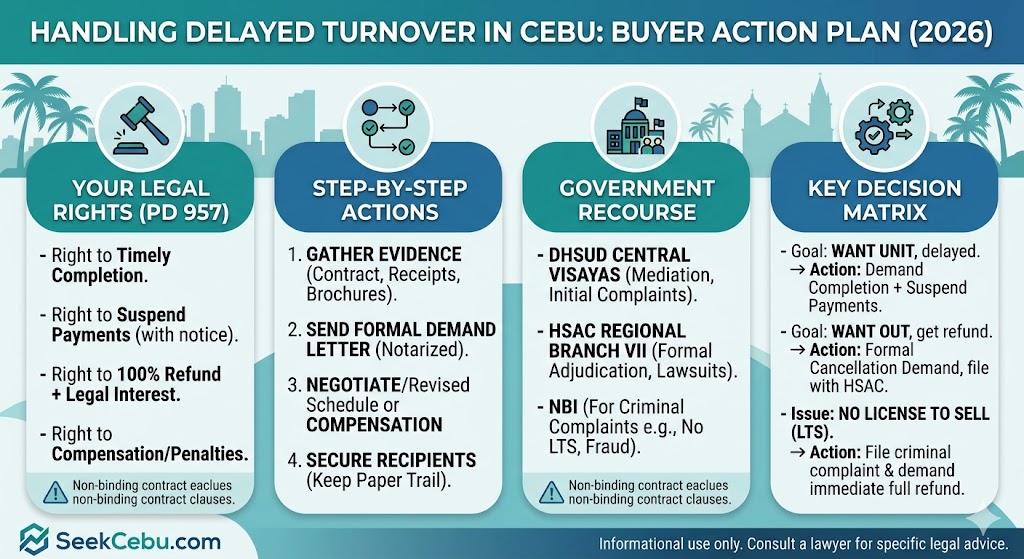
                    • How to Handle a Delayed Turnover in Cebu: A Step-by-Step Guide for Buyers (2026) – SeekCebu

                      How to Handle a Delayed Turnover in Cebu

                      Delayed turnover is frustrating. You may have been paying monthly amortizations for years—sometimes as much as P1 million or more—only to find your unit nowhere near completion.

                      This guide provides a practical, legal roadmap for buyers facing project delays in Cebu, covering your rights, step-by-step actions, and recourse through the Department of Human Settlements and Urban Development (DHSUD) and Human Settlements Adjudication Commission (HSAC).

                      Your Rights Under the Law

                      First, understand that you are protected. Philippine law provides a “protective mantle” over buyers in preselling agreements. Your key rights when facing delays include:

                      • Right to timely turnover. The completion date on your contract is a demandable obligation. Developers cannot unilaterally extend it without DHSUD approval and notifying you.
                      • Right to suspend payments. If the developer fails to complete the project within the prescribed timeframe, you may suspend amortization payments after giving due notice. Under PD 957, no installment payment shall be forfeited in your favor in this scenario.
                      • Right to cancel and obtain a full refund. At your option, you can demand cancellation of the contract and reimbursement of all payments you have made, including amortization interest (excluding delinquency interest), plus legal interest.
                      • Right to compensation for delay. You may be entitled to penalties as stipulated in your contract or other forms of compensation.
                      • Right to file a complaint. You may file a case with HSAC to compel the developer to perform, deliver the unit, or cancel the contract and recover your payments.
                      • Right to legal recourse if the developer has no License to Sell (LTS). Developers cannot legally sell preselling lots or units without an LTS from DHSUD. If a developer sold you a unit without one, you may have strong grounds for refund and possibly criminal liability on their part.

                      ⚠️ Caution: Any contract provision that requires you to waive your right to file a complaint or allows the developer to delay turnover at its own discretion has no legal validity.

                      Step-by-Step Action Plan for Delayed Turnover

                      Step 1: Review Your Contract and Gather Evidence

                      Your Contract to Sell (CTS) is your most important document. You will need to locate:

                      • The turnover date – Look for an absolute date (e.g., “to be delivered on or before Dec. 31, 2025”).
                      • Penalty clauses – What penalties does the contract impose on the developer for failing to meet the deadline?
                      • Force majeure provisions – Be aware that only events entirely outside the developer’s control (not just “permits taking longer”) typically excuse delays.

                      📁 Documents to compile now (both to send to the developer and as evidence for a potential complaint):

                      • Copy of the Contract to Sell (CTS).
                      • Official receipts of all payments (reservation fee, equity, monthly amortizations).
                      • Developer’s brochure, advertisements, or email promises showing the project timeline.
                      • Screenshots or printed copies of all email and chat communications with the developer about the delay.
                      • Photos or videos of the project site showing the lack of development (if safe to visit).

                      Step 2: Send a Formal Written Notice

                      Before anything else, you must send a written demand letter to the developer. This establishes your position and creates a paper trail.

                      What to include:

                      1. Your full name and contact details.
                      2. The project name, unit number, and contract details.
                      3. The original promised turnover date.
                      4. The current status (delayed).
                      5. A clear demand: either deliver the unit by a reasonable new deadline or provide a written explanation.
                      6. A warning that you may exercise your legal rights to suspend payments or cancel the contract if no satisfactory response is received.

                      How to send:

                      • Physical letter: Have the letter notarized and send it via registered mail or personal delivery with acknowledgment receipt.
                      • Email: Follow up with a PDF copy to the developer’s official email address.
                      • Keep proof: Keep your postal receipt, acknowledgment slip, and screenshot of the email.

                      Step 3: Negotiate a Revised Turnover Schedule

                      Many developers will respond by offering a new estimated completion date. If you are willing to wait, try to secure:

                      • A written revised turnover schedule signed by an authorized company representative.
                      • Compensation for the delay (e.g., waiver of association dues for a certain period, assistance with moving costs).
                      • Regular construction updates (monthly or quarterly) via email.

                      👉 Tip: If you want to stay in the project, you can consider asking for a binding revised turnover commitment in writing, with clear penalties for further delay.

                      Step 4: Suspend Amortization Payments (If You Choose to Stay)

                      If you have given proper notice and the developer still fails to deliver, PD 957 entitles you to suspend further payments. This is an effective way to stop the financial drain while waiting.

                      Important guidelines:

                      • Do not simply stop paying without notice. You must first issue a written notice of your intent to suspend payments.
                      • Keep a copy of that notice and proof of delivery.
                      • Prepare for possible collection letters. The developer may still send demand letters; respond by referencing your suspension rights under PD 957.
                      • Seek formal recognition. If the developer disputes your right to suspend, you can file a complaint with DHSUD to have your suspension formally recognized.

                      Step 5: Seek Assistance from the DHSUD Regional Office

                      If negotiations fail or the developer remains unresponsive, the first government channel is the DHSUD Regional Office where your project is located. For Cebu-based projects, this is:

                      DHSUD Central Visayas Regional Office
                      3rd Floor, J.G. Arcade Building, Legaspi Street, Brgy. Kamputhaw, Cebu City
                      Contact: (032) 412-3521

                      What happens when you file?

                      • DHSUD will attempt mediation or conciliation between you and the developer to enforce your rights and the developer’s obligations.
                      • If unresolved, you may escalate the matter to HSAC.

                      Step 6: File a Formal Complaint with HSAC

                      If mediation fails or the delay is egregious (e.g., no construction at all or developer has no License to Sell), you can file a verified complaint before the Human Settlements Adjudication Commission (HSAC), the quasi-judicial body that resolves housing disputes.

                      📋 Filing steps:

                      1. Download the complaint form from the official HSAC website (hsac.gov.ph).
                      2. Prepare a verified complaint explaining the facts, attaching all your evidence (contract, receipts, demand letters, etc.).
                      3. Pay the required legal fees.
                      4. File the complaint with the HSAC Regional Adjudication Branch that has jurisdiction over the region where the project is located. For Cebu projects, the appropriate RAB would be HSAC RAB VII in Cebu City.
                      5. The developer will be served a copy of your complaint and required to file an answer.

                      📍 Filing Venues in Cebu & Nearby

                      DHSUD Central Visayas Regional Office
                      Address: 3rd Flr., J.G. Arcade Bldg., Legaspi St., Brgy. Kamputhaw, Cebu City
                      Purpose: Initial mediation, enforcement of buyer rights

                      HSAC RAB VII – Cebu City
                      Address: (Coordinate with DHSUD Central Visayas or check HSAC website for exact address)
                      Purpose: Formal adjudication of disputes, complaints against developers

                      HSAC Caraga Office (For reference)
                      Address: Arellano Real Estate Lessor Bldg., P-2, Brgy. Doongan, Butuan City
                      Purpose: Example only – not for Cebu cases

                      National Bureau of Investigation (NBI) Cebu
                      Address: NBI Cebu District Office, Cebu City
                      Purpose: For possible criminal complaints (e.g., large-scale estafa, no LTS)

                      Step 7: Consider Legal Counsel

                      While you can file a complaint on your own, serious delays involving large amounts of money (especially over P500,000) may be worth consulting a lawyer. An attorney can:

                      • Review your contract and identify the strongest claims.
                      • Advise you on whether to pursue refund or specific performance (forcing the developer to finish the project).
                      • Represent you in HSAC proceedings or court.

                      💰 Cost-saving tip: Many law firms offer initial consultations for a fixed fee. The expense may be worth it if you have paid over P1 million and the developer is uncooperative.

                      ⚖️ Developer Watchlist: Are They Trustworthy?

                      Before investing, always verify the developer’s track record. Recent complaints in Cebu highlight that even developers with multiple projects can fail to deliver.

                      Azzela Properties
                      Issue Summary: Failed to deliver housing units in Minglanilla despite years of equity payments; delayed refunds; alleged fraudulent practices. Some buyers paid over P1 million and found no construction when they visited the site.
                      Latest Update: Ongoing NBI investigation as of March 2026. Developer promised to complete projects and refunds by early 2026.

                      Tumabini Land Development Corp.
                      Issue Summary: Alleged illegal selling, bouncing checks, and syndicated estafa involving townhouse projects in Carcar City, Consolacion, and Cebu City. Buyers discovered the developer allegedly had no License to Sell.
                      Latest Update: NBI reviewing contracts, receipts, and bank records for possible criminal charges as of February 2026.

                      ✅ Red Flags to Watch For in Any Developer:

                      • No visible construction progress despite years of equity payments.
                      • Promises of “quick turnover” that seem unrealistic (e.g., 3–5 months for a preselling project).
                      • Repeated extensions of deadlines (from February to May to June, etc.) without any actual progress.
                      • Refund offers that stop or shrink over time.
                      • Staff giving the same script about “once equity is completed” without concrete construction milestones.
                      • Inability to provide a valid DHSUD License to Sell (LTS).

                      🔍 Quick Check: How to Verify a Developer Before Buying


                      Step 1
                      Action: Ask for the DHSUD License to Sell (LTS) number and project registration details.

                      Step 2
                      Action: Verify the LTS directly with the DHSUD Central Visayas Regional Office.

                      Step 3
                      Action: Check the developer’s SEC registration and background.

                      Step 4
                      Action: Visit the project site to see if any actual construction is happening.

                      Step 5
                      Action: Talk to existing buyers in the developer’s past projects.

                      Step 6
                      Action: Search online for news articles or complaints (e.g., “Azzela Properties complaints” or “[Developer Name] scam”).

                      🧭 Summary Table: Your Options at a Glance

                      Your Goal: You want the unit, just delayed
                      Recommended Action: Send written demand → negotiate revised schedule → consider suspending payments → file with DHSUD if needed

                      Your Goal: You want out and a full refund
                      Recommended Action: Send written demand for cancellation → if ignored, file complaint with HSAC for refund + legal interest

                      Your Goal: You suspect fraud or no License to Sell
                      Recommended Action: File complaint with HSAC + consider filing a criminal complaint with the NBI for large-scale estafa

                      Your Goal: You have paid less than 2 years of installments
                      Recommended Action: You are entitled to a 60-day grace period before the developer can cancel the contract. The cash surrender value refund calculation may differ (50% of payments if under 2 years, potentially higher after 5 years under Maceda Law)

                      Your Goal: You have paid 2+ years of installments
                      Recommended Action: Stronger refund rights (50% of payments, plus 5% per year after 5 years, up to 90% total). You also have a grace period of one month for every year of payments (max one use every 5 years)

                      🛠️ Additional Resources

                      • PD 957 (Subdivision and Condominium Buyers’ Protective Decree) – The primary law protecting pre-selling buyers. Administrative fines for violations can reach up to PHP 10,000 for first offenses, with criminal penalties up to PHP 20,000 and imprisonment.
                      • Maceda Law (RA 6552) – Governs refund rights for installment buyers in case of cancellation.
                      • HSAC Official Websitehsac.gov.ph – Download complaint forms and check updates.

                      📝 Final Honest Advice

                      Delayed turnover is never easy, but you have more legal protection than many buyers realize. Preselling contracts are not just marketing materials—they are binding obligations, and developers who fail to deliver can face serious administrative, civil, and even criminal consequences.

                      Your best defense? Do your homework before you sign. Verify the License to Sell, visit the site, and check the developer’s track record. But if you are already in a delay situation, act promptly. The longer you wait, the harder it can be to recover your funds.

                      Disclaimer: This article is for informational purposes only and does not constitute legal advice. Laws and regulations may change, and each case is unique. For specific legal concerns, consult a licensed attorney.


                      If you’d like to learn how to spot reliable developers, check out our guide: Johndorf Ventures Review: Is This Cebuano Developer Worth Your Trust?

                      And if you’re weighing whether to file a formal complaint or just move on, our honest reality check on Airbnb vs Long-Term Rental ROI (2026) might help you decide if it’s worth pursuing or time to cut your losses.

                      Contact Us

                        Author
                        John Paul Ybañez Paquibot
                        Licensed Real Estate Broker | PRC No. 00014132 | DHSUD No. CVRFO-B-03/18-2672
                        Bachelors Realty and Brokerage, Inc. Cebu
                        G/F Cap Building, Brgy. Corner, Osmeña Blvd.
                        Arlington Pond St. Extension, Cebu City, 6000 Cebu