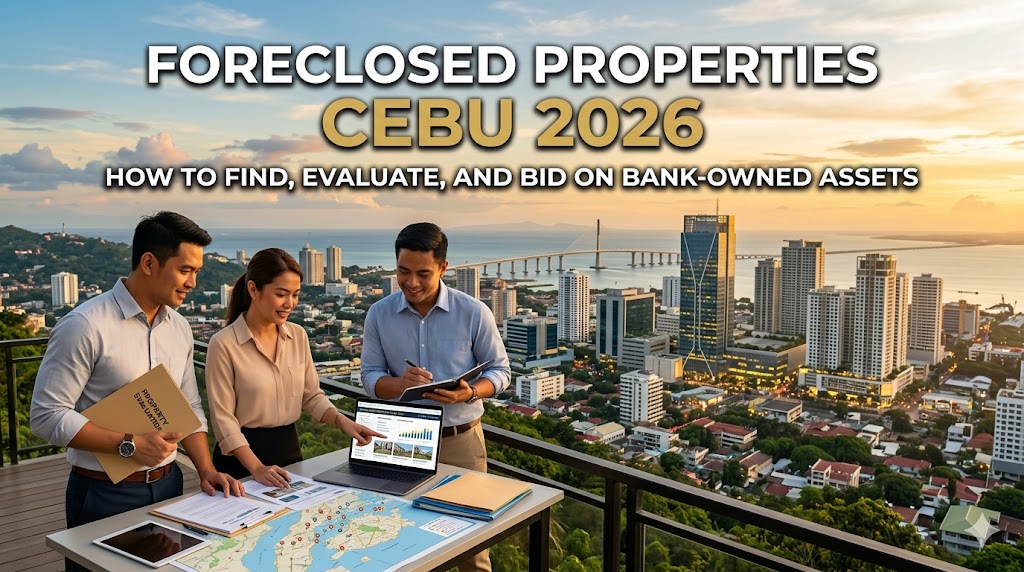
Buying a foreclosed property in Cebu can be a lucrative investment strategy—but it is not a shortcut to wealth. While these assets often come with significant discounts ranging from 20 to 50 percent below market value, they demand rigorous due diligence, patience, and a high tolerance for uncertainty.
This guide merges the sharp, scannable structure of a quick reference with the deep, actionable intelligence you need to actually protect your capital. It walks you through the entire process: where to find these properties, how to evaluate them, how the bidding works, and—most importantly—how to avoid the traps that swallow inexperienced buyers.
The Brutal Truth Upfront
Foreclosed properties are sold on an “as-is, where-is” basis. This means the seller makes no warranties about the property’s condition. If you discover a major structural defect, a hidden lien, or an illegal occupant after purchase, you have no legal recourse against the bank or government agency. The property is yours, problems and all.
The low price tag is compensation for these risks. In 2026, with Cebu’s real estate market becoming more selective and interest rates still elevated, the margin for error is thinner than ever. Success belongs to those who do their homework.
Where to Find Foreclosed Properties in Cebu
In 2026, you can locate foreclosed listings through the following primary channels.
Government Sources
Pag-IBIG Fund is the largest source of acquired assets in the country. Their inventory includes residential lots, townhouses, condominiums, and house-and-lot properties across Cebu. Pag-IBIG conducts public auctions through their Online Public Auction (OPA) portal, where you can bid remotely without visiting a physical office. Listings are updated regularly, and properties are categorized as “1st Public Auction” (newly listed, first time offered) or subsequent auctions (properties that didn’t sell previously). Bidding windows are typically short—for example, a Cebu property might accept bids from June 22 to June 26, 2026.
The Philippine Deposit Insurance Corporation (PDIC) sells properties acquired from closed banks. In 2026, PDIC has been actively disposing of assets through electronic bidding (e-bidding), with recent sales covering 44 properties across Visayas and Mindanao. Their online portal at assetsforsale.pdic.gov.ph allows prospective buyers to register, view the complete property catalogue, and submit bids from any location.
Other government agencies like the Social Security System (SSS) also sell foreclosed properties, typically through negotiated sale rather than public auction.
Private Banks
Major Philippine banks maintain regularly updated lists of their acquired assets—often called ROPA (Real and Other Properties Acquired). Banks like BDO, BPI, Metrobank, Security Bank, EastWest Bank, and Maybank all publish these lists on their websites.
In Cebu, recent bank listings include:
- Maybank foreclosed condominium units in Casa Mira Tower, Labangon
- EastWest Bank residential lots in Alta Vista Subdivision, Bulacao
- Metrobank properties with improvements in Midori Plains Subdivision, Minglanilla
Negotiated Sales
If a property does not sell at auction, banks often move it to a “negotiated sale” list. This can offer more flexibility in pricing and payment terms, as you are dealing directly with the bank rather than competing in a public auction.
Aggregator Platforms
Websites like ForeclosurePhilippines.com consolidate listings from multiple banks and government institutions, making it easier to search across sources in one place. Lamudi and other real estate portals also feature foreclosed property sections.
Evaluating a Foreclosed Property: The Due Diligence Checklist
This is where most inexperienced buyers lose money. A low price is meaningless if the property comes with hidden costs, legal entanglements, or structural nightmares. Do not skip a single step on this checklist.
Physical Inspection
Never buy a foreclosed property sight unseen. Listings provide basic information—price, lot size, floor area, and location—but they will not tell you if the roof is collapsing, if the plumbing is corroded, or if the property is located in a flood-prone area.
Schedule a visit as soon as possible. Good deals don’t stay available for long. During your inspection:
- Check for structural damage: cracks in walls, water stains on ceilings, sagging floors, signs of pest infestation. These may indicate underlying structural issues that will be expensive to repair.
- Test utilities: does the property have working electricity, water, and sewage connections? In Cebu’s competitive market, a “cheap” property is often inexpensive precisely because it lacks the utility connections required to live or build legally.
- Look for signs of neglect: foreclosed homes are often left vacant for months or years, leading to significant deterioration.
- Visit at different times of day to assess the neighborhood’s character, noise levels, security, and flood risk.
- Talk to neighbors if possible. They may know about problems the listing doesn’t mention—legal disputes, boundary issues, or informal settlers.
Occupancy Status
This is a potential deal-breaker. Is the property vacant or occupied?
If occupied, you are buying the structure but not necessarily the right to occupy it immediately. Evicting informal settlers or former owners can take months or years and cost a fortune in legal fees. Some listings explicitly state “occupied,” while others are vacant. Treat occupied properties with extreme caution unless you have the resources and patience for a lengthy legal eviction process.
Title and Legal Verification
This is the single most important step. A property might look perfect, but if the title is clouded, you are buying a lawsuit.
- Obtain a Certified True Copy of the title from the Registry of Deeds. This ensures the seller is the registered owner.
- Check for encumbrances: are there existing mortgages, liens, adverse claims, or court cases attached to the property? Some foreclosed properties have pending legal disputes, and you may inherit these issues.
- Confirm the property’s classification: is it residential, agricultural, or commercial? Zoning matters. Check local zoning ordinances to ensure the property is suitable for your intended use.
- Check for boundary issues: has the property been surveyed recently? Boundary disputes are common and expensive to resolve.
Unpaid Liabilities
You are responsible for all outstanding debts attached to the property. These can include:
- Real property taxes (back taxes can accumulate significantly over years of non-payment)
- Association dues (if in a subdivision or condominium, these can be substantial)
- Utility bills (electricity and water bills left unpaid by the previous owner)
- Other liens (mechanic’s liens, court-ordered judgments)
Get a full accounting of these liabilities before you bid. They can add tens of thousands of pesos to your total cost.
Hidden Costs
The purchase price is just the beginning. Factor in the full acquisition cost:
- Capital gains tax (typically 6 percent of the selling price or zonal value, whichever is higher)
- Documentary stamp tax
- Transfer tax and registration fees
- Real property taxes (current and back taxes)
- Association dues (if applicable)
- Repair and renovation costs (often substantial for neglected properties—budget 10 to 20 percent of the purchase price as a rule of thumb)
A property that looks like a bargain at 30 percent below market value can quickly become a money pit once these costs are added.
The Bidding and Purchase Process
The specific process varies depending on the seller. Here is how each works.
For Pag-IBIG Public Auction (OPA Portal)
- Browse listings on the Pag-IBIG OPA portal or their official website.
- Register on the OPA platform. Both individual buyers and companies can register.
- Select properties of interest and conduct your due diligence—inspection, title verification, cost assessment.
- Submit your bid during the specified acceptance period. Bids are submitted online. Bidding windows are typically short—for example, a Cebu property might accept bids from June 22 to June 26, 2026.
- Wait for the results. Pag-IBIG typically announces winning bidders after the bidding period closes.
- Complete the payment and transfer documents. If you win, you will need to pay the full amount within a specified period.
For PDIC E-Bidding
- Register on the PDIC portal at assetsforsale.pdic.gov.ph.
- Review the property catalogue, which includes detailed descriptions and bidding procedures.
- Submit your bid electronically during the scheduled e-bidding dates.
- Complete the purchase if your bid is successful.
For Bank ROPA (Negotiated Sale)
Banks typically sell their acquired assets through negotiated sale rather than public auction. This means you make an offer directly to the bank, and they accept or reject it. The process is more flexible but also less transparent—you won’t know if other buyers are offering more.
- Review the bank’s ROPA list on their website.
- Submit a formal “Offer to Buy” form. The bank will evaluate your offer.
- Negotiate price and terms if your offer is not immediately accepted.
- Complete the purchase if an agreement is reached.
The Real Risks: What the Brochures Don’t Tell You
Foreclosed properties are not for everyone. Here are the risks that get downplayed in marketing materials.
You are buying someone else’s problem. The previous owner defaulted for a reason—often because they could not afford the property. That same financial distress may have led to neglect, deferred maintenance, or even deliberate damage.
“As-is, where-is” means no recourse. If you discover a major structural defect after purchase, you cannot go back to the bank and ask for repairs or a refund. The property is yours, problems and all.
Eviction can be a nightmare. If the property is occupied, you are not just buying a house—you are buying a legal battle. Evicting occupants can take years and cost hundreds of thousands of pesos in legal fees.
Title issues can be buried. Some foreclosed properties have pending court cases, unclear documentation, or disputes over boundaries. These may not surface until after you have paid.
Low appraisal = low financing. Banks may appraise foreclosed properties at their purchase price, not their market value. This can limit your ability to get financing or refinance later.
Competition is real. Good deals attract multiple bidders. In a competitive auction, it is easy to get caught up and overbid. Know your maximum price before you start.
Who Should Buy Foreclosed Properties?
Foreclosed Properties Are Best Suited For:
- Experienced investors who have capital for repairs and the patience for legal processes.
- Buyers with cash who can avoid the delays and uncertainties of bank financing.
- Those with construction or renovation expertise who can accurately assess repair costs.
- People who can visit the property in person and conduct thorough inspections.
- Investors who understand the legal process of eviction and title transfer.
Foreclosed Properties Are NOT Ideal For:
- First-time buyers with limited capital and no renovation experience.
- Anyone who needs to move in immediately (occupied properties and repair delays will frustrate you).
- Buyers relying on 100 percent financing (banks are cautious about lending on foreclosed assets).
- Anyone unwilling to invest time in physical inspections and title verification.
- Emotional buyers who might overbid in a competitive auction.
The Smart Money Approach for 2026
If you are serious about buying a foreclosed property in Cebu this year, here is a realistic, disciplined strategy.
Start small. Consider a lot-only purchase or a smaller unit rather than a large, complex property. This limits your downside while you learn the process.
Build a team. Work with a licensed real estate broker who specializes in foreclosed properties. They have access to databases and can help you navigate the process. Also engage a lawyer for title verification and a contractor for inspection.
Secure financing pre-approval before bidding. Banks favor bidders who demonstrate clear financial capacity. If you are financing the purchase, have your pre-approval ready.
Be patient. The best deals don’t appear overnight. Monitor listings regularly—new properties are added weekly. Pag-IBIG’s 1st Public Auction listings, in particular, offer “first dibs” at properties that haven’t been passed over by other buyers.
Budget for repairs. Assume you will need to spend at least 10 to 20 percent of the purchase price on renovations. If you are wrong and the property is in better condition, that’s a pleasant surprise. If you are right, you are prepared.
Know your walk-away point. Set a maximum bid and a maximum repair budget before you start. Emotional bidding is how people overpay for problems. Stick to your numbers.
Document everything. Keep records of all communications, bids, and due diligence findings. This will protect you if disputes arise.
Final Verdict
Foreclosed properties in Cebu can be excellent investments—but they are not passive investments. They demand time, money, and a willingness to get your hands dirty. The 20 to 50 percent discount is real, but so are the risks: structural neglect, legal entanglements, occupied units, and hidden costs.
In 2026, with Cebu’s market becoming more discerning, the days of buying any foreclosed property and automatically making money are over. Success belongs to those who do their homework—who inspect the property, verify the title, check occupancy status, and budget realistically for repairs.
If you are willing to put in that work, foreclosed properties offer a genuine path to below-market acquisition. If you are looking for a simple, hassle-free purchase, buy a traditional property and pay the premium for peace of mind.
The choice is yours. Just make it with your eyes open.
You might want to read about
Condotel investment in Cebu
House and lot vs Lot Only Investment
Disclaimer: This guide is for informational purposes only and does not constitute financial, legal, or investment advice. Foreclosed property investments involve substantial risk, including the potential loss of principal. Always obtain Certified True Copies of titles from the Registry of Deeds, conduct physical inspections, consult with licensed real estate professionals and legal counsel, and perform thorough due diligence before making any purchase. The specific properties, bidding dates, and platforms mentioned are provided as examples and may change without notice.
Author
John Paul Ybañez Paquibot
Licensed Real Estate Broker | PRC No. 00014132 | DHSUD No. CVRFO-B-03/18-2672
Bachelors Realty and Brokerage, Inc. Cebu
G/F Cap Building, Brgy. Corner, Osmeña Blvd.
Arlington Pond St. Extension, Cebu City, 6000 Cebu
Leave a Reply