Delayed turnover is frustrating. You may have been paying monthly amortizations for years—sometimes as much as P1 million or more—only to find your unit nowhere near completion.
This guide provides a practical, legal roadmap for buyers facing project delays in Cebu, covering your rights, step-by-step actions, and recourse through the Department of Human Settlements and Urban Development (DHSUD) and Human Settlements Adjudication Commission (HSAC).
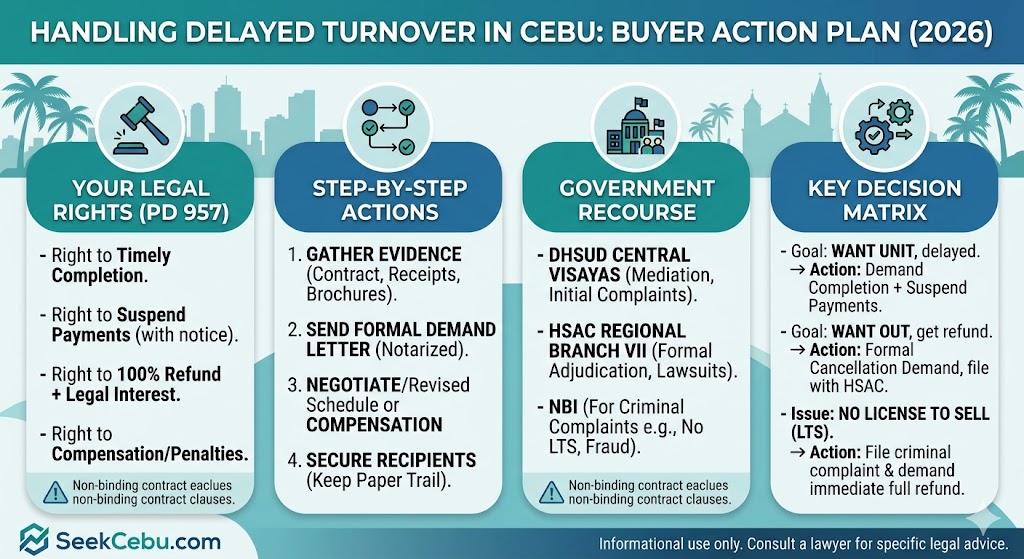
Your Rights Under the Law
First, understand that you are protected. Philippine law provides a “protective mantle” over buyers in preselling agreements. Your key rights when facing delays include:
- Right to timely turnover. The completion date on your contract is a demandable obligation. Developers cannot unilaterally extend it without DHSUD approval and notifying you.
- Right to suspend payments. If the developer fails to complete the project within the prescribed timeframe, you may suspend amortization payments after giving due notice. Under PD 957, no installment payment shall be forfeited in your favor in this scenario.
- Right to cancel and obtain a full refund. At your option, you can demand cancellation of the contract and reimbursement of all payments you have made, including amortization interest (excluding delinquency interest), plus legal interest.
- Right to compensation for delay. You may be entitled to penalties as stipulated in your contract or other forms of compensation.
- Right to file a complaint. You may file a case with HSAC to compel the developer to perform, deliver the unit, or cancel the contract and recover your payments.
- Right to legal recourse if the developer has no License to Sell (LTS). Developers cannot legally sell preselling lots or units without an LTS from DHSUD. If a developer sold you a unit without one, you may have strong grounds for refund and possibly criminal liability on their part.
⚠️ Caution: Any contract provision that requires you to waive your right to file a complaint or allows the developer to delay turnover at its own discretion has no legal validity.
Step-by-Step Action Plan for Delayed Turnover
Step 1: Review Your Contract and Gather Evidence
Your Contract to Sell (CTS) is your most important document. You will need to locate:
- The turnover date – Look for an absolute date (e.g., “to be delivered on or before Dec. 31, 2025”).
- Penalty clauses – What penalties does the contract impose on the developer for failing to meet the deadline?
- Force majeure provisions – Be aware that only events entirely outside the developer’s control (not just “permits taking longer”) typically excuse delays.
📁 Documents to compile now (both to send to the developer and as evidence for a potential complaint):
- Copy of the Contract to Sell (CTS).
- Official receipts of all payments (reservation fee, equity, monthly amortizations).
- Developer’s brochure, advertisements, or email promises showing the project timeline.
- Screenshots or printed copies of all email and chat communications with the developer about the delay.
- Photos or videos of the project site showing the lack of development (if safe to visit).
Step 2: Send a Formal Written Notice
Before anything else, you must send a written demand letter to the developer. This establishes your position and creates a paper trail.
What to include:
- Your full name and contact details.
- The project name, unit number, and contract details.
- The original promised turnover date.
- The current status (delayed).
- A clear demand: either deliver the unit by a reasonable new deadline or provide a written explanation.
- A warning that you may exercise your legal rights to suspend payments or cancel the contract if no satisfactory response is received.
How to send:
- Physical letter: Have the letter notarized and send it via registered mail or personal delivery with acknowledgment receipt.
- Email: Follow up with a PDF copy to the developer’s official email address.
- Keep proof: Keep your postal receipt, acknowledgment slip, and screenshot of the email.
Step 3: Negotiate a Revised Turnover Schedule
Many developers will respond by offering a new estimated completion date. If you are willing to wait, try to secure:
- A written revised turnover schedule signed by an authorized company representative.
- Compensation for the delay (e.g., waiver of association dues for a certain period, assistance with moving costs).
- Regular construction updates (monthly or quarterly) via email.
👉 Tip: If you want to stay in the project, you can consider asking for a binding revised turnover commitment in writing, with clear penalties for further delay.
Step 4: Suspend Amortization Payments (If You Choose to Stay)
If you have given proper notice and the developer still fails to deliver, PD 957 entitles you to suspend further payments. This is an effective way to stop the financial drain while waiting.
Important guidelines:
- Do not simply stop paying without notice. You must first issue a written notice of your intent to suspend payments.
- Keep a copy of that notice and proof of delivery.
- Prepare for possible collection letters. The developer may still send demand letters; respond by referencing your suspension rights under PD 957.
- Seek formal recognition. If the developer disputes your right to suspend, you can file a complaint with DHSUD to have your suspension formally recognized.
Step 5: Seek Assistance from the DHSUD Regional Office
If negotiations fail or the developer remains unresponsive, the first government channel is the DHSUD Regional Office where your project is located. For Cebu-based projects, this is:
DHSUD Central Visayas Regional Office
3rd Floor, J.G. Arcade Building, Legaspi Street, Brgy. Kamputhaw, Cebu City
Contact: (032) 412-3521
What happens when you file?
- DHSUD will attempt mediation or conciliation between you and the developer to enforce your rights and the developer’s obligations.
- If unresolved, you may escalate the matter to HSAC.
Step 6: File a Formal Complaint with HSAC
If mediation fails or the delay is egregious (e.g., no construction at all or developer has no License to Sell), you can file a verified complaint before the Human Settlements Adjudication Commission (HSAC), the quasi-judicial body that resolves housing disputes.
📋 Filing steps:
- Download the complaint form from the official HSAC website (hsac.gov.ph).
- Prepare a verified complaint explaining the facts, attaching all your evidence (contract, receipts, demand letters, etc.).
- Pay the required legal fees.
- File the complaint with the HSAC Regional Adjudication Branch that has jurisdiction over the region where the project is located. For Cebu projects, the appropriate RAB would be HSAC RAB VII in Cebu City.
- The developer will be served a copy of your complaint and required to file an answer.
📍 Filing Venues in Cebu & Nearby
DHSUD Central Visayas Regional Office
Address: 3rd Flr., J.G. Arcade Bldg., Legaspi St., Brgy. Kamputhaw, Cebu City
Purpose: Initial mediation, enforcement of buyer rights
HSAC RAB VII – Cebu City
Address: (Coordinate with DHSUD Central Visayas or check HSAC website for exact address)
Purpose: Formal adjudication of disputes, complaints against developers
HSAC Caraga Office (For reference)
Address: Arellano Real Estate Lessor Bldg., P-2, Brgy. Doongan, Butuan City
Purpose: Example only – not for Cebu cases
National Bureau of Investigation (NBI) Cebu
Address: NBI Cebu District Office, Cebu City
Purpose: For possible criminal complaints (e.g., large-scale estafa, no LTS)
Step 7: Consider Legal Counsel
While you can file a complaint on your own, serious delays involving large amounts of money (especially over P500,000) may be worth consulting a lawyer. An attorney can:
- Review your contract and identify the strongest claims.
- Advise you on whether to pursue refund or specific performance (forcing the developer to finish the project).
- Represent you in HSAC proceedings or court.
💰 Cost-saving tip: Many law firms offer initial consultations for a fixed fee. The expense may be worth it if you have paid over P1 million and the developer is uncooperative.
⚖️ Developer Watchlist: Are They Trustworthy?
Before investing, always verify the developer’s track record. Recent complaints in Cebu highlight that even developers with multiple projects can fail to deliver.
Azzela Properties
Issue Summary: Failed to deliver housing units in Minglanilla despite years of equity payments; delayed refunds; alleged fraudulent practices. Some buyers paid over P1 million and found no construction when they visited the site.
Latest Update: Ongoing NBI investigation as of March 2026. Developer promised to complete projects and refunds by early 2026.
Tumabini Land Development Corp.
Issue Summary: Alleged illegal selling, bouncing checks, and syndicated estafa involving townhouse projects in Carcar City, Consolacion, and Cebu City. Buyers discovered the developer allegedly had no License to Sell.
Latest Update: NBI reviewing contracts, receipts, and bank records for possible criminal charges as of February 2026.
✅ Red Flags to Watch For in Any Developer:
- No visible construction progress despite years of equity payments.
- Promises of “quick turnover” that seem unrealistic (e.g., 3–5 months for a preselling project).
- Repeated extensions of deadlines (from February to May to June, etc.) without any actual progress.
- Refund offers that stop or shrink over time.
- Staff giving the same script about “once equity is completed” without concrete construction milestones.
- Inability to provide a valid DHSUD License to Sell (LTS).
🔍 Quick Check: How to Verify a Developer Before Buying
Step 1
Action: Ask for the DHSUD License to Sell (LTS) number and project registration details.
Step 2
Action: Verify the LTS directly with the DHSUD Central Visayas Regional Office.
Step 3
Action: Check the developer’s SEC registration and background.
Step 4
Action: Visit the project site to see if any actual construction is happening.
Step 5
Action: Talk to existing buyers in the developer’s past projects.
Step 6
Action: Search online for news articles or complaints (e.g., “Azzela Properties complaints” or “[Developer Name] scam”).
🧭 Summary Table: Your Options at a Glance
Your Goal: You want the unit, just delayed
Recommended Action: Send written demand → negotiate revised schedule → consider suspending payments → file with DHSUD if needed
Your Goal: You want out and a full refund
Recommended Action: Send written demand for cancellation → if ignored, file complaint with HSAC for refund + legal interest
Your Goal: You suspect fraud or no License to Sell
Recommended Action: File complaint with HSAC + consider filing a criminal complaint with the NBI for large-scale estafa
Your Goal: You have paid less than 2 years of installments
Recommended Action: You are entitled to a 60-day grace period before the developer can cancel the contract. The cash surrender value refund calculation may differ (50% of payments if under 2 years, potentially higher after 5 years under Maceda Law)
Your Goal: You have paid 2+ years of installments
Recommended Action: Stronger refund rights (50% of payments, plus 5% per year after 5 years, up to 90% total). You also have a grace period of one month for every year of payments (max one use every 5 years)
🛠️ Additional Resources
- PD 957 (Subdivision and Condominium Buyers’ Protective Decree) – The primary law protecting pre-selling buyers. Administrative fines for violations can reach up to PHP 10,000 for first offenses, with criminal penalties up to PHP 20,000 and imprisonment.
- Maceda Law (RA 6552) – Governs refund rights for installment buyers in case of cancellation.
- HSAC Official Website – hsac.gov.ph – Download complaint forms and check updates.
📝 Final Honest Advice
Delayed turnover is never easy, but you have more legal protection than many buyers realize. Preselling contracts are not just marketing materials—they are binding obligations, and developers who fail to deliver can face serious administrative, civil, and even criminal consequences.
Your best defense? Do your homework before you sign. Verify the License to Sell, visit the site, and check the developer’s track record. But if you are already in a delay situation, act promptly. The longer you wait, the harder it can be to recover your funds.
Disclaimer: This article is for informational purposes only and does not constitute legal advice. Laws and regulations may change, and each case is unique. For specific legal concerns, consult a licensed attorney.
If you’d like to learn how to spot reliable developers, check out our guide: Johndorf Ventures Review: Is This Cebuano Developer Worth Your Trust?
And if you’re weighing whether to file a formal complaint or just move on, our honest reality check on Airbnb vs Long-Term Rental ROI (2026) might help you decide if it’s worth pursuing or time to cut your losses.
Contact Us
Author
John Paul Ybañez Paquibot
Licensed Real Estate Broker | PRC No. 00014132 | DHSUD No. CVRFO-B-03/18-2672
Bachelors Realty and Brokerage, Inc. Cebu
G/F Cap Building, Brgy. Corner, Osmeña Blvd.
Arlington Pond St. Extension, Cebu City, 6000 Cebu
Leave a Reply