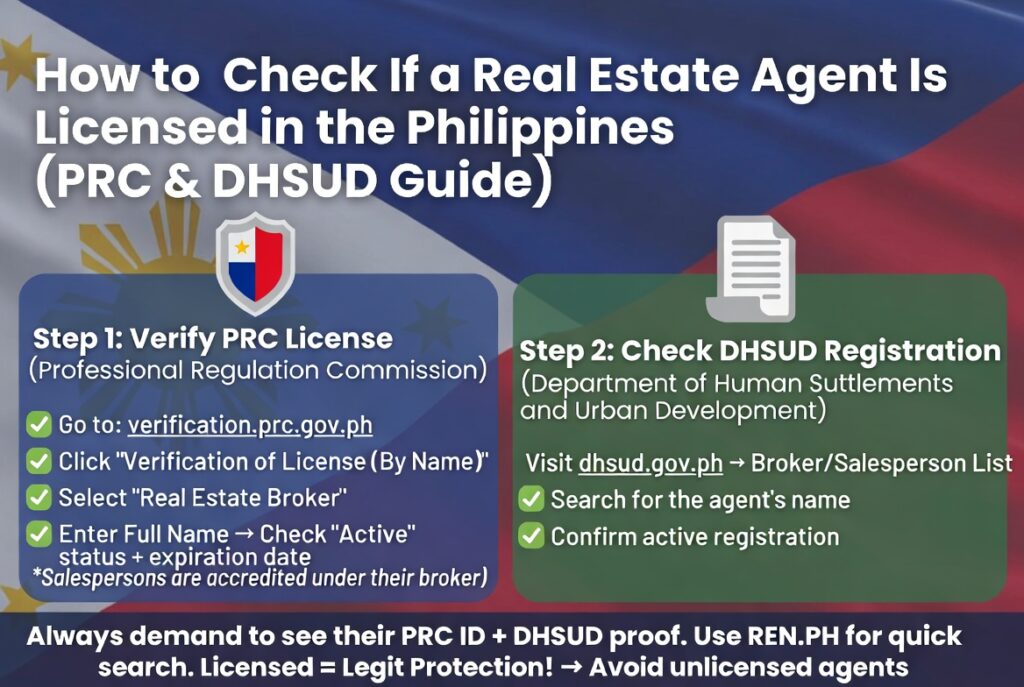
It’s a hard truth that many Filipinos, especially OFWs, only discover a real estate agent‘s lack of license after losing their hard-earned savings. A single transaction with an unlicensed “colorum” agent can lead to financial ruin and zero legal protection. This guide shows you exactly how to protect yourself by verifying credentials through the PRC and DHSUD in 2026.
⚡ At-a-Glance: The 5-Minute Verification Checklist
Before paying a single peso for any property, run this checklist on every agent you meet:
#1
Action: Ask for their PRC license number (for brokers) or PRC accreditation number (for salespersons)
Where to Check: Agent must provide
#2
Action: Verify online via PRC Verification Portal
Where to Check: verification.prc.gov.ph
#3
Action: Check license status: ACTIVE (not expired/suspended)
Where to Check: PRC portal
#4
Action: Ask for their DHSUD Certificate of Registration
Where to Check: Agent must provide
#5
Action: Verify registration with DHSUD Regional Office
Where to Check: DHSUD Central Visayas: (032) 412-3521
#6
Action: Ask which licensed broker they are affiliated with (for salespersons)
Where to Check: Agent must provide broker’s name & PRC license
#7
Action: Verify the supervising broker’s license
Where to Check: PRC portal
#8
Action: Get everything in writing before paying
Where to Check: N/A
Let’s break down each step in detail—because skipping any of them could cost you everything.
👥 First, Understand Who You’re Dealing With
The first step in protecting yourself is understanding the difference between a Real Estate Broker and a Real Estate Salesperson (Agent). Many people use these terms interchangeably, but under Republic Act No. 9646 (Real Estate Service Act or RESA) , they have distinct roles, requirements, and legal authorities.
Real Estate Broker vs. Salesperson: Key Differences
PRC Exam Required?
Real Estate Broker: ✅ YES. Must pass REBLE (Real Estate Brokers Licensure Examination)
Real Estate Salesperson (Agent): ❌ NO. No PRC exam required
Minimum Education
Real Estate Broker: BS in Real Estate Management (4-year degree)
Real Estate Salesperson (Agent): At least 2 years of college + 12-hour training
Can Operate Independently?
Real Estate Broker: ✅ YES. Licensed to run own real estate business
Real Estate Salesperson (Agent): ❌ NO. Must work under a licensed broker
Can Sign Contracts & Close Deals?
Real Estate Broker: ✅ YES
Real Estate Salesperson (Agent): ❌ NO. Cannot sign legal documents independently
DHSUD Registration Fee
Real Estate Broker: ₱720.00 (renewal) + ₱5,000 bond
Real Estate Salesperson (Agent): ₱288.00 (renewal) + ₱1,000 bond
⚠️ Critical Warning: A real estate salesperson cannot legally operate a real estate service independently, sign contracts, or offer services without PRC accreditation and DHSUD registration. Anyone doing so is engaging in illegal practice under Philippine law.
Here is the official definition of a real estate salesperson under RA 9646:
A real estate salesperson is a duly accredited natural person who performs service for, and in behalf of, a real estate broker who is registered and licensed by the Professional Regulatory Board of Real Estate Service for or in expectation of a share in the commission, professional fee, compensation or other valuable consideration.
🛡️ Why This Matters: The Real Cost of Unlicensed Agents
Dealing with an unlicensed agent is not a harmless shortcut. It is a direct violation of Philippine law that carries both financial risks and potential criminal liability for the agent.
Financial & Legal Risks for Buyers
Risk: No Legal Accountability
What Could Happen: Licensed brokers answer to PRC and can be sanctioned. Unlicensed individuals do not
Risk: Scams & Double-Selling
What Could Happen: Unlicensed agents are a primary vehicle for property fraud
Risk: Invalid Transactions
What Could Happen: The entire sale may be legally questionable, leaving you without ownership rights
Risk: Misrepresentation
What Could Happen: No training means higher risk of false property details, title issues, or undisclosed problems
Risk: Unauthorized Fee Collection
What Could Happen: “Agents” may collect reservation fees with no legal authority and disappear with your money
Penalties for Unlicensed Practice (For Your Awareness)
If you encounter an unlicensed agent, understand that they are violating the law and can face serious consequences. Mahipus noted that penalties for unauthorized practice can range from a minimum fine of ₱5,000 to possible imprisonment, even for first-time offenders. Other sources indicate fines can reach ₱100,000 or imprisonment of not less than two years, or both.
Real-Life Case Example
In March 2026, the NBI arrested a woman in Koronadal City for engaging in real estate scams. She was charged with violations of RA 9646 (Real Estate Service Act) , PD 957, and estafa. Verification with PRC showed she was not a licensed real estate practitioner. The property was being marketed without the required authority from DHSUD. The NBI Director urged the public: “Always verify the legitimacy of brokers, agents, and supporting documents through the proper government agencies before entering into any transaction”.
This is not a theoretical risk. It happens.
📝 Step-by-Step: How to Verify a Real Estate Professional in 2026
Step 1: Ask for Their PRC License/Accreditation Number
The first step is the simplest: ask directly.
- For a Broker: Ask for their PRC license number.
- For a Salesperson (Agent) : Ask for their PRC accreditation number and the name of the licensed broker they are affiliated with.
If they cannot or will not provide it, consider that a major red flag.
Step 2: Visit the PRC Official Verification Website
The PRC provides a free, public, and official online verification system.
🔗 Direct link: https://verification.prc.gov.ph/
Step 3: Enter the Required Information
You have two options:
Option: Verification by Name
Instructions: Enter the full name of the professional
Option: Verification by License Number
Instructions: Enter the PRC ID or license number
Then, select “Real Estate Broker” from the list of professions (even if verifying a salesperson, their accreditation falls under the same framework).
Step 4: Click Verify and Check the License Status
The system will display the professional’s details. Carefully check the license status:
- ✅ ACTIVE – Valid. Proceed with additional verification.
- ⚠️ EXPIRED – Invalid. Do not transact.
- 🚫 SUSPENDED/REVOKED – Invalid. Do not transact.
Step 5: Contact PRC Directly If Anything Is Unclear
If the information on the PRC website is unclear or you have any concerns, you can contact the PRC directly: (02) 735-6244 or (02) 735-6245.
📋 The DHSUD Requirement: The Second Layer of Verification
Many buyers stop at PRC verification. That is a mistake.
Under PD 957, an additional requirement of registration with the DHSUD for all licensed brokers and accredited salespersons is imposed before engaging in advertising and selling subdivision houses and lots or condominium units.
In short: A licensed real estate professional must also be registered with DHSUD to legally sell housing projects.
How to Verify DHSUD Registration in Cebu
- Ask the agent or broker for their DHSUD Certificate of Registration.
- Contact the DHSUD Central Visayas Regional Office to cross-check:
- Address: 3rd Floor, J.G. Arcade Building, Legaspi Street, Brgy. Kamputhaw, Cebu City
- Tel: (032) 412-3521
- If they cannot produce a valid DHSUD registration, they are not legally authorized to sell subdivision or condominium units.
⚠️ Remember: A DHSUD Certificate of Registration for the agent/broker is different from a DHSUD License to Sell (LTS) for the property project. Both are required in a legitimate transaction. You should ask for and verify both.
🚩 Red Flags: How to Spot an Unlicensed Agent Without Even Verifying
Before you even open the PRC website, watch for these behavioral red flags:
Red Flag: Rushes you to pay a reservation fee
What It Means: Classic pressure tactic to get money before you verify
Red Flag: Cannot produce a PRC license number when asked
What It Means: Likely unlicensed
Red Flag: Claims to be a “broker” but cannot name their supervising broker
What It Means: Misrepresenting themselves
Red Flag: Works independently without mentioning any brokerage firm
What It Means: Salespersons must be affiliated with a licensed broker
Red Flag: Requests payment in cash or to a personal bank account
What It Means: No accountability or paper trail
Red Flag: Cannot or will not provide the DHSUD License to Sell for the property
What It Means: Project may be illegal or non-existent
Red Flag: Only communicates via Facebook Messenger with no physical office
What It Means: High risk—scammers often operate exclusively online
Red Flag: Offers a “too good to be true” discount
What It Means: Classic scammer bait
💰 OFW Section: Why You Are a Primary Target
Overseas Filipino Workers are prime targets for unlicensed real estate scammers. Here’s why—and how to protect yourself.
Why OFWs Are Targeted
Reason: Distance from the market
Explanation: Cannot easily visit the property or verify documents in person
Reason: Emotional motivation
Explanation: Strong desire to own a home in the Philippines and provide for family
Reason: Limited local market knowledge
Explanation: May not know fair market prices or standard procedures
Reason: Trust in fellow Filipinos
Explanation: Scammers exploit this by appearing professional and trustworthy
Reason: High demand for property
Explanation: Creates opportunities for unscrupulous individuals
OFW-Specific Verification Steps
If you are buying from abroad, follow these additional safeguards:
- Never pay a reservation fee without verifying the agent’s PRC license online. You can do this from anywhere in the world via the PRC portal.
- Ask for a video call where the agent shows you their PRC ID and DHSUD certificate. Do not accept photos—they can be doctored.
- Require all documents to be emailed to you before any payment. Legitimate agents will comply.
- Ask a trusted relative or friend in Cebu to meet the agent in person at their physical office before you send any money.
- Use escrow or bank-to-bank transfers when possible. Avoid cash, remittance centers to personal accounts, or cryptocurrency payments.
📌 One OFW’s nightmare: Some OFWs think they are buying a legal property, only to later discover that the title is fake and they have no legal claim to the land. This can be devastating, as the OFW loses their entire investment and has no recourse.
Sample Script for OFWs to Ask an Agent via Messenger/Email
“Hi. Before I send any payment, please send me the following:
1. Your full name and PRC license number (for broker) or PRC accreditation number (for agent).
2. The name and PRC license number of the supervising broker (if you are an agent).
3. Your DHSUD Certificate of Registration.
4. The DHSUD License to Sell number for the property.I will verify these online before proceeding. Thank you for your understanding.”
A legitimate professional will provide these without hesitation. An unlicensed one will make excuses or disappear.
🛠️ What to Do If You’ve Already Been Scammed
If you discover that you have already transacted with an unlicensed agent and suspect fraud, here is your recourse:
- Gather all evidence – receipts, bank transfer records, screenshots of conversations, the agent’s name and contact information.
- File a complaint with the NBI – The NBI has successfully arrested unlicensed practitioners for violations of RA 9646 and estafa.
- File a complaint with HSAC (Human Settlements Adjudication Commission) for housing-related disputes.
- Consult a lawyer – Especially if large sums of money are involved. The earlier you act, the higher the chance of recovery.
✅ Conclusion: Your Safety Net in Two Verifications
The entire process of verifying a real estate agent boils down to two government checks:
PRC Verification
What to Verify: PRC license number (broker) or PRC accreditation number (salesperson)
Where: verification.prc.gov.ph
DHSUD Verification
What to Verify: DHSUD Certificate of Registration
Where: DHSUD Central Visayas Regional Office: (032) 412-3521
These checks take less than five minutes total. The cost is zero. The protection is priceless.
The bottom line: Never, ever hand over a single peso to anyone claiming to be a real estate professional without first seeing their verified PRC and DHSUD credentials. If they are legitimate, they will be proud to show them. If they hesitate, walk away. Your hard-earned money—and your dream of owning property in Cebu—depends on it.
Disclaimer: This article is for informational purposes only and does not constitute legal advice. Laws and regulations may change, and each case is unique. For specific legal concerns, consult a licensed attorney.
Related reads on SeekCebu:
- The 5 Documents You Must Check Before Paying a Reservation Fee
- OFW Guide: How to Buy a House in Cebu Without Getting Scammed (Updated for 2026)
- How to Handle a Delayed Turnover in Cebu: A Step-by-Step Guide for Buyers (2026)
Contact Us
Author
John Paul Ybañez Paquibot
Licensed Real Estate Broker | PRC No. 00014132 | DHSUD No. CVRFO-B-03/18-2672
Bachelors Realty and Brokerage, Inc. Cebu
G/F Cap Building, Brgy. Corner, Osmeña Blvd.
Arlington Pond St. Extension, Cebu City, 6000 Cebu
Leave a Reply