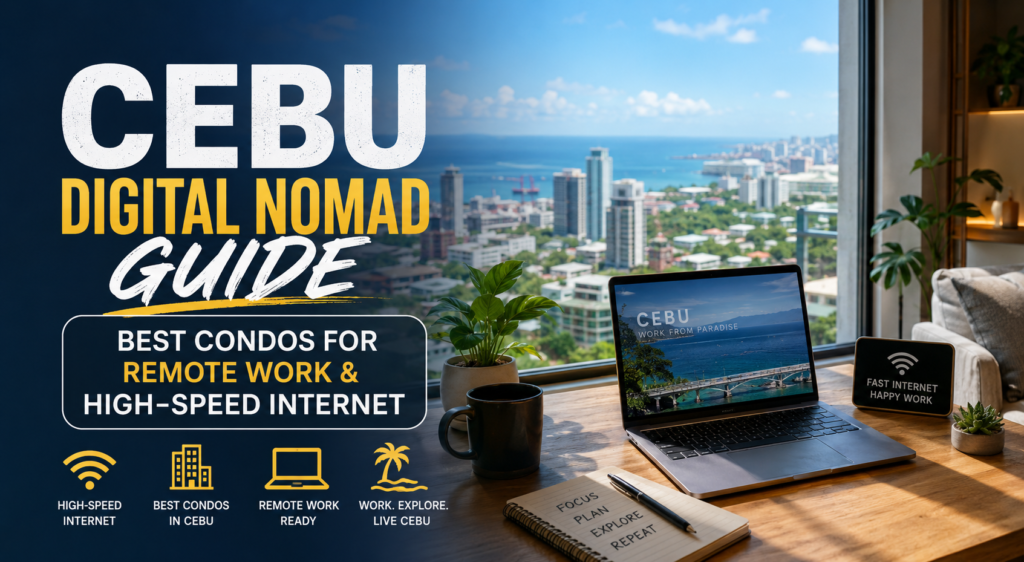
The Philippines officially launched its Digital Nomad Visa (DNV) in June 2025, putting Cebu squarely on the map as a legitimate long‑term base for remote workers. With monthly living costs ranging from $700 to $1,500, reliable fiber internet, and beaches just an hour away, Cebu offers a compelling alternative to pricier Southeast Asian hubs.
But here’s the honest truth: not all fiber is created equal, and power outages do happen. This guide cuts through the glossy marketing to help you find a condo where you can actually get work done.
Before You Rent – Critical Infrastructure Checks
Don’t sign a lease without verifying these things first.
1. Confirm Fiber is Actually Installed
Most condos in IT Park and Cebu Business Park already have fiber lines running to the building, but units just 500 meters away might not. Before committing, ask the landlord for a recent screenshot of a speed test taken inside the exact unit you’ll rent. Speeds above 50 Mbps are standard for remote work.
2. Check Backup Power and Invest in a UPS
Unplanned brownouts happen, especially during storms or maintenance. Ask if your building has a generator that covers common areas and, ideally, your unit’s outlets. Many modern buildings in IT Park have backup power; older buildings often don’t.
Even with building backup, buy a UPS (Uninterruptible Power Supply). A small UPS for your laptop, monitor, and router costs ₱2,000–₱4,000 ($35–$70) and is one of the best investments you can make in Cebu. It gives you 10–30 minutes to save your work and gracefully end a call when the power blinks.
3. Budget Realistically for Electricity
Air conditioning can easily add $50–$100 to your monthly bill. A home office setup with a laptop, monitor, and router typically costs ₱2,500–₱4,000 ($45–$70) per month for electricity alone.
Top Condos for Digital Nomads
Cebu IT Park – The Obvious (but Solid) Choice
IT Park is a designated Special Economic Zone – a modern enclave of glass towers, 24/7 restaurants, and coworking spaces. It’s walkable, safe, and convenient, but rents are higher than elsewhere.
Rent range: ₱15,000–₱30,000+ ($265–$530) per month
Avida Towers Riala – The nomad favorite. Located inside IT Park, walking distance to Ayala Malls Central Bloc, Sugbo Mercado food market, and dozens of cafes. Units typically include 100 Mbps fiber internet and are fully furnished with a work desk. Pool access and 24‑hour security. A 23 sqm 1‑bedroom usually requires a 1‑year lease with 2 months advance and 2 months deposit.
The Flats IT Park – No long‑term lease needed. This co‑living residence offers compact furnished rooms with shared facilities. Fast Wi‑Fi and 24/7 security, steps from everything in the tech hub.
Cebu Business Park – More Upscale, More Expensive
Located minutes from IT Park, Cebu Business Park is home to Ayala Center Cebu, upscale restaurants, and premium condos. Quieter and more polished, but you pay a premium.
Rent range: ₱20,000–₱60,000 ($350–$1,060) per month
1016 Residences – Ayala Land Premier building with direct second‑floor bridge access to Ayala Mall. High‑end finishes, excellent security, panoramic city views. Best for long‑term stays with larger budgets.
Park Point Residences – Alveo Land development with basement access to Ayala Mall. Fully furnished units, gym, pool. Popular with expats and retirees.
Solinea – More affordable than 1016 or Park Point, still offers resort‑style amenities: pool, gym, function rooms. One‑bedroom units ₱35,000–₱60,000 per month. Solid mid‑range option.
Mactan Island – Beach Living with Trade‑offs
If you want ocean views and resort‑style living, Mactan Island is your spot. It’s home to the international airport and plenty of beachfront condos.
Rent range: ₱10,000–₱20,000 ($175–$350) per month
Mactan Newtown – Mixed‑use development with condos, retail, and dining right on the water. Popular among expats who want beach life and remote work. Check internet availability carefully before signing – fiber varies by building.
Important time‑zone reality: If your work involves daily video calls with North American or European time zones, the commute from Mactan to Cebu City (where most coworking spaces and nomad meetups happen) can take 1–2 hours in rush hour. That commute may interfere with attending high‑priority local social or professional networking events. If community and spontaneous coffee meetings matter to you, think twice before committing to Mactan.
Lahug & Banilad – The Balanced Middle Ground
These residential neighborhoods border IT Park and offer quieter surroundings without sacrificing convenience. You’re still a short Grab ride to coworking spaces and restaurants, but rents are more reasonable.
Rent range: ₱15,000–₱30,000 ($265–$530) per month
Coworking Spaces Worth the Money
Even with good condo internet, coworking spaces offer backup power, reliable connections, and community – all valuable when your home connection drops mid‑call.
The Company Cebu (IT Park)
Professional environment, private offices, meeting rooms, unlimited coffee. Monthly hot desk: ₱6,000 ($105).
Nest Workspaces (Horizons 101)
Community‑focused, fiber internet, soundproof call booths, open 7am–1am daily. ₱400/day.
WorkNook (Baseline Center)
Private offices, meeting rooms, fiber internet, ergonomic furniture. Open 8am–6pm Mon–Sat. ₱250/half‑day, ₱5,500/month.
ASPACE Cebu (Crossroads)
Boutique creative space in a hipster hub just outside IT Park. Check website for current rates.
Nomad’s Hub (location varies)
Coworking + hostel hybrid with 24‑hour desks and meeting rooms. Check website.
Internet Providers and Backup Plans
Cebu has multiple fiber providers, but quality and availability depend heavily on your building and neighborhood.
PLDT Home Fibr – Fiber Unli Plan 1399: up to 100 Mbps for ₱1,399/month.
Converge ICT – FiberX Plan 1500: up to 200 Mbps for ₱1,500/month.
Globe – GFiber Plan 1749: up to 200 Mbps for ₱1,749/month.
Red Fiber – Plan 1000: up to 100 Mbps for ₱1,000/month. No lock‑in contract – ideal for nomads uncertain about their stay length. Also offers up to 500 Mbps for ₱1,900/month, with 50% off installation until December 31, 2025.
InfiniVAN – Ultra 350: up to 350 Mbps for ₱1,499/month. Currently Manila only, but expanding to Cebu.
The Honest Truth About Internet Reliability
Fiber is generally stable in central areas, but quality still varies by neighborhood and building. Mobile data (Smart or Globe 5G) is a solid backup – most nomads carry a pocket Wi‑Fi or eSIM for emergencies.
A dual‑router setup with a backup LTE router or hotspot is worth investing in if your work can’t tolerate any downtime. And again: buy a UPS. It’s cheap insurance.
Neighborhood Breakdown – Where to Actually Live
Cebu IT Park – Best for New Arrivals
Vibe: Modern, walkable, 24/7 energy. Cafes, restaurants, coworking everywhere.
Pros: Safest and most convenient area. Most buildings have fiber and backup power.
Cons: More expensive. Can feel like a bubble. Traffic gets heavy at rush hour.
Cebu Business Park – Best for Long‑Term Expats
Vibe: Upscale, quieter, business‑focused. Home to Ayala Center Cebu.
Pros: Central, excellent security, walkable to mall and restaurants. Less chaotic.
Cons: Significantly more expensive. Fewer casual dining options.
Mactan Island – Best for Beach Lovers
Vibe: Resort‑style, relaxed, near airport.
Pros: Beach access, quieter, more space for your money.
Cons: Traffic to Cebu City is brutal in peak hours. Fewer coworking spaces. Internet less reliable. Commute kills spontaneous networking.
Lahug/Banilad – Best for Balance
Vibe: Residential, quieter, but close to everything.
Pros: More affordable than IT Park or Business Park. Short Grab ride to coworking. Quieter at night.
Cons: Fewer amenities within walking distance. You’ll need transport more often.
Visa Options – The Full Picture
The Philippines launched its Digital Nomad Visa (DNV) in June 2025 under Executive Order No. 86.
DNV basics:
- Valid for 12 months, renewable once (24 months maximum)
- Minimum annual income: $24,000 from outside the Philippines
- Valid international health insurance
- Clean criminal record
- Age 18+
- Proof of remote work for foreign clients/employers
Tax and fee info:
- DNV holders are not Philippine tax residents and owe no local tax on foreign‑sourced income.
- Estimated application fee: $200–$300
- Processing: 6–12 weeks
The tourist visa alternative (still widely used):
Because the DNV is new and may have hurdles (e.g., the reciprocity rule for certain nationalities), many nomads still rely on the standard tourist visa.
- 30 days on arrival for most nationalities.
- Extensions: 30 additional days for ₱3,030–₱3,500; subsequent extensions for ₱4,540–₱8,150.
- Maximum stay for most non‑visa‑required nationals: 36 months.
- After 59 days, you need an ACR I‑Card (₱2,100).
Bottom line: If you qualify and plan to stay 6–24 months, the DNV is cleaner. If you’re staying less than 6 months or don’t meet the income requirement, the tourist extension shuffle still works.
Finding a Condo – Practical Tips
Airbnb – Good for your first month while you scout neighborhoods.
Facebook Marketplace – Where locals post the best deals. Search “Cebu condo for rent” in expat groups.
Local property sites – Lamudi, Property24, and CebuGrandRealty have listings.
Medium‑term rentals (1–6 months) – Many units are fully furnished with kitchens and Wi‑Fi. Monthly rates are lower than hotels, and you can often negotiate flexible payment terms.
Pro Tip – Test the 5G signal where your desk will go. When viewing a unit, pull out your phone and run a speed test (or just check signal bars) in the exact spot where you plan to put your desk. High‑rise concrete buildings can create frustrating dead zones. Having a strong 5G signal in your chair is your final line of defense if the building’s fiber ever goes down. If you can’t get a good signal there, ask about the nearest cell tower or consider a different unit.
Watch for hidden costs in leases:
- Long‑term contracts often require 2 months advance + 2 months deposit.
- Confirm whether the monthly association dues are included in the rent (they usually are, but ask).
Cost of Living Snapshot (Monthly, in USD)
Budget (comfortable solo nomad): $700–$1,000
- Condo rent (1BR): $265–$350 (₱15,000–₱20,000)
- Electricity (with AC): $45–$70 (₱2,500–₱4,000)
- Fiber internet: $20–$25 (₱1,200–₱1,500)
- Groceries: $90–$140 (₱5,000–₱8,000)
- Eating out (local meal): $2.50–$4.50 (₱150–₱250)
- Grab ride (short trip): $2–$4.50 (₱120–₱250)
- Coworking membership: $95–$105 (₱5,500–₱6,000)
Mid‑range: $1,200–$2,000+
Hidden costs to watch:
- Electricity bills spike in summer (March–May) when you run AC more.
- Imported groceries (cheese, wine, specialty items) are surprisingly expensive.
- Typhoon season (July–September) can disrupt internet and power for hours or days.
Final Honest Summary
Cebu is a genuinely good base for digital nomads – affordable, well‑connected, and surrounded by natural beauty. The new Digital Nomad Visa makes long‑term stays much simpler than the old tourist visa extension shuffle.
But go in with clear eyes: internet reliability varies by building, power outages happen, and rent in prime areas is rising as more nomads arrive.
Your pre‑move checklist:
- [ ] Verified fiber internet is installed in the building
- [ ] Confirmed building has generator backup (at least for common areas)
- [ ] Bought a UPS – this is non‑negotiable
- [ ] Budgeted ₱2,500–₱4,000 monthly for electricity
- [ ] Have a backup data plan (Smart or Globe 5G)
- [ ] Tested the 5G signal at your potential desk spot
- [ ] Carried a surge protector for your devices
If you prioritize fiber internet and backup power, stay in IT Park or Cebu Business Park. If beach views matter more than work stability and social networking, Mactan is worth the trade‑off – just know the commute will cost you time and spontaneous meetups.
Cebu won’t be the cheapest spot in Southeast Asia forever, but for now, it’s one of the most balanced. Work hard, explore hard, and always keep a backup connection – and a UPS.
All prices and visa details are accurate as of June 2026 but may change. Double‑check with official sources before making financial commitments.
Author
John Paul Ybañez Paquibot
Licensed Real Estate Broker | PRC No. 00014132 | DHSUD No. CVRFO-B-03/18-2672
Bachelors Realty and Brokerage, Inc. Cebu
G/F Cap Building, Brgy. Corner, Osmeña Blvd.
Arlington Pond St. Extension, Cebu City, 6000 Cebu
Leave a Reply