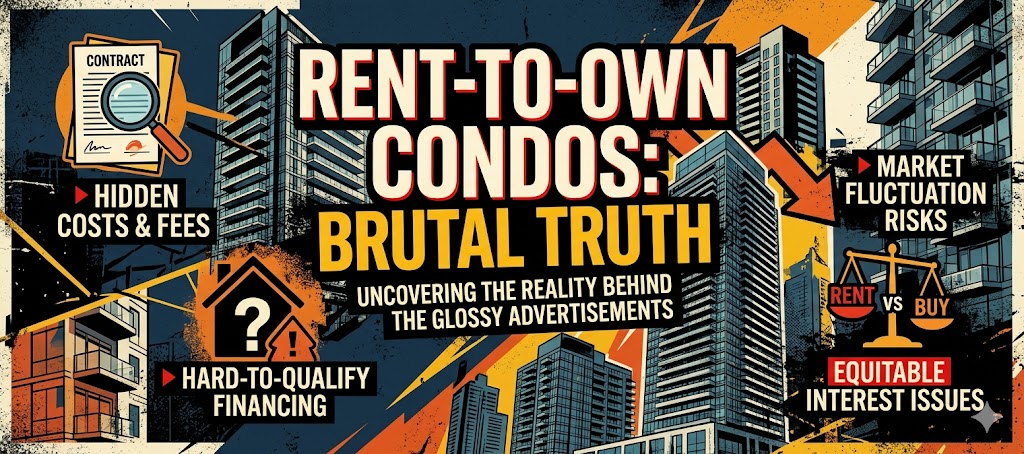
Let’s cut through the marketing fluff.
Rent-to-own sounds like a dream. Move in now, pay rent like you always have, and someday—magically—the place becomes yours. No bank loan headaches. No massive down payment. Just a simple path to ownership.
That’s the promise. Here’s the reality.
What Rent-to-Own Actually Is
Rent-to-own is exactly what it sounds like: you rent a property for a set period—typically one to three years—with the option to buy it at the end. A portion of your monthly rent goes toward the eventual purchase price, building what the industry calls “equity”.
Think of it as dating before marriage. You get to test the property, the neighborhood, the building management, and the lifestyle before committing.
But here’s the brutal truth that most sales agents won’t tell you: rent-to-own is not a shortcut. It’s often a more expensive, higher-risk path to ownership than a traditional bank loan.
The Brutal Truth #1: You’re Paying a Premium
Rent-to-own monthly payments are almost always higher than market rent. Why? Because part of your payment is supposed to go toward the purchase price.
One industry analysis notes that “the monthly payments are usually higher than market-rate rent, meaning buyers who cannot convert lose both the premium they paid and the time they spent building equity”.
In other words, you’re paying extra every month for the privilege of maybe owning the place someday. If you don’t end up buying, that extra money is gone forever.
The Brutal Truth #2: The Option Fee Is Gone If You Walk Away
Most rent-to-own agreements require an upfront option fee—a non-refundable payment that gives you the right to buy the property at the end of the lease.
If you decide not to buy, you lose that fee.
And here’s the kicker: you also lose every rent credit you accumulated. All those months of paying above-market rent? Gone. Forfeited.
One source puts it bluntly: “If you fail to make your monthly payments as agreed, you risk losing not only your right to purchase but also all the rent credits you’ve accumulated thus far”.
The Brutal Truth #3: You Might Not Qualify for Financing When the Time Comes
Here’s the scenario that plays out more often than developers admit.
You sign a rent-to-own agreement. You pay above-market rent for two or three years. You accumulate credits toward the purchase. The lease ends. You’re ready to buy.
Then the bank says no.
Your credit score isn’t high enough. Your income documentation isn’t sufficient. The property appraisal comes in lower than the agreed purchase price. The bank won’t approve your loan.
Now what?
You can’t buy. You lose your option fee. You lose your rent credits. You’ve been paying above-market rent for years, and you have nothing to show for it.
This is not a hypothetical risk. This is the single biggest danger of rent-to-own agreements.
The Brutal Truth #4: Many “Rent-to-Own” Programs Aren’t Really Rent-to-Own
Property consultancy Colliers Philippines made a striking observation: many developers’ rent-to-own schemes are “essentially early move-in programs with extended payment terms”—not genuine rent-to-own models.
What does that mean?
You’re not really building equity toward ownership. You’re just moving in early and paying installments under a different name. The flexibility to walk away? Often nonexistent.
Colliers noted that “as far as we know, it’s only DMCI Homes that provides this kind of setup where renters can truly transition from renter to owner, with the flexibility to opt out if they choose”.
If even the industry experts are pointing out that most programs are misleading, you should be paying very close attention.
The Brutal Truth #5: You’re Locking in a Price That Could Go Down
Rent-to-own agreements typically fix the purchase price at the beginning of the lease. This is marketed as a benefit—you’re protected if property values go up.
But what if they go down?
If the market cools and the condo’s value drops below your agreed purchase price, you’re stuck. You’ll be paying above-market rates for a property that’s worth less than what you owe.
Here’s where context matters. In Cebu’s current market, prime areas like Cebu IT Park, Mactan Newtown, and the South Road Properties have been steadily appreciating. The demand from BPO workers, offshore gaming employees, and young professionals has kept prices on a generally upward trajectory. In these established townships, the risk of a significant price drop is relatively low.
But the equation is very different outside these prime areas. In fringe locations, unproven townships, or areas with oversupply, prices are more vulnerable. If you lock in a high purchase price in a location where demand is weak, you could end up paying above-market rates for a property that isn’t appreciating as expected.
The honest take: In highly developed townships with strong demand, prices are generally stable and the risk of a major drop is low. But in fringe or unproven locations, the risk of locking into an overpriced unit is much higher. Before signing, ask yourself: Is this location genuinely in high demand, or is the developer trying to inflate prices based on promises that haven’t materialized yet?
The Brutal Truth #6: You’re Responsible for Maintenance
During the rental period, you’re typically responsible for maintenance and repairs—just like a standard tenant.
But here’s the catch: if you’re paying above-market rent with the intention of buying, you might be inclined to spend more on upgrades and improvements. New paint. Better fixtures. Minor renovations.
Then you don’t buy. You lose the option fee, the rent credits, and the money you spent on improvements.
The Brutal Truth #7: Scammers Love Rent-to-Own
The rent-to-own model is fertile ground for fraud.
Common scams include:
- Fake ownership: Someone rents a condo they don’t own and offers it to you as rent-to-own.
- Hidden fees: Agreements that impose impossible conditions or hidden costs to ensure you never actually own the property.
- Misrepresentation: Glossy brochures with misleading layouts and unrealistic promises.
- “Sangla-Tira-Benta” schemes: Fraudsters pose as owners, collect payments, and disappear.
The Philippine real estate market, with its strong demand and complex legal processes, is unfortunately a breeding ground for these scams.
So When Does Rent-to-Own Actually Make Sense?
With all that said, rent-to-own isn’t always a bad deal. There are situations where it can work.
You have poor credit but a solid income. Banks won’t touch you, but you can afford the payments. Rent-to-own gives you time to rebuild your credit while living in the property.
You’re self-employed with irregular income. Proving income to a bank is difficult. Rent-to-own programs often have more flexible verification.
You want to test the neighborhood before committing. Rent-to-own gives you a trial period.
You’re an OFW or expat. You need time to get your documents in order and decide if you really want to settle in the Philippines.
You’re dealing with a reputable developer with a transparent program. DMCI Homes’ HomeReady™ program, for example, allows you to walk away with “no strings attached” if you decide not to buy. Filinvest’s “Rent it. Own it. Easy.” program offers zero percent interest over ten years with no bank loan required.
These are legitimate programs. But they’re the exception, not the rule.
What to Look For in a Rent-to-Own Contract
If you’re determined to go the rent-to-own route, here’s what you need to check before signing anything:
The option fee. Is it refundable under any circumstances? (Spoiler: usually not.)
The rent credit. Exactly how much of your monthly payment goes toward the purchase price? Get it in writing. DMCI Homes, for example, credits at least 60% of lease payments toward the purchase. Many programs credit far less—or nothing at all.
The purchase price. Is it fixed, or can it change? If it’s fixed, what happens if the market drops? This is especially important in fringe or unproven locations where prices are more volatile.
The timeline. How long do you have to decide? What happens if you need more time?
The penalties. What happens if you miss a payment? How many missed payments trigger forfeiture?
The maintenance responsibilities. Who pays for major repairs? Structural issues? Appliance replacements?
The financing clause. What happens if you can’t secure a bank loan at the end of the lease? Can you extend the term? Can you walk away with any of your money?
Red flags to watch for:
- Vague or missing terms
- Monthly payments way above fair market rent
- No rent credit toward the purchase
- Unreasonable penalties
- Seller can terminate easily for minor violations
- You’re responsible for all repairs, even major structural issues
If you see any of these, walk away.
The Bottom Line
Rent-to-own is not a shortcut to homeownership. It’s a higher-cost, higher-risk alternative to a traditional mortgage.
The brutal truth is this: most people who enter rent-to-own agreements never actually buy the property. They either can’t qualify for financing when the time comes, or they realize they’ve been paying above-market rent for years with nothing to show for it.
Risky rent-to-own schemes have grown in popularity precisely because of the “affordability gap” that economists have flagged in the Philippine housing market. They’re a workaround for a broken system—not a solution.
If you can qualify for a bank loan, get the bank loan. The interest rates might seem high, but at least you’re building real equity from day one. The property is yours. You’re not at risk of losing everything if your circumstances change.
If you can’t qualify for a bank loan, rent-to-own might be your only option. Just go in with your eyes wide open. Understand that you’re paying a premium. Understand that you could lose everything you’ve put in. Pay close attention to the location—if it’s a prime, established township, the price stability is in your favor. If it’s a fringe or unproven area, the risk of overpaying is significantly higher.
And never, ever sign a rent-to-own agreement without having a lawyer review it first.
The dream of homeownership is real. But don’t let that dream blind you to the brutal truth about how rent-to-own actually works.
Sources & Methodology: This guide is based on verified industry reports, developer announcements, and independent analysis as of June 2026. Information on DMCI Homes’ HomeReady™ program sourced from Colliers Philippines and official company disclosures. Filinvest’s program details sourced from company announcements. Scam information sourced from NBI reports and consumer protection guides. Cebu market context sourced from real estate industry reports, BIR zonal value data, and independent market analysis. This guide is intended for informational purposes only and does not constitute professional financial or legal advice. Always consult with a licensed real estate professional and attorney before entering any property agreement.
Author
John Paul Ybañez Paquibot
Licensed Real Estate Broker | PRC No. 00014132 | DHSUD No. CVRFO-B-03/18-2672
Bachelors Realty and Brokerage, Inc. Cebu
G/F Cap Building, Brgy. Corner, Osmeña Blvd.
Arlington Pond St. Extension, Cebu City, 6000 Cebu
Leave a Reply