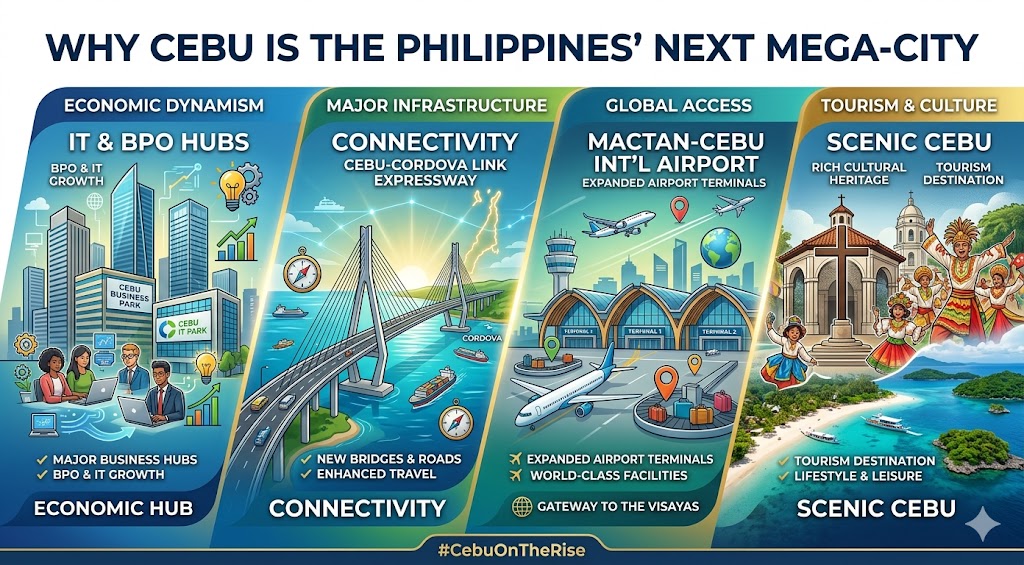
For decades, Manila has been the undisputed center of Philippine commerce and real estate investment. But the ground is shifting. Cebu—long affectionately known as the “Queen City of the South”—is rapidly evolving into something far bigger than a provincial tourist hub.
Cebu is currently crossing the threshold to become the Philippines’ next mega-city. Not in the distant future. Right now.
Here is the unvarnished, data-driven look at why corporate capital is flooding south, the infrastructure making it happen, and where smart money is positioning itself in the 2026 market.
The Numbers Don’t Lie: A Diversified Economic Engine
Cebu is no longer a one-trick tourism economy. With a gross regional domestic product of ₱1.28 trillion in 2024 and a 7.3 percent expansion rate, it remains one of the country’s fastest-growing economies outside Metro Manila.
Under the current leadership of Governor Pamela Baricuatro, the provincial government has aggressively leaned into transitioning the region into a diversified hub for industry, trade, and technology. The results are visible in the commercial real estate data.
In 2025, Cebu captured roughly 121,000 square meters of office transactions—accounting for about half of all deals outside Metro Manila. High-value Business Process Outsourcing (BPO) firms and multinationals are moving south to escape Manila’s gridlock and secure lower operating costs, bringing thousands of highly paid employees with them.
What this means for investors: Office space demand is the engine of real estate. Where jobs go, housing demand follows. This corporate migration is creating a highly stable, high-income tenant pool for residential landlords.
The Infrastructure Tsunami: Building the Mega-City
A city cannot achieve mega-city status without pouring concrete. Cebu’s current infrastructure pipeline rivals anything seen in the capital—and in some cases, exceeds it.
Mass Transit (Cebu BRT)
The ₱28.7-billion Cebu Bus Rapid Transit system is transforming the city’s core. Package 1, commencing operations this year, is designed to carry 34,000 passengers daily, seamlessly linking downtown to major business districts.
Beyond the BRT, the Department of Transportation is preparing groundwork for the ₱199-billion Metro Cebu Urban Mass Rapid Transit system—a long-term rail-based network targeted for completion by 2040. A feasibility study is scheduled to begin in October 2026.
Connecting the Islands
The Cebu-Cordova Link Expressway (CCLEX) has already redefined property values in Cordova and Mandaue. Now, a ₱3-billion to ₱4-billion interchange is prioritizing direct access between CCLEX and downtown Cebu City.
Even more significant: CCLEX is studying a future extension directly to the Mactan-Cebu International Airport. Construction could begin by late 2026, with delivery in about a year and a half.
Meanwhile, a ₱4.8-billion elevated skyway in Lapu-Lapu City will connect the airport to CCLEX and other key areas.
Logistics and Ports
The ₱335-million modernization of the Port of San Fernando is targeted for completion in the first quarter of 2026, aimed at boosting cargo capacity and improving intermodal links. The New Cebu International Container Port is also in the pipeline.
The Events Economy
The newly opened SM Seaside Cebu Arena accommodates up to 25,000 people—one of the country’s largest indoor arenas.
Even more significant: the SMX Convention Center Cebu, a ₱3.3-billion investment, will be the largest convention facility in the Philippines once it opens in the third quarter of 2026. With over 21,000 square metres of leasable event space and capacity for up to 18,000 delegates, it positions Cebu as a premier hub for large-scale business events and exhibitions.
What this means for investors: Properties near BRT stations, new interchanges, and expanded ports will see the greatest appreciation. Hotels, short-term rentals, and commercial spaces near the new arena and convention center will benefit from increased demand.
The Human Tide: Population and Housing Demand
A mega-city needs people. The metro area population of Cebu City in 2026 is estimated at 1,082,000, growing by over 20,000 people in the last year alone. This sustained growth is driven by migration from neighboring provinces, corporate relocations, and returning Overseas Filipino Workers.
This demographic pressure translates directly to the housing market. First-quarter 2026 data reveals incredible absorption rates across the Visayas:
- House-and-Lot Developments: 92 percent take-up rate
- Condominiums: 87 percent take-up rate
- Lot-Only Properties: 86 percent take-up rate (with roughly 22,000 transactions)
The question for investors is no longer whether demand exists—it’s where the supply will come from and whether it will be in the right locations.
The Brutal Reality: Challenges and Risks
I am a licensed broker, but I am not here to sell you a fantasy. Mega-cities experience severe growing pains, and Cebu faces real headwinds in 2026 that you must factor into your investment strategy.
Tourism Contraction
Tourism is expected to contract by 25 to 30 percent this year amid fierce competition from Vietnam, Thailand, and Indonesia. These countries are capturing higher-value markets through better airports, safer transport systems, and more predictable regulations.
If you are buying a condo in a fringe area relying entirely on Airbnb tourist traffic, your numbers will likely suffer. Look for properties with diverse tenant pools—not just tourists.
Investment and Export Headwinds
Investments in Central Visayas fell 62.1 percent in 2025, while exports declined 20.7 percent, reflecting softer global demand and heightened uncertainty linked to trade tensions. Nationally, economic growth slowed to 2.8 percent during the first quarter of 2026.
Energy and Water Gaps
The speed of infrastructure growth is straining local power grids and water supplies. Panelists at the Cebu International Investment Summit underscored the importance of aligning infrastructure growth with resilient power systems. Water security was also presented as a key pillar of sustainable growth.
Smart investors are now rigorously vetting developers for off-grid redundancies—solar backups, private water sources, and reliable generators—before buying.
Localized Oversupply
Outside of the prime districts, some areas are showing early signs of condo oversupply, characterized by a growing number of similar units competing for tenants and buyers. Property owners in these secondary locations are facing longer vacancy periods and flat rental rates.
The Verdict: Where Is the Smart Money Going?
The days of buying anywhere in Cebu and expecting automatic gains are over. The Location Premium is now critical.
According to current market absorption data, units located inside or immediately adjacent to major commercial hubs—specifically Cebu IT Park, Cebu Business Park, and Lahug—remain highly stable due to sustained demand from BPO employees and corporate executives. These areas offer predictable rental activity and strong liquidity if you need to sell.
Cebu IT Park studios lease in an average of just 10 days with 95 percent occupancy. Lahug offers estimated 5.5 percent net yield with strong tenant depth. These are the numbers that matter.
For horizontal investments, the smart capital is moving to the suburbs. Subdivisions in Consolacion, Liloan, and the southern corridors offer families the space they need while remaining connected via the new highway infrastructure.
What about Mactan? Be highly cautious. While luxury beachfront living sounds incredible, Mactan is currently dealing with an oversupply of vertical developments, with vacancy rates crossing 30 percent in some submarkets. Buy here only if you intend to live in it personally.
Cebu is not a speculative bubble. It is a rapidly maturing economy undergoing structural transformation. But every investment decision requires a clear understanding of your specific numbers.
The mega-city is not a prediction. It’s a process. And it’s already underway.
This article is based on information available as of June 2026. Market conditions change. Always conduct your own due diligence and consult with a licensed real estate professional before making investment decisions.
Author
John Paul Ybañez Paquibot
Licensed Real Estate Broker | PRC No. 00014132 | DHSUD No. CVRFO-B-03/18-2672
Bachelors Realty and Brokerage, Inc. Cebu
G/F Cap Building, Brgy. Corner, Osmeña Blvd.
Arlington Pond St. Extension, Cebu City, 6000 Cebu
Leave a Reply