Cebu’s real estate market is facing a fascinating paradox. On one side, property values are under steady upward pressure due to a growing IT-BPM sector, booming tourism, and a strict geographical constraint—only 7% of Cebu’s land is considered flat.
On the other side, a massive wave of condominium developments has flooded the market with a sea of identical units. Cebu City added 982 new Airbnb listings in 2025 alone, a 27.7% year-over-year spike.
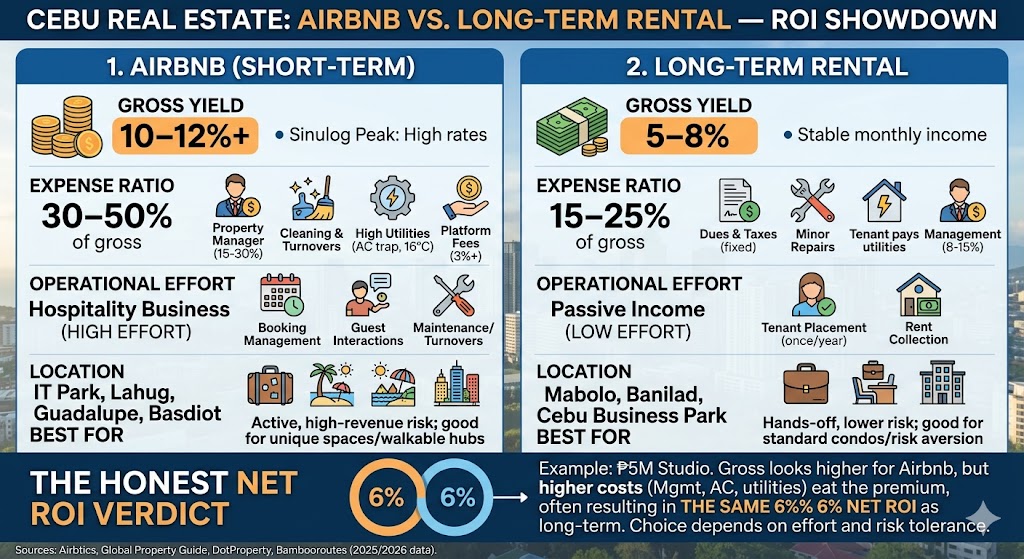
If you own a property here—or are looking to buy—you’ve likely seen the headline numbers: short-term rentals boast an alluring 12.3% gross annual yield, while traditional long-term leases sit at a more modest 5–8%.
But gross yield is a dangerous vanity metric. Let’s cut through the developer hype and calculate exactly what you keep after expenses.
🏠 The ROI Showdown: Gross vs. Net
Gross Rental Yield
Airbnb (Short-Term): 10–12% (can exceed 12% in prime spots)
Long-Term Rental: 5–8%
Occupancy Rate
Airbnb (Short-Term): 45–57% average
Long-Term Rental: 80–90% (plus long-term security)
Revenue Potential
Airbnb (Short-Term): Higher ceiling, lower floor
Long-Term Rental: Stable, predictable
Management Effort
Airbnb (Short-Term): High (guest turnover, cleaning, marketing)
Long-Term Rental: Low (once tenant is placed)
Expense Ratio
Airbnb (Short-Term): 30–50% of gross income
Long-Term Rental: 15–25% of gross income
A ₱5M studio pulling ₱30k/month long-term generates ₱360k annual gross (7.2% gross). After dues, taxes, maintenance → net ~6%.
The same unit on Airbnb at ₱387k annual gross (12% gross) incurs management fees, cleaning, utilities, platform fees, and higher wear-and-tear → often nets the same 6% – but you’re working full-time as a hotel operator.
📍 Location & Strategy: Neighborhood Breakdown
Your returns vary drastically by location. The market has segregated into highly specific sub-neighborhoods:
IT Park (Lahug/Apas)
- Optimal Strategy: Hybrid / Both
- Expected Gross Yield: 5.5–8% (long-term) / 10–12% (short-term)
- Market Dynamics: The most balanced hub. Strong BPO demand weekdays, tourists/digital nomads weekends. Over 1,200 active Airbnb listings.
Mabolo
- Optimal Strategy: Long-Term
- Expected Gross Yield: 7.7–8.7%
- Market Dynamics: Excellent local professional demand. Lower entry prices than IT Park mean superior long-term yields.
Cebu Business Park
- Optimal Strategy: Long-Term
- Expected Gross Yield: 3.6–4.2%
- Market Dynamics: Lower rental yields due to premium purchase prices. This is a play for capital appreciation, not monthly cash flow.
Guadalupe
- Optimal Strategy: Airbnb
- Expected Gross Yield: 5–7%
- Market Dynamics: 334 listings; lower nightly rates (₱1,616) but affordable entry prices.
Mactan / Lapu-Lapu
- Optimal Strategy: Long-Term (Premium)
- Expected Gross Yield: 5.8%+ (net)
- Market Dynamics: High expat premium. Crucial caveat: Many resort-condos here explicitly ban daily Airbnb rentals.
Basdiot (South Cebu)
- Optimal Strategy: Airbnb
- Expected Gross Yield: 36.3% occupancy, $618/month
- Market Dynamics: Higher revenue potential but less stable, seasonal.
💸 The Hidden Expenses That Kill Airbnb Net Yields
Airbnb can generate higher top-line revenue, but its operating costs generally eat 30–50% of gross income, compared to just 15–25% for a long-term lease. In Cebu, three specific drains catch investors off guard:
1. The Aircon Trap 🥶
Short-term guests pay a flat nightly fee – they have no incentive to conserve energy. It’s incredibly common for guests to leave the split-type AC running at 16°C while they head out on a 12-hour day trip to Oslob or Moalboal. With Cebu’s high electricity rates, this alone can drive a studio’s utility bill to ₱5,000–₱7,000 per month.
2. The Hands-Off Management Tax
Running an Airbnb is a hospitality business, not passive investing. If you’re an OFW or busy professional, you’ll need a property manager. In Cebu, full-service short-term management charges 15–30% of gross booking revenue. Long-term managers charge just 8–15%.
3. The Rapid Wear-and-Tear Cycle
To maintain the high ratings needed to survive among Cebu’s 4,000+ active listings, your unit must look flawless. Luggage scraping walls, heavy appliance use, constant linen laundering – budget roughly 10% of revenue for continuous maintenance and premium furnishing replacements.
Other Costs (Don’t Ignore These)
- Airbnb service fees: ~3% of booking subtotal + VAT
- Condo association dues: ₱50–150 per sqm monthly (e.g., ₱1,500–₱4,500 for a 30 sqm unit)
- Business permit & BIR registration – required by Cebu City LGU
- Property insurance – often higher for short-term rentals
📜 Regulations & Tax: The Gray Area You Can’t Ignore
Cebu City’s rules are surprisingly lenient – but that doesn’t mean you can ignore them.
Current requirements:
- Business permit (Mayor’s Permit + Barangay Clearance)
- BIR tax registration for all rental income
- DOT accreditation – the Department of Tourism is actively pushing Airbnb operators to comply; even micro-accommodations can qualify
- Condominium corporation approval – many buildings have bylaws explicitly banning short-term rentals or Airbnb. Check this before buying.
The big hidden issue: Traditional hotels are lobbying for stricter regulation, citing unfair competition from unlicensed Airbnbs that sidestep taxes. That pressure could tighten at any time.
For long-term rentals, the path is simpler: a standard lease agreement, security deposit handling, and registration with local authorities if required. Rent control only applies to units at ₱10,000/month or below – most investment condos are exempt.
⚠️ The Honest Risks: What Nobody Tells You
Airbnb Risks
- Oversupply is real. Revenue per listing declined 8.9% over three years while inventory surged.
- Occupancy is lower than you think – 45–57% average means your property sits empty nearly half the year.
- Foreigner ownership restrictions – you can own a condo as a foreigner, but land is off-limits.
- Condo rules can ban Airbnb overnight – if your building changes bylaws, your strategy dies.
- You’re competing with 4,000+ other listings. Standing out requires exceptional service and aggressive pricing.
Long-Term Rental Risks
- Eviction is slow and expensive – removing a non-paying tenant can take months and legal fees.
- Corporate tenants may withhold tax directly from rent payments.
- Rent control exists at lower price points (units under ₱10k/month).
- Capital appreciation is steady not explosive – 5–7% annually, not 20%+.
- Limited exit liquidity – selling a condo takes time.
🎯 Practical Decision Matrix: Which Is Better for You?
If you want… Higher potential gross income (and can handle the risk)
Choose… Airbnb
If you want… Passive, hands-off income with predictable cash flow
Choose… Long-term rental
If you want… To be close to tourist attractions or nightlife
Choose… Airbnb (IT Park, Lahug, Basdiot)
If you want… To be near BPO offices or business districts
Choose… Long-term rental (IT Park, Mabolo, Banilad)
If you want… To maximize net yield with minimal effort
Choose… Long-term rental
If you want… To actively manage your property as a business
Choose… Airbnb
If you want… To own in a building with restrictive condo rules
Choose… Long-term rental (your only option)
If you want… To avoid regulatory uncertainty
Choose… Long-term rental
Choose Airbnb IF:
- Your unit is a highly styled, uniquely designed studio or 1-bedroom in a hyper-walkable location (IT Park or near Ayala Center Cebu)
- You have local, low-cost trusted help to manage turnovers (not paying 25–30% to a manager)
- You want the flexibility to stay in the unit yourself when visiting Cebu
- Your building explicitly allows short-term rentals (get it in writing)
Choose Long-Term Rental IF:
- You want a completely passive investment
- You prefer a 12-month contract where the tenant pays utilities and covers day-to-day care
- Your vacancy risk drops close to zero
- You value sleep and sanity over the slim chance of 2–3% extra net yield
🔑 Best Strategy by Property Type
- Studio condos (25–35 sqm): Sweet spot for both. In IT Park or Mabolo, try Airbnb first for a year – you can always convert to long-term.
- 1-bedroom condos (35–50 sqm): Long-term tends to perform better. The higher monthly rent (₱20k–35k) from professionals offers better risk-adjusted returns.
- 2-bedroom condos (50–70 sqm): Long-term wins. Less competition, attracts families or senior professionals who stay for years.
- Houses/lots: Long-term only. Most residential houses restrict short-term rentals.
📝 The Honest Verdict
A ₱5 million studio condo renting long-term for ₱30,000 a month generates a net yield settling around 6% with almost zero monthly effort.
The exact same unit optimized for Airbnb might bring in more gross cash, but after stripping out platform fees, high utilities, a 25% management cut, and seasonal vacancies, it will likely net out to the exact same 6% return – except you’re working full-time as a hotel operator.
For most investors in Cebu City right now, long-term rental in a prime location (IT Park, Mabolo) is the safer, saner, more reliable wealth-building vehicle.
That said, Airbnb can work for the right investor in the right location. If you own in IT Park or Lahug, can self-manage or have cheap help, are prepared for seasonal swings, and have building approval upfront – you might beat long-term by 2–3 percentage points in net yield. But you’ll earn every extra peso with your time and stress.
Unless you enjoy running a hospitality business or have a deeply unfair advantage in low-cost property management, stick with long-term rental. You’ll sleep better. And your ROI will thank you.
Sources: Airbtics 2026 Market Data, Bambooroutes Cebu Property Reports 2026, RichestPH Cebu Rental Yield Analysis 2025, Global Property Guide Q1 2026, DotProperty Cebu Listings 2025, Cebu Grand Realty 2025, Philippine Star 2025, SunStar Cebu 2025
Contact Us
Author
John Paul Ybañez Paquibot
Licensed Real Estate Broker | PRC No. 00014132 | DHSUD No. CVRFO-B-03/18-2672
Bachelors Realty and Brokerage, Inc. Cebu
G/F Cap Building, Brgy. Corner, Osmeña Blvd.
Arlington Pond St. Extension, Cebu City, 6000 Cebu
Leave a Reply