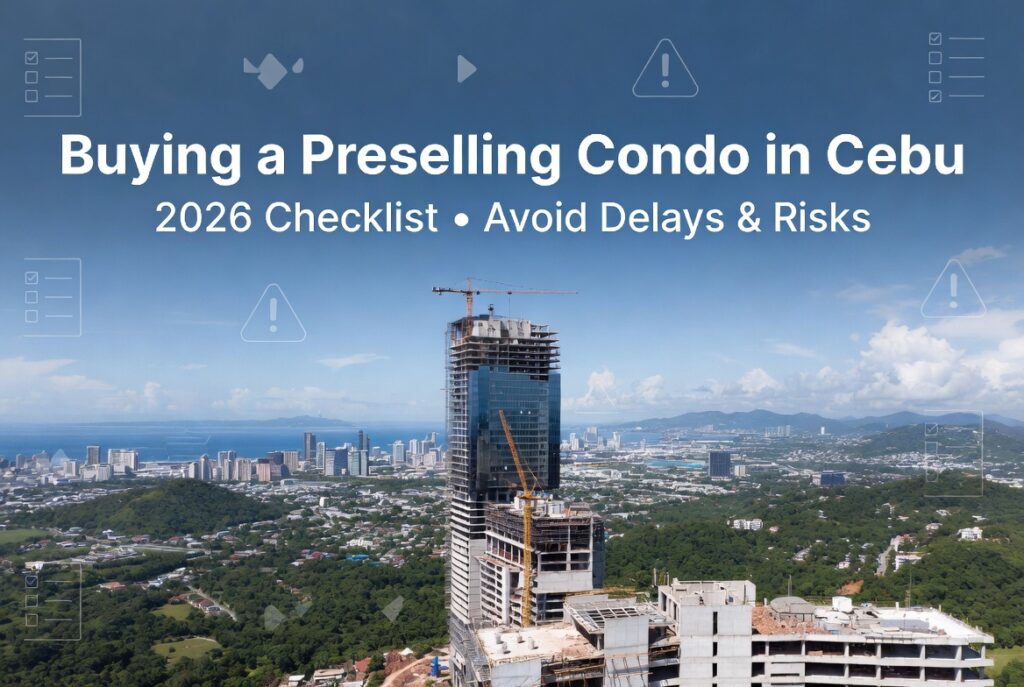
Buying a pre-selling condo in Cebu can be a smart move—lower entry prices, flexible payment terms, and potential appreciation. But without rigorous due diligence, you could face years of delays, surprise fees, or even a completely abandoned project.
This guide gives you a practical, Cebu-focused checklist to protect your hard-earned money. Use it before you pay a single peso.
📋 At-a-Glance: The 10-Step Buyer’s Checklist
#1 Action: Verify DHSUD License to Sell (LTS)
Why It Matters: Prevents buying into illegal or “ghost” projects.
#2 Action: Research developer’s track record
Why It Matters: Ensures they actually finish what they sell.
#3 Action: Physically visit the site
Why It Matters: Confirms location, flood risk, and real progress.
#4 Action: Budget 5–10% extra for hidden turnover fees
Why It Matters: Avoids nasty surprises at move-in.
#5 Action: Assume 6–12 months of delay
Why It Matters: Sets realistic expectations—be happy if it’s on time.
#6 Action: Review the Contract to Sell (CTS) carefully
Why It Matters: Protects your legal rights and specs.
#7 Action: Check penalty clauses for developer delays
Why It Matters: You deserve compensation if they’re late.
#8 Action: Secure bank or Pag-IBIG pre-approval
Why It Matters: Know your borrowing power before reserving.
#9 Action: Confirm the project’s loan tie-ups
Why It Matters: Ensures your chosen lender will finance it.
#10 Action: Keep a complete paper trail
Why It Matters: Essential for any future dispute or refund claim.
Now let’s dive into the details—because the fine print is where most buyers get burned.
Step 1: Do Your Homework Before You Even Visit a Showroom
Trust us—this step saves the most heartache.
🔍 Verify the DHSUD License to Sell (LTS)
The most critical step: confirm the developer has a valid License to Sell (LTS) from the Department of Human Settlements and Urban Development (DHSUD). Selling a property without an LTS is illegal.
How to verify in Cebu:
- Ask the developer or agent for the LTS number.
- Contact the DHSUD Central Visayas Regional Office directly to cross-check:
3rd Floor, J.G. Arcade Building, Legaspi Street, Brgy. Kamputhaw, Cebu City
Tel: (032) 412-3521 - If the LTS cannot be produced or verified, walk away immediately.
⚠️ Why this matters: If a developer sells without an LTS and later abandons the project, your chances of a refund plummet—and the developer can face criminal liability.
👷 Check the Developer’s Track Record—Including Cebu’s Problem Developers
A glossy brochure means nothing without a track record.
Ask these questions:
- How many projects has this developer completed in Cebu?
- What was their average turnover delay in past projects?
- Can they provide references of past buyers you can actually call?
- Are they a major player like Cebu Landmasters (CLI) (₱3.1B net income in 2025) or a one-project startup?
⚠️ Cebu red flag alert (2026):
The DHSUD-7 has confirmed a rising number of cases involving non-compliant developers in Cebu. Below are real examples that made news this year:
Developer: Azzela Properties
Issue Summary: Failed to deliver units in Minglanilla despite years of payments; buyers visited site to find no construction. NBI investigation ongoing as of March 2026.
Developer: Tumabini Land Development Corp.
Issue Summary: Alleged illegal selling, bouncing checks, syndicated estafa in Carcar City, Consolacion, and Cebu City. Developer allegedly had no License to Sell.
🧠 Takeaway: If a developer’s name appears in complaints, don’t rationalize it. Just walk.
🏗️ Visit the Site—Yes, Even Before Groundbreaking
Never rely solely on artist’s renderings or a fancy showroom.
Go to the actual location and check:
- Is the land surveyed, fenced, and cleared?
- Are there construction materials or equipment on site?
- Can you talk to residents of nearby buildings about flooding, traffic, or noise?
- Does the neighborhood match the developer’s promises?
Step 2: Master the Financials Before You Sign
The price tag on the brochure is never the final number.
💰 Understand the Total Contract Price—Including Hidden Fees
Pre-selling discounts of 5–15% sound great, but separate contract price from actual cash out.
Common hidden costs you’ll pay at turnover:
Creditable Withholding Tax (CWT)
Estimated Rate: 1.5% of selling price/zonal value (whichever higher)
Who Pays: Buyer
Documentary Stamp Tax (DST)
Estimated Rate: ₱15 per ₱1,000 of property value
Who Pays: Buyer
Transfer Tax
Estimated Rate: 0.5% to 0.75% of selling price (depends on LGU)
Who Pays: Buyer
Registration/Notarial Fees
Estimated Rate: Variable
Who Pays: Buyer
Turnover/Taxes Fees & Expenses
Estimated Rate: Some developers charge ~6% of TCP for “TTFE”
Who Pays: Buyer ⚠️
Example: A ₱3,000,000 studio can easily add ₱60,000–₱180,000+ in mandatory taxes and fees at turnover.
📌 New 2026 concern: BIR’s RMC 31-2025 broadly includes transfer fees, processing fees, and miscellaneous fees in the definition of “taxable income.” Make your broker spell out which fees are VAT-inclusive before you sign.
📉 Factor in a 6–12 Month Delay (At Minimum)
Here’s the brutal truth: delays are the norm, not the exception.
Industry insiders recommend factoring in at least 6 months to a year of potential delay beyond the stated turnover date. Be pleasantly surprised if it arrives on time, not crushed if it doesn’t.
📊 Budget for the “Hidden Monthly Costs” After Turnover
Your monthly amortization is only part of the story. After you move in, you’ll pay:
- Association dues – Typically ₱50–100 per square meter in Cebu
- Real property tax – Annual, based on assessed value
- Insurance – Fire and mortgage redemption
- Utilities connection fees – Electricity, water, internet
Step 3: Review the Contract Like a Forensic Accountant
Never, ever sign a Contract to Sell (CTS) without a thorough review.
📝 The Non-Negotiable Clauses You Must Check
Turnover date
What to Look For: Must be an absolute date (e.g., “on or before December 31, 2027”) – no “estimated” or “targeted” language
Delay penalties
What to Look For: What compensation does the developer owe you for each month of delay?
Force majeure definition
What to Look For: Limited to truly unforeseeable events (natural disasters, not “permit delays”)
Refund terms
What to Look For: Under PD 957, you can cancel and demand a full refund + legal interest if the developer fails to deliver. Does your contract say that?
Unit specifications
What to Look For: Detailed floor plan, finishes, appliances, and common area amenities – no vague language
Non-waiver of rights
What to Look For: Any clause making you waive your right to file a complaint is legally void
🚨 Red Flags That Should Make You Walk Away
- The agent rushes you to sign without a lawyer.
- The contract contains an unfair or unconscionable clause that strips your rights under PD 957.
- No penalty clause for developer delays.
- No breakdown of hidden turnover fees.
- The turnover date is “estimated” or “targeted” rather than fixed.
Step 4: Secure Your Financing—In Writing
Don’t assume you’ll qualify for a loan when the time comes.
🏦 Pre-Approval vs. Reservation
Bank Financing:
- Secure pre-approval from a bank before paying a reservation fee. It’s free and gives you confidence.
- Typical pre-selling loans require 10-20% down payment (equity) paid over 1-3 years, with the remaining 80-90% financed via bank loan at turnover.
Pag-IBIG Financing:
- Must be an active member with at least 24 months of savings (not necessarily consecutive).
- Lower interest rates, but lower maximum loan amounts – better for units under ₱3-5 million.
✍️ Put the Financing Terms in Writing
Before signing, confirm with the developer:
- Is the project Pag-IBIG accredited? If not, Pag-IBIG financing won’t be an option.
- Which banks have approved the project for financing?
- Will the developer assist with loan take-out paperwork?
Step 5: Monitor the Construction—Don’t Be a Passive Buyer
You’ve signed and paid. Now the real vigilance begins.
👀 Monthly Drive-By Checks
Visit the construction site monthly and document:
- Take photos and videos from the same angle each visit.
- Keep a log of worker activity (none? minimal? full crew?).
- Look for permit postings (building permit, occupancy permit).
📧 Request Written Progress Updates
Ask the developer for quarterly construction progress reports in writing. If they can’t or won’t provide them, that’s a red flag.
📞 Build a Relationship with Your Agent
A good agent will fight for you. Check in regularly and ask hard questions:
- “What percentage of construction is complete?”
- “What permits are still pending with the local government?”
- “Have there been any change orders affecting unit layouts?”
Step 6: Know Your Legal Recourse Before You Need It
Hope for the best, but prepare for the worst.
🛡️ Your Rights Under Philippine Law
You have significant legal protections under Presidential Decree 957 and the Maceda Law (RA 6552):
- Right to cancel and claim a full refund if the developer fails to deliver within the prescribed period.
- Right to suspend payments after giving written notice for delays.
- Right to file a complaint with HSAC (Human Settlements Adjudication Commission).
- Right to recover payments plus legal interest if the developer’s License to Sell was invalid.
📂 How to File a Complaint in Cebu
If the developer misses deadlines or stops communicating:
- Send a formal demand letter to the developer via registered mail (keep proof).
- File a complaint with the DHSUD Regional Office for mediation:
DHSUD Central Visayas, 3rd Floor, J.G. Arcade Building, Legaspi St., Cebu City - If unresolved, escalate to the HSAC Regional Adjudication Branch (RAB) VII in Cebu City. HSAC has jurisdiction over refund claims and disputes.
💡 Tip: Keep all receipts, contracts, and email correspondence organized from day one. You’ll need them if you ever go to HSAC.
📈 The 2026 Cebu Market Reality Check
To make an informed decision, you need context.
- As of end 2025, Cebu’s condominium stock reached 92,300 units – the largest supply outside Metro Manila.
- Total supply is projected to reach 109,000 units by end 2029 (substantial completions from 2026–2029).
- Despite this, Cebu sustained strong demand in early 2026 with an 87% condominium take-up rate in Q1.
What this means for you:
More supply means more choices – but also more variance in developer quality. A preselling unit in a prime Cebu City or Mactan location with a reputable developer can still be a great investment. A project in a questionable location with an unknown developer is a gamble you may not want to take.
⚠️ Hidden 2026 risk: DHSUD’s LTS approval bottleneck has quietly become a major risk for preselling projects. Even honest developers can face delays because the government itself is slow to issue licenses. Ask if the developer already has their LTS – not just “applied for.”
✅ Final Printable Checklist
Print this page and check off each item before you hand over a single peso:
#1
Action: Verified DHSUD License to Sell with regional office
✓: ☐
#2
Action: Researched developer track record – talked to past buyers
✓: ☐
#3
Action: Physically visited the site – not just showroom
✓: ☐
#4
Action: Budgeted for hidden turnover fees (5-10% extra minimum)
✓: ☐
#5
Action: Factored in 6-12 months of delay into your timeline
✓: ☐
#6
Action: Reviewed the entire Contract to Sell – preferably with a lawyer
✓: ☐
#7
Action: Confirmed exact penalty clause for developer delays
✓: ☐
#8
Action: Secured bank or Pag-IBIG pre-approval before reservation
✓: ☐
#9
Action: Confirmed developer’s loan tie-ups (banks/Pag-IBIG)
✓: ☐
#10
Action: Photographed every document, receipt, and email – organized a paper trail
✓: ☐
🧭 Bottom Line
A preselling condo can be a smart investment in Cebu’s growing market – but only if you go in with your eyes wide open. The discounts can be compelling, but the risks of delays, hidden fees, and even unscrupulous developers are very real.
The golden rule: Never fall for a “too good to be true” deal. If the price is dramatically lower than comparable projects, ask yourself why. And always, always verify the DHSUD License to Sell before you hand over your reservation fee.
Disclaimer: This article is for informational purposes only and does not constitute legal advice. Laws and regulations may change, and each case is unique. For specific legal concerns, consult a licensed attorney.
Related reads on SeekCebu:
- How to Handle a Delayed Turnover in Cebu: A Step-by-Step Guide for Buyers (2026)
- Johndorf Ventures Review: Is This Cebuano Developer Worth Your Trust?
- Hidden Costs of Owning a Condo in the Philippines: Beyond the Brochure
Contact Us
Author
John Paul Ybañez Paquibot
Licensed Real Estate Broker | PRC No. 00014132 | DHSUD No. CVRFO-B-03/18-2672
Bachelors Realty and Brokerage, Inc. Cebu
G/F Cap Building, Brgy. Corner, Osmeña Blvd.
Arlington Pond St. Extension, Cebu City, 6000 Cebu
Leave a Reply