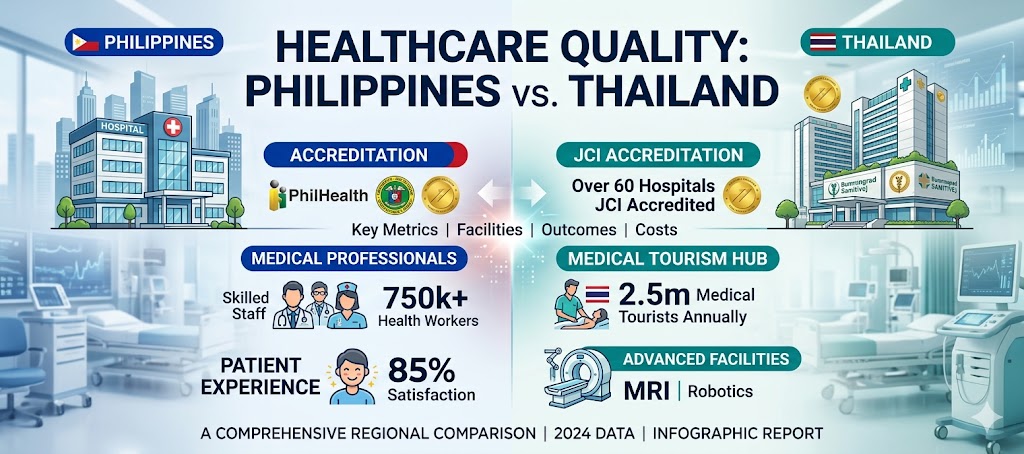
If you are over 50 and planning a Southeast Asian retirement, let us cut to the chase: healthcare is not a “nice to have.” It is the single most important variable in your decision. Not the cost of rent. Not the visa fees. Not the quality of the internet. Healthcare.
The 2026 data presents a nuanced picture. The Retirement Abroad Index 2026 by the Expatriate Group officially ranks the Philippines as the #1 global retirement destination—a testament to its visa accessibility, affordability, and social integration. Thailand sits at a close #2. But when we isolate healthcare infrastructure, Thailand remains the regional benchmark.
Here is the honest, ground-level comparison you need to make an informed decision.
1. Healthcare Philosophy: Institutional Power vs. Human Connection
The two countries approach healthcare from fundamentally different angles, and understanding this philosophical divide will tell you more than comparing hospital bed counts.
Thailand operates on a model of institutional excellence. The government has spent decades building a medical tourism empire. Hospitals like Bumrungrad—ranked #96 in Newsweek’s World’s Best Hospitals 2026—are international brands with standardized, repeatable, and highly efficient processes. Thailand operates on a “five-star hotel” model of care. You receive predictable, high-acuity support across their major cities. The systems are flawless, the protocols are relentless, and the quality control is world-class.
The Philippines takes a human-centric approach. The system is less centralized and less standardized, but it excels in patient-provider communication. Because English is the primary language of medical education and practice, the “quality of experience” is entirely different. You can discuss a chronic condition, argue a billing error, and understand your discharge instructions without a translator, an app, or a Thai-speaking friend. You are a participant in your care, not just a patient. The diagnostic explanations are clearer. The insurance paperwork is comprehensible. The emotional friction of navigating a foreign healthcare system simply evaporates.
The honest trade-off: Thailand gives you a flawless machine. The Philippines gives you a fluent conversation.
2. Quality and Accreditation: The JCI Context
The gold standard for hospital quality is Joint Commission International (JCI) accreditation. Both countries host internationally recognized, JCI-accredited facilities, but the “depth” differs significantly.
Thailand boasts a wider network of JCI-accredited hospitals that are consistent across the country. Bangkok Hospital Headquarters earned its sixth consecutive JCI accreditation in 2023. MedPark Hospital achieved its second consecutive term in February 2026. Whether you are in Bangkok, Chiang Mai, or Phuket, you can expect a reliable, world-class standard. Thailand has built a deep bench of quality that extends beyond the capital.
The Philippines has elite flagship institutions that are globally competitive. St. Luke’s Medical Center in Quezon City was the first hospital in the Philippines—and only the second in Asia—to achieve JCI accreditation back in 2003. It remains the country’s only JCI-accredited Academic Medical Center. In 2026, St. Luke’s earned additional JCI Clinical Care Program Certification for its kidney transplant program, scoring an extraordinary 9.9 out of 10. The Medical City in Pasig also took top honors at the Healthcare Asia Awards 2026.
The catch? Quality is “clustered” in the Philippines. The drop-off from St. Luke’s to a provincial hospital is steep and sudden. In Thailand, the drop-off is gentler; the national integration of healthcare is simply better. In the Philippines, your healthcare quality is directly proportional to your proximity to a major urban hub—Manila or Cebu.
3. The Cost of Care: The “Mandatory” vs. “Voluntary” Trap
The narrative that healthcare in Thailand is roughly 56% more expensive than in the Philippines is broadly accurate for out-of-pocket costs. Monthly insurance premiums average $100 in Thailand versus $75 in the Philippines. Doctor visits and dental care cost nearly 70% more in Thailand.
But the real cost difference is not about the sticker price. It is about the insurance strategy each country forces upon you.
Thailand offers forced protection. If you are on an O-A retirement visa, Thailand mandates health insurance with a minimum coverage of 3,000,000 Baht (roughly $84,000 USD). While this increases your annual budget, it effectively eliminates the risk of being underinsured. You cannot gamble with your health because the government will not let you.
The Philippines presents a hidden risk. Health insurance is not mandatory for the SRRV visa. While this lowers the “entry cost” of your visa, it creates a dangerous temptation for retirees to skip comprehensive coverage. This is the single most common financial disaster among expats. One emergency hospitalization for a cardiac event can wipe out a year’s worth of “savings.”
The honest verdict: Do not fall into this trap. Treat comprehensive international health insurance as a non-negotiable expense, regardless of which country you choose. If you cannot afford it, you cannot afford to retire in either nation.
4. Strategic Location: Your Zip Code is Your Health Outcome
In 2026, the gap between urban and rural health services remains the most critical metric for retiree health outcomes.
Thailand offers better national integration. You have several secondary cities—Chiang Mai, Hua Hin, Phuket—that offer reliable, modern medical access comparable to Bangkok. You have geographic flexibility without sacrificing quality.
The Philippines demands that you choose your home base strategically. Your quality of life is heavily dependent on being within 30 to 60 minutes of a major medical center. If you choose the provincial islands or remote beach towns, you are effectively betting that you will never have a serious medical emergency. The moment you do, you are looking at a costly and stressful evacuation to Manila or Cebu.
The honest advice: If you choose the Philippines, do not retire to a remote province unless you are young, healthy, and have a robust evacuation plan. If you choose Thailand, you have more flexibility, but the same rule applies—stick to major cities or well-serviced hubs.
The Final Verdict for 2026
Choose Thailand if: You prioritize the “Safety-First” model. You want institutional consistency, world-class specialist care, and a system where high standards are mandated by the state. You are willing to pay the higher premiums and navigate annual visa renewals in exchange for a highly predictable medical environment. Thailand is the choice for the retiree who wants to minimize surprises.
Choose the Philippines if: You prioritize the “Integration” model. You want the lowest possible friction in daily life, where you can speak to your cardiologist and navigate your insurance billing in your native English. You are willing to accept traffic congestion and higher energy costs in exchange for a lifetime, “set-and-forget” visa (SRRV) and more seamless social integration.
The Pro Strategy for 2026
Do not rely on “country-wide” rankings. Your medical reality is determined by the hospital within 10 kilometers of your front door, not by a national average.
If you are serious about a specific city—whether it is Cebu, Chiang Mai, Bangkok, or Davao—check the Newsweek 2026 World’s Best Hospitals list for that exact location. It is the most accurate, up-to-date benchmark for your actual, day-to-day access to top-tier care.
Then, do this: Contact those hospitals directly. Get quotes for a routine check-up and for a hypothetical emergency procedure. Ask about their JCI accreditation status. Speak to expats in local Facebook groups who have undergone similar treatments.
And most importantly: secure your health insurance before you land. In Thailand, it is a visa requirement. In the Philippines, it is not—but if you skip it, you are not retiring; you are gambling. And at 50, 60, or 70 years old, that is a bet you will eventually lose.
Choose the country that gives you the care you need, at a price you can honestly afford, in a language you understand. Everything else—the beaches, the food, the nightlife—is secondary. Your health is the foundation on which your entire retirement is built. Do not build it on sand.
Author
John Paul Ybañez Paquibot
Licensed Real Estate Broker | PRC No. 00014132 | DHSUD No. CVRFO-B-03/18-2672
Bachelors Realty and Brokerage, Inc. Cebu
G/F Cap Building, Brgy. Corner, Osmeña Blvd.
Arlington Pond St. Extension, Cebu City, 6000 Cebu
Leave a Reply