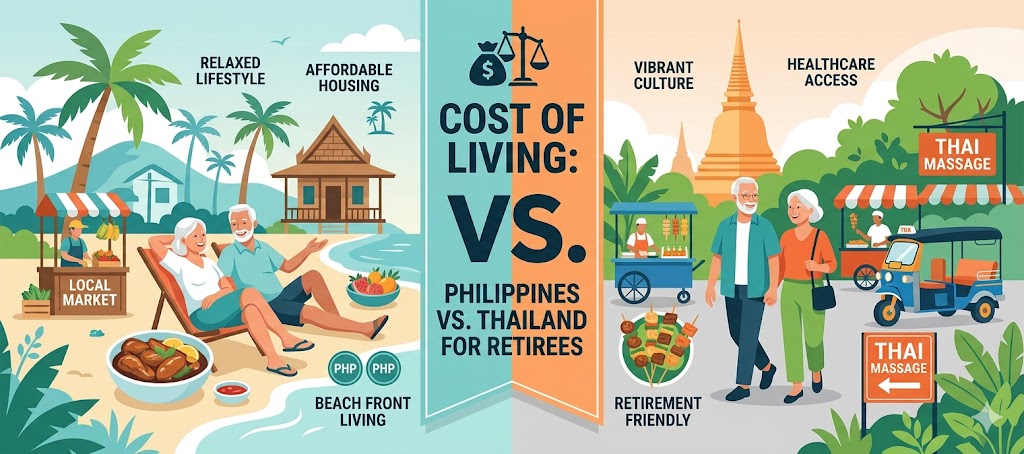
The $1,000-a-month dream is officially retired. As of June 2026, the choice between the Philippines and Thailand is no longer about which beach has whiter sand. It is a hard-nosed strategic decision where you must weigh regulatory reform against infrastructural reliability, and absolute cost against price stability.
Forget the outdated travel blogs. Here is the ground-truth reality of what your money, time, and daily sanity will actually look like this year.
The Economic Landscape: Decoding the Inflation Paradox
The inflation numbers for 2026 present a fascinating contradiction that most expats misinterpret.
The Philippines recently posted a remarkably low headline inflation rate of around 2.0% for January 2026, sitting comfortably within its government target. Thailand, meanwhile, is forecasting a slightly tighter band averaging between 1.3% and 2.9%. On paper, both economies look stable.
However, here is the honest distinction: Thailand offers predictability; the Philippines offers a lower sticker price. Comparative indices from mid-2026 clearly show that the absolute cost of living—covering rent, groceries, and utilities—remains approximately 26% to 35% lower in the Philippines than in Thailand.
The catch? The Philippines remains structurally vulnerable to fuel and energy shocks. While its headline inflation is low right now, a global oil price spike hits Philippine electricity bills much harder than it hits Thailand’s more diversified grid. If you are on a fixed pension, Thailand provides a smoother, less volatile ride. If you have a flexible budget and want your physical cash to go further, the Philippines wins on raw affordability—provided you accept the energy wildcard.
Residency and Red Tape: The 2026 Shake-Up
This is the year everything changed. If you haven’t looked at visa rules since 2024, you are operating on obsolete information.
The Philippines (SRRV Reforms): The September 2025 reforms were a seismic shift. The minimum age for the Special Resident Retiree’s Visa has dropped to 40, opening the door to early retirees. The deposit structure is now tiered, ranging from a remarkably low $1,500 to $50,000, depending on your exact age bracket and whether you have a guaranteed monthly pension.
The core benefit remains untouched: this is a lifetime visa with no annual reporting to the Bureau of Immigration. It is the ultimate “set and forget” solution. The trade-off, however, is liquidity. Your deposit is a locked asset, though the 2026 rules now allow you to convert that deposit directly into a condo purchase or a long-term lease—effectively turning a sunk cost into an appreciating asset.
Thailand (Digitalization and the LTR): Thailand has finally listened to expat complaints. The 90-day reporting requirement is increasingly handled via the ‘ThaID’ mobile app, and the E-Visa portal has streamlined entry. However, the annual renewal for the standard O-A retirement visa remains a mandatory, in-person procedural requirement.
For those with deeper pockets, the Long-Term Resident (LTR) visa remains the premium route, offering a 10-year stamp for wealthier applicants who meet higher financial thresholds. For the average retiree, however, Thailand still demands a yearly administrative “check-in” that the Philippines has completely abolished.
Infrastructure vs. Human Connection: The Daily Friction Test
This is where you stop looking at spreadsheets and start looking at your own tolerance for irritation.
Thailand’s Predictability: If you value efficiency, Thailand is unbeatable. The BTS Skytrain runs like clockwork. The private hospitals maintain a consistent, globally accredited standard. The utility grids are stable. If you want a “Western-adjacent” level of urban convenience, Thailand delivers it seamlessly.
The Philippines’ Social Ease: The Philippines offers a different kind of ease—one that is linguistic and cultural. Because English is an official language, you are never lost in translation. You can discuss a chronic health condition with your cardiologist in fluent English. You can haggle at the market and joke with your neighbors from day one. You aren’t just an expat; you are an active, verbal participant in the local economy.
The honest trade-off is mobility. To get that social ease in the Philippines, you must accept the gridlock of Metro Manila or the underdeveloped public transport of secondary cities. In Thailand, you get the smooth roads and trains, but you must accept that navigating bureaucracy, healthcare paperwork, and daily errands will always require a translation app or a Thai-speaking friend.
Budgeting for 2026: The Reality Check
Let us kill the “shoestring” fantasy right now. To maintain a Western-standard lifestyle in 2026—meaning modern, air-conditioned housing, reliable high-speed fiber internet, and comprehensive private health insurance—you need a realistic baseline of $2,200 to $3,200 per month in the major urban centers of either country.
Yes, you can technically survive on $1,200 to $1,600 in provincial areas. But be brutally honest with yourself: at that level, you are adopting a local standard of living. That means rationing your air-conditioning, relying on public jeepneys or songthaews, and eating a locally sourced diet. It is doable, but it is austerity, not the “expat dream.”
The 20% Non-Negotiable Buffer: Regardless of which flag you fly, add a 20% contingency to your calculated budget. Medical costs in Southeast Asia have seen significant upward pressure since 2025. Assuming you can skip international health insurance to save a few hundred dollars a month is the single most catastrophic financial mistake you can make. One emergency hospitalization will wipe out a year’s worth of “savings.”
The Final Strategic Verdict for 2026
Your decision is not about which country is “better.” It is about which set of frustrations you are personally equipped to handle.
Choose the Philippines if: You crave the administrative peace of a lifetime visa (thanks to the new SRRV reforms) and you value waking up in a country where you can speak, shop, and seek medical care without a language barrier. You accept that your electricity bill will be a gamble, and you are willing to trade traffic jams for effortless human connection.
Choose Thailand if: You prioritize superior urban infrastructure, standardized medical excellence, and a stable, predictable economic environment. You are comfortable with the annual renewal cycle and you are tech-savvy enough to leverage their new digital reporting systems. You accept that you will remain a linguistic outsider, but you gain the convenience of a world-class transit system.
The Pro Strategy: Test Your Friction Threshold
Do not rely on averages or YouTube vlogs. If you are serious about a 2026 relocation, treat it like a business diligence process. Rent an Airbnb for 30 days in a residential neighborhood—not a tourist enclave—in Cebu City, and another 30 days in Chiang Mai or Bangkok.
During those stays, do not act like a tourist. Pay your own utility bills. Navigate the local government offices for a simple errand. Visit the supermarket for a full month’s groceries. Get a routine blood test at a local hospital.
The place where your daily frustrations are lowest is your true destination. At the end of the day, retirement is about reducing stress, not optimizing a spreadsheet. Choose the nation where you can breathe easily, navigate confidently, and afford to live without constantly checking your bank balance. That is the only metric that truly matters.
Author
John Paul Ybañez Paquibot
Licensed Real Estate Broker | PRC No. 00014132 | DHSUD No. CVRFO-B-03/18-2672
Bachelors Realty and Brokerage, Inc. Cebu
G/F Cap Building, Brgy. Corner, Osmeña Blvd.
Arlington Pond St. Extension, Cebu City, 6000 Cebu
Leave a Reply