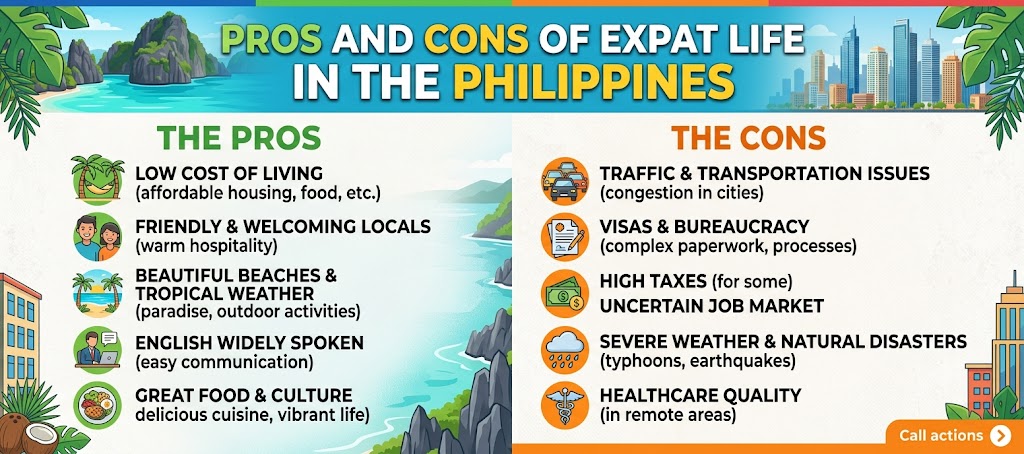
The Philippines has become an increasingly popular destination for expats, retirees, and digital nomads. In 2026, it was named the world’s best place to retire by the Retirement Abroad Index, scoring 78 out of 100 for its combination of affordability, visa accessibility, and community.
But as with any major life decision, the reality is more nuanced. Success here often depends on balancing the country’s undeniable charms against its systemic challenges. Here is the unvarnished truth.
The Pros: Why Many Choose to Call the Philippines Home
Remarkable Affordability
This is the Philippines‘ biggest draw. Your money stretches significantly further than in most Western countries. A retired couple can live comfortably on around £750 to £1,000 per month, though costs are higher in Manila than in smaller cities and coastal communities. Overall, living expenses are about 50% to 90% cheaper than in the United States.
Housing is particularly affordable. A one-bedroom apartment in the city center can cost as little as PHP 10,000 (around USD 200) per month. Even in central Manila, you’ll find options ranging from PHP 25,000 to PHP 45,000 monthly, while smaller cities and suburbs offer apartments for PHP 10,000 to PHP 20,000. Street food is both delicious and cheap, often costing less than a dollar per meal.
In the Expat Insider 2025 survey, a remarkable 74% of expats reported feeling they are paid fairly—far exceeding the global average. The Philippines also ranks among the most affordable destinations for expats globally.
Genuine Warmth and Effortless Community
Filipino culture is famously hospitable. Expats consistently report that forming social circles is easier here than in many other parts of Asia. You’ll get invited to family gatherings, karaoke nights, and local fiestas almost immediately.
Crucially, English is an official language, which removes a common barrier to integration. You can navigate daily life, handle bureaucracy, and access healthcare without needing to learn Tagalog—though learning a few basic phrases will certainly endear you to locals. The Philippines ranks high for ease of settling in, making it one of the easiest places in the world to find friends and feel at home.
Beautiful Natural Environment
The Philippines is an archipelago of more than 7,000 islands with pristine beaches, lush forests, and breathtaking mountains. Palawan’s crystal-clear waters, Bohol’s Chocolate Hills, and the Banaue Rice Terraces are just a few examples. Whether you prefer world-class diving, surfing in Siargao, or the cool highland climate of Baguio, the sheer variety of landscapes is a primary draw for a relaxed, nature-focused lifestyle.
Accessible and Updated Visa Pathways
The Philippines has dramatically improved its visa offerings for foreigners.
- For Retirees: The Special Resident Retiree’s Visa (SRRV) remains among the most attractive programs globally. Applicants aged 50 and over who receive a pension can qualify with a fixed deposit of just USD 15,000. As of July 2025, there were approximately 60,000 active SRRV holders. In a recent change, foreign nationals aged 40 to 49 are now also eligible, subject to higher deposit requirements. SRRV holders enjoy indefinite stay, multiple-entry privileges, and exemptions from certain taxes.
- For Remote Workers: Following Executive Order No. 86 in 2025, the Philippines launched its Digital Nomad Visa. This allows remote workers earning at least USD 2,000 per month from a foreign employer to live in the country for up to two years, tax-free. This has opened new doors for location-independent professionals.
The Cons: The Realities of Daily Life
Infrastructure and Transit
This is arguably the biggest frustration for expats. Major cities, particularly Manila, are notorious for heavy traffic. This isn’t just “bad” traffic—it is a psychological drain. A 5-kilometer commute can easily take 90 minutes. Roads are perpetually clogged, and public transport is often unreliable, uncomfortable, or unpredictable.
Beyond the capital, you will encounter frequent power outages (“brownouts”) and notoriously unreliable internet outside premium business districts like BGC or Makati. Expats report being profoundly frustrated by the poor air quality and the sheer inefficiency of getting from point A to point B.
Bureaucracy is an Ordeal by Paper
Everyday tasks that would be simple back home can become multi-week ordeals. Forget online portals. Government offices still run on carbon paper, handwritten ledgers, and typewriters.
To open a simple savings account, expect to submit a utility bill, a barangay clearance, your passport, your visa, and two reference letters—all in person. You will make multiple visits, because the first clerk will send you away for a missing stamp, and the second will find a different missing document. Supermarket queues move at a glacial pace, yet no one seems particularly bothered by it. This “lack of digitization” requires the patience of a saint.
Healthcare Quality Varies Dramatically—And Payment is a Trap
The quality of healthcare is a mixed bag, ranging from world-class to bare-bones. Major cities like Manila and Cebu offer access to modern private hospitals with internationally accredited facilities and English-speaking professionals. However, standards drop significantly outside these urban centres, where rural clinics often have outdated equipment and a shortage of staff.
Here is the critical reality that glossy guides leave out: private hospitals will refuse to admit you (except in life-or-death emergencies) without a cash deposit or a letter of guarantee from your insurer. You cannot just flash a health insurance card and walk in. If you are admitted, they will treat you and then stop further non-emergency procedures until the next payment is secured. Comprehensive health insurance isn’t a suggestion; it is a survival tool. Without it, even a minor surgery can quickly drain your savings.
Safety Requires Street Smarts
The “exercise increased caution” advisory is real. Beyond pickpocketing, riding-in-tandem snatch thefts—armed assailants on motorcycles grabbing bags or phones from pedestrians—are prevalent in urban centres. Drive-by robberies are common and considered opportunistic.
The statistics are sobering. According to Philippine National Police data, compared to Japan, robbery occurs about three times more frequently, homicide about four times more, and non-consensual sex about twice as often. In the first nine months of 2025 alone, 1,590 foreigners became crime victims in the Philippines. Common advice from authorities: don’t display wealth, avoid walking alone at night, and stay hyper-aware of your surroundings. You cannot walk around obliviously staring at your iPhone.
The Climate is Relentless
The tropical maritime climate means it is hot and humid year-round. But the dry season (March to May) brings something far worse: a heat index that frequently hits 45°C (113°F) with 80% humidity. You will sweat through your clothes just walking to the corner store. This fundamentally changes how you structure your day—errands are done at dawn or dusk, and afternoons are for air-conditioned hibernation.
Conversely, the rainy season brings 15 to 20 major typhoons annually, alongside regular earthquakes and occasional volcanic eruptions. You are living in a disaster-prone zone; preparedness isn’t optional, it is mandatory.
Imported Goods Are Expensive
While local goods and services are cheap, imported items can be costly. If you have specific dietary preferences, need particular Western brands, or want quality imported wine or cheese, expect to pay a significant premium. Your monthly budget can inflate quickly if you refuse to adapt to local products.
The Bottom Line
Living in the Philippines is a study in contrasts. It is a country that offers profound financial and social rewards, where the warmth of the people and the beauty of the islands can make you feel at home very quickly. However, it also demands a “go-with-the-flow” attitude.
As Dr. Alicor Panao, a data scientist at the University of the Philippines, put it: “For expats, life in the Philippines is a mixed bag. The country’s greatest appeal seems to be in the financial and social dimensions.”
The specific trade-off is this: You get financial freedom and social belonging, but you trade away efficiency, convenience, and predictability.
If you move here expecting everything to work like it does back home, you will find yourself perpetually frustrated. If you move here seeking a lifestyle that prioritizes connection and affordability over rigid structure, and you can laugh at bureaucratic absurdities rather than rage against them, you may find it to be one of the best decisions you ever make.
Pro Tip: Before committing to the SRRV or Digital Nomad Visa, treat your first few months as a trial run. Rent a place on a standard tourist visa. Live through the heat. Go to a local city hall and experience the bureaucracy firsthand. Sit in rush-hour traffic once. If you can still smile after that, the Philippines is absolutely for you.
Author
John Paul Ybañez Paquibot
Licensed Real Estate Broker | PRC No. 00014132 | DHSUD No. CVRFO-B-03/18-2672
Bachelors Realty and Brokerage, Inc. Cebu
G/F Cap Building, Brgy. Corner, Osmeña Blvd.
Arlington Pond St. Extension, Cebu City, 6000 Cebu
Leave a Reply