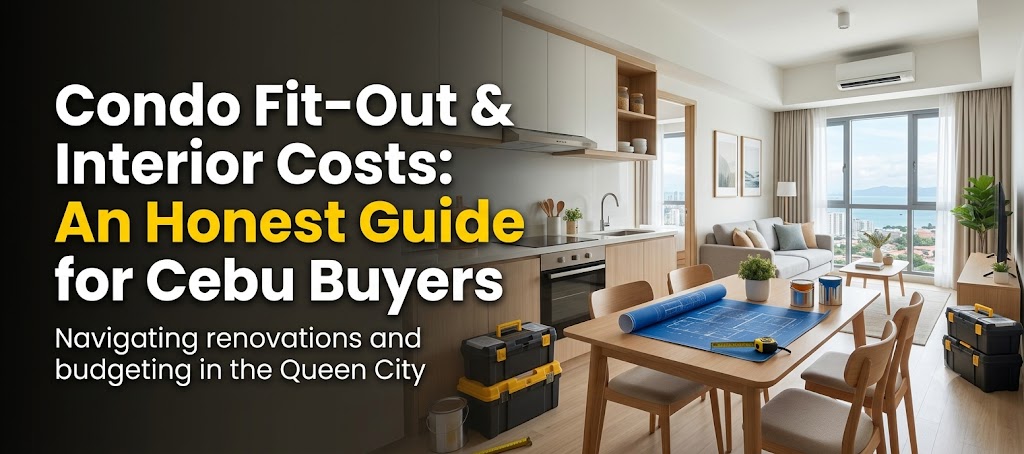
You’ve signed the papers. The keys are in your hand. You walk into your bare Cebu condo—concrete floors, unpainted walls, bare lightbulbs hanging from the ceiling. It’s a blank canvas. And now you’re staring at it, wondering: how much is this actually going to cost?
Here’s the honest answer: anywhere from PHP 300,000 to over PHP 1.5 million for a typical 30 to 50 square meter unit. That’s a massive range, and the difference comes down to one question: what are you trying to do with this space?
This guide breaks down what things actually cost, where your money goes, and most importantly—where it shouldn’t.
Part 1: The Big Picture—What You’re Actually Paying For
Before we talk numbers, let’s clarify what a “fit-out” means. A fit-out transforms a bare condo unit into a livable or rental-ready space. It includes design, construction, electrical work, finishes, and furniture. A renovation, by contrast, upgrades an existing unit.
For a 50-square-meter Cebu condo, a full interior fit-out typically ranges from PHP 550,000 to PHP 750,000 covering essential furnishings and finishes. But that’s just one data point. The real story is in the details.
The honest take: The cheapest option is rarely the best value, and the most expensive option rarely delivers the best return. The sweet spot for most buyers sits between PHP 25,000 and PHP 30,000 per square meter.
Part 2: The Cost Tiers—What Your Money Actually Gets You
Basic—PHP 300,000 to PHP 600,000 (PHP 15,000 to PHP 20,000 per sqm)
At this level, you’re getting functional. Standard paint and finishes, off-the-shelf fixtures, minimal layout planning. You’ll cover essentials—lighting, basic furniture, a bed, a table, maybe a sofa. This works for long-term rentals where tenants prioritize affordability over aesthetics.
But here’s the catch: units in this range often show problems within the first year. Cabinet swelling, poor lighting placement, inefficient storage. You save money upfront, but you pay for it later in maintenance and lost rental appeal.
Mid-Range—PHP 600,000 to PHP 1.2 million (PHP 25,000 to PHP 30,000 per sqm)
This is where most smart money goes. Cohesive design, better space planning, durable finishes, furniture selected for both comfort and aesthetics. Units in this range perform significantly better in the rental market because they create a strong first impression—and in the world of online bookings, that first impression directly impacts your bottom line.
A 40-square-meter Airbnb unit with a PHP 900,000 budget might break down like this: PHP 500,000 for construction and finishes, PHP 250,000 for furniture and styling, PHP 100,000 for design and planning, and PHP 50,000 for permits and logistics.
Premium—PHP 1.2 million and above (PHP 35,000 to PHP 60,000+ per sqm)
Custom cabinetry, built-in storage, designer lighting, layered interiors. This only makes sense if your building and location can command higher rental rates. Otherwise, you’re spending money you’ll never recover.
The honest take: A PHP 900,000 unit can outperform a PHP 1.3 million unit if the design is more cohesive. ROI is driven by design decisions, not total budget.
Part 3: Where Your Money Actually Goes
Design Fees
This covers layout planning, space optimization, and material direction. Skipping proper design leads to wasted space or costly revisions later. For small units, this is even more critical because every square meter needs to work efficiently.
In Cebu, interior designer rates typically range from PHP 1,500 to PHP 2,000 per hour for mid-level designers, while established designers may charge around PHP 3,000 per hour. Some designers charge 10 to 30 percent of the total project cost.
Construction and Labor
This is usually the largest portion of your budget. It includes electrical work, carpentry, and installation. Poor execution here leads to the most expensive problems later—uneven finishes, faulty wiring, rework.
Residential condominiums in the Philippines have the highest average construction cost within the residential category at PHP 19,938.63 per square meter. Keep in mind this is construction cost alone, not including furniture or design fees.
Materials and Finishes
Flooring, tiles, paint, cabinetry. A common mistake is overspending on finishes without improving layout. Mid-range materials often outperform premium ones when the design is done properly.
Furniture and Styling
This is where rental units gain their advantage. Guests decide quickly based on visuals. A well-styled living room—sofa, coffee table, statement lighting, and decor—can cost between PHP 110,000 and PHP 150,000. A six-seater dining set starts at PHP 25,000. Kitchen enhancements vary from a simple cabinet refresh to a full overhaul priced between PHP 115,000 and PHP 250,000.
Permits and Fees
Condo approvals, deposits, and administrative requirements. These costs don’t add visual value, but they affect your timeline and budget. You’ll need approval from the building management before starting any major work. For significant renovations, you may need architectural and engineering drawings signed by licensed professionals.
Part 4: The Factors That Drive Costs Up
Unit Size
Smaller units often cost more per square meter. Tighter spaces require more detailed planning, especially for storage and layout. A 22-square-meter unit presents a design challenge that requires skillful blending of comfort, convenience, and efficient use of every square centimeter.
Scope of Work
A bare unit requires full setup—electrical planning, cabinetry, layout optimization. Semi-furnished units reduce some costs but may limit flexibility.
Material Selection
Even small upgrades can significantly affect total cost. Switching tile types or cabinet finishes across an entire unit can increase your budget by hundreds of thousands.
Condo Restrictions
Building rules play a major role. Limited work hours slow down progress. Delivery schedules affect workflow. Access restrictions increase labor time. Two similar units can differ by PHP 200,000 to PHP 300,000 based on planning alone.
Logistics
Material movement is controlled. Elevator booking is required. Delivery windows are limited. Additional handling fees may apply. Missed schedules can delay work and increase labor costs.
The honest take: These challenges don’t improve your unit, but if ignored, they increase your total project cost. A missed permit, delayed delivery, or restricted schedule can add days or even weeks to your timeline.
Part 5: The Hidden Costs Nobody Mentions
The “change order” trap. Changing materials mid-project can increase costs by 20 percent or more. Define your scope before starting and avoid changes during construction.
The approval delay. Each building has its own permit process that can take days or weeks. Start this early to avoid delays before construction even begins.
The furniture gap. Many buyers budget for construction but forget about furniture. A complete setup requires everything from beds and sofas to curtains and kitchenware. Those costs add up fast.
The maintenance reality. A common rule of thumb is to set aside 1 percent of the property’s value annually for maintenance and unexpected fixes. For a PHP 5 million condo, that’s PHP 50,000 a year.
The timeline reality. A typical condo fit-out takes 4 to 10 weeks. A 40-square-meter unit can be completed in 4 to 6 weeks if decisions are finalized early. Most delays occur during approvals and mid-project changes, not construction itself.
Part 6: How to Budget Based on Your Goal
For Airbnb units
Design directly affects income. Strong visuals improve click-through rates. Better layout improves guest experience. Good lighting enhances photos. Allocate around 20 to 40 percent of your property value to keep your unit competitive. Layout improvements, lighting, and furniture have the biggest impact on returns.
For long-term rentals
Durability matters more than design. Materials should last longer. Maintenance should be minimal. Layout should be practical. Spending too much on finishes rarely increases rental value in this segment.
For personal use
Usability becomes the priority. Storage solutions. Layout efficiency. Daily comfort. Spend on what makes the space work for your life, not what looks good in photos.
Part 7: The Bottom Line—What to Do Before You Start
Get multiple quotes. Request detailed, itemized quotes from at least three contractors. Compare not just prices but what’s included.
Check building rules before you plan. Find out what you can and can’t do. Structural changes are usually restricted. Know the work hours, delivery schedules, and approval process.
Visit similar units. See what other owners have done with the same floor plan. Learn from their successes and mistakes.
Budget 10 to 20 percent extra for surprises. There will be surprises.
Define your scope before spending a peso. Clear decisions early lead to better control over your budget.
Final Thoughts
Fitting out a Cebu condo isn’t cheap. But it doesn’t have to be a money pit either. The difference between a smart fit-out and a wasteful one isn’t the size of your budget—it’s how you allocate it.
A PHP 600,000 fit-out done right can outperform a PHP 1.2 million fit-out done wrong. The key is matching your spending to your goal. If you’re renting long-term, prioritize durability over design. If you’re doing Airbnb, invest in lighting and layout. If it’s for you, spend on what makes you happy to come home.
And whatever you do, plan before you build. Get the approvals first. Lock in your decisions early. And never—ever—start demolition without knowing exactly what you’re building and what it’s going to cost.
The blank canvas is exciting. Just make sure you’re not the one paying to repaint it.
Pro Tip: The 10% Cash Reserve
Never deplete your entire budget. Always keep at least 10 to 15 percent of your total fit-out budget in a “quick-access” cash account for the “Day 1” extras—curtains, cleaning supplies, kitchenware, and those final aesthetic touches that make a place feel like a home. Most investors forget these, and they are usually the items that turn a house into a rentable, high-performing property.
That emergency cash reserve isn’t just for the pretty things either. It’s your safety net for the unexpected—a fixture that doesn’t fit, a delivery that gets damaged, an approval that requires an extra fee. When you’ve accounted for both the visible finishes and the invisible expenses, you’re not just finishing a condo. You’re finishing a profitable asset.
Author
John Paul Ybañez Paquibot
Licensed Real Estate Broker | PRC No. 00014132 | DHSUD No. CVRFO-B-03/18-2672
Bachelors Realty and Brokerage, Inc. Cebu
G/F Cap Building, Brgy. Corner, Osmeña Blvd.
Arlington Pond St. Extension, Cebu City, 6000 Cebu
Leave a Reply