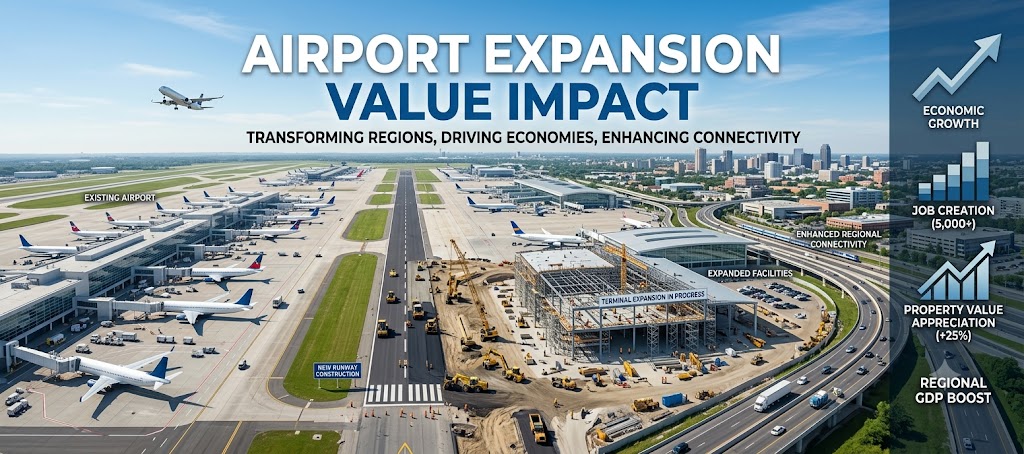
So you’ve heard the news. Mactan-Cebu International Airport just opened its second parallel runway. Passenger numbers are climbing toward 13 million. Aboitiz InfraCapital is talking about 16 million passengers by the end of 2025. And every real estate agent in Cebu is telling you the same thing: buy now, prices are going to explode.
The airport expansion is real. The impact on property values is real. But the way it works—and who actually benefits—is more complicated than the marketing brochures suggest.
This guide cuts through the hype. Here’s what airport expansion actually does to property values, where the real opportunities are, and where you’re most likely to get burned.
Part 1: The Numbers—What’s Actually Happening at MCIA
First, let’s get the facts straight.
Mactan-Cebu International Airport served 11.32 million passengers in 2024—a 13 percent jump from the previous year. In 2025, that climbed to 11.6 million. By 2026, the airport expects to hit 13 million. Aboitiz InfraCapital, which took over operations in October 2024, is targeting 16 million passengers by the end of 2025.
The big news came in January 2025 when President Marcos inaugurated the airport’s second parallel runway. This 2.56-kilometer runway was officially opened in July 2025, making MCIA the first airport in the Philippines to operate a parallel runway system. The airport’s capacity jumped from 4.5 million passengers per year (pre-Terminal 2) to a target of 12.5 million. Aircraft movements per hour increased from 30 to 40.
New routes followed. AirAsia now flies twice daily from Cebu to Kuala Lumpur. Jetstar launched direct flights to Brisbane. Firefly Airlines added Cebu to Kuala Lumpur five times a week. Sunlight Air started a new non-stop service to Siquijor. The airport is positioning itself as a primary transit hub for the archipelago, bypassing Manila’s congestion.
The honest take: This is genuine growth, not speculation. More runways mean more flights. More flights mean more tourists, business travelers, and expats. More people mean more demand for places to stay, live, and work. The connection between airport expansion and property values isn’t theoretical—it’s already happening.
Part 2: How Airport Expansion Actually Affects Property Values
Here’s the rule: connectivity raises prices. When more people can reach a place easily, more people want to live, work, and stay there. Hotels fill up. Businesses open. Infrastructure gets built. And land values follow.
But the impact isn’t uniform. It spreads outward in layers, and each layer behaves differently.
The immediate airport corridor—properties within walking distance or a short drive of MCIA—gets the most direct benefit. Mactan Island sits right next to the airport, making it one of the most exposed areas to this growth. Commercial land values in Mactan are shaped less by office demand and more by proximity to MCIA, resort corridor economics, and estate-controlled developments. Every new route adds tourists, expats, and business travelers who need accommodation. Many end up in Mactan and Lapu-Lapu.
The ripple zone—areas connected to the airport by new infrastructure—also benefits, but differently. The Cebu-Cordova Link Expressway (CCLEX) significantly reduces travel time to Cebu City, making Mactan even more desirable. Areas along these transport corridors see appreciation as accessibility improves.
The broader Cebu market benefits from the sheer volume of people flowing through the airport. Tourism is the lifeblood of the island. More tourists mean more demand across hospitality, retail, and residential sectors. Infrastructure upgrades like road expansions and additional flights continue to boost property values and attract more investments.
Studies on airport expansion elsewhere show that property appreciation in airport corridors can range between 70 percent and 120 percent—significantly higher than city-wide averages. In Cebu, one developer reported that property prices at a tower near MCIA increased by 71 percent since the project’s launch in 2018, with the developer linking foreign demand directly to airport development.
The honest take: The airport expansion is a genuine value driver. But not every property near the airport appreciates equally, and not every buyer should assume they’re getting the same opportunity.
Part 3: The Winners—Where the Real Value Is
Not all airport-adjacent properties are created equal. Here’s where the smart money is actually going.
Short-term rentals are among the biggest winners. Short-term rentals in Mactan earn PHP 3,000 to PHP 6,000 per night—among the best in Cebu. More flights mean more tourists who need places to stay. Hotels fill up, and vacation rentals capture the overflow. If you’re buying a condo with the intention of renting it out, airport proximity is a powerful advantage.
Luxury residences are another strong play. Mactan is increasingly synonymous with high-end living. Condominiums and exclusive residential developments with ocean views, private beach access, and resort-style amenities are in demand from affluent locals and international buyers. Developers are creating resort-style living experiences with infinity pools, spas, and gourmet restaurants. These properties cater to people who want a relaxed lifestyle without sacrificing modern conveniences.
Commercial and hospitality properties benefit from the MICE (Meetings, Incentives, Conferences, Exhibitions) tourism segment, which is growing in Mactan. Facilities that cater to corporate events attract travelers willing to spend more on accommodation.
The honest take: If you’re buying a residential property primarily for personal use, the airport expansion is a nice bonus but shouldn’t be your main reason. If you’re buying for investment income, the rental economics in Mactan are genuinely strong. If you’re buying commercial land, proximity to MCIA is one of the primary value drivers.
Part 4: The Traps—What Nobody Tells You
Now for the part the brochures leave out.
Noise is a real problem. Properties closest to the airport—particularly those directly under flight paths—often experience lower values due to noise pollution. More flights mean more noise. The second runway means more planes taking off and landing. If you’re buying a property that’s too close, you’re not buying peace and quiet—you’re buying the sound of jet engines at 3 AM. Even if a property meets zoning regulations, noise from aircraft can be a major issue. And zoning laws in airport areas manage noise pollution through building restrictions and noise buffers.
The supply glut is real. More than 4,000 new rooms across 14 to 15 properties are set to enter the Cebu-Mactan market within the next two years. Hotel occupancy is already struggling. “Room rates are depressed, and new supply is coming in faster than demand can catch up,” one analyst warned. Without stronger demand drivers, Cebu risks intensifying price competition and eroding profitability. If you’re buying a hotel or resort property, you’re entering a crowded market.
Not all “airport-adjacent” properties are equal. Some properties marketed as “near the airport” are actually a 30-minute drive away. Others are in areas with poor road access. The airport expansion benefits Mactan Island most directly. Areas further out see less impact. Don’t pay airport-premium prices for a property that isn’t actually airport-adjacent.
Zoning restrictions limit what you can build. Philippine airport zoning laws control land use, establish noise buffers, and prevent objects from entering airspace. Properties within high-noise zones may face building restrictions to minimize noise pollution. If you’re buying land with the intention of developing it, check the zoning first. What you want to build and what you’re allowed to build may be two different things.
The honest take: The airport expansion is a tailwind, not a guarantee. Properties that are too close suffer from noise. Properties that are too far don’t benefit. And the hospitality market is already showing signs of oversupply. Buy with your eyes open.
Part 5: What to Check Before You Buy
If you’re serious about buying property near Cebu’s airport, here’s what you need to investigate.
Spend time in the neighborhood at different times. Visit on a weekday morning. Visit on a Friday night. Visit when planes are taking off and landing. The airport’s flight schedule changes—what’s quiet at noon might be loud at midnight. Don’t buy based on a single visit.
Check the flight path. Properties directly under the approach or departure paths get the most noise. Properties off to the side get less. Maps showing flight paths are available from the airport authority. Use them.
Verify the zoning. What’s the property classified as? What can you build? What are the height restrictions? What are the noise buffers? The answers to these questions determine what you can actually do with the property.
Research the developer’s track record. If you’re buying pre-construction, look at the developer’s past projects. Did they deliver on time? Did they deliver what they promised? Are their existing properties well-maintained? The airport expansion has attracted new developers to the area. Not all of them are reputable.
Check the competition. If you’re buying a rental property, find out how many other units are coming online in the same area. The supply glut is real. More rooms mean more competition for guests. More competition means pressure on rates. Make sure your numbers work even with downward pressure on rental income.
Part 6: The Bottom Line—Who Should Buy and Who Shouldn’t
You should consider buying if:
- You understand that airport proximity is a value driver but not a guarantee
- You’ve visited the property at different times and confirmed the noise level is acceptable
- You’re buying a residential property for personal use with the airport as a convenience factor
- You’re buying an investment property with realistic rental projections that account for competition
- You’ve verified the zoning and know what you’re actually allowed to build
- You’re working with a broker who knows the Mactan market specifically
You should not buy if:
- You think the airport expansion guarantees automatic appreciation—it doesn’t
- You’re buying a property directly under the flight path expecting peace and quiet
- You’re buying a hospitality property without checking the supply pipeline
- You haven’t verified the zoning or flight path
- You’re buying based solely on a developer’s marketing materials
- You’re counting on the airport expansion to bail out a marginal investment
Final Thoughts
The Mactan-Cebu International Airport expansion is one of the most significant infrastructure developments in the Philippines. A second runway. More flights. More passengers. Better connectivity. These are real changes with real impacts on property values.
But the impacts aren’t evenly distributed. Some properties benefit enormously. Others suffer from noise and overcrowding. Some areas see genuine appreciation. Others see oversupply and falling rents.
The airport expansion is a powerful force in Cebu’s property market. But like any force, it works differently depending on where you stand. Buy in the right place and you’ll ride the wave. Buy in the wrong place and you’ll wonder why everyone else got rich while you’re listening to jet engines at sunrise.
Do your homework. Visit the property at different times. Check the flight path. Verify the zoning. Research the competition. And never assume that airport expansion means every property near the airport is a winner.
The opportunity is real. But so are the traps. Buy wisely.
Author
John Paul Ybañez Paquibot
Licensed Real Estate Broker | PRC No. 00014132 | DHSUD No. CVRFO-B-03/18-2672
Bachelors Realty and Brokerage, Inc. Cebu
G/F Cap Building, Brgy. Corner, Osmeña Blvd.
Arlington Pond St. Extension, Cebu City, 6000 Cebu
Leave a Reply