You’re looking at southern Cebu. Maybe you’ve driven down the coast, past the rolling hills of Argao, through the dive-town energy of Moalboal, all the way to the whale sharks of Oslob. And now you’re thinking: I want a piece of this.
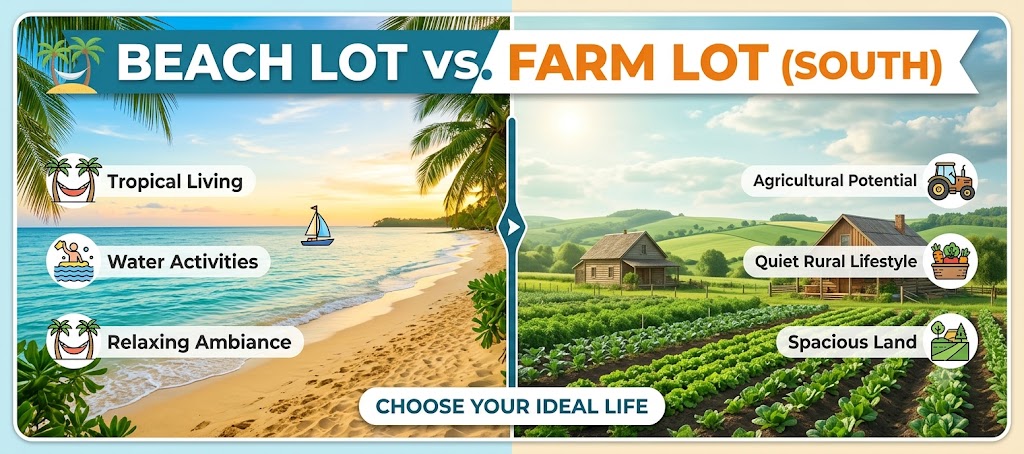
But here’s the question that stops most people cold: beach or farm? A strip of sand with a view of the sea, or a chunk of green earth with room to breathe?
It sounds like a lifestyle choice. It’s actually a financial decision with very different rules, very different risks, and very different outcomes. This guide breaks down what you’re actually buying with each option—and what nobody tells you until it’s too late.
Part 1: The Fundamental Difference Nobody Explains
Let’s start with the most important distinction: a beach lot and a farm lot are not the same kind of asset.
A beach lot, at least in the way most people imagine it, is usually classified as residential or commercial land. You’re buying it to build something—a house, a villa, a resort. The value comes from location, views, and proximity to the sea.
A farm lot is agricultural land. It’s designated for growing crops, raising livestock, or other primary production activities. The value comes from the land itself—soil quality, water access, and productive potential. You can build on it, but that requires navigating a process that many buyers don’t fully understand until they’re already committed.
The honest take: These are different asset classes with different legal frameworks, different cost structures, and different timelines. Comparing them purely on price per square meter misses the point entirely.
Part 2: The Price Reality
Here’s where the numbers get interesting.
In southern Cebu, beachfront lots in towns like Moalboal, Oslob, and Badian typically range from PHP 4,000 to PHP 9,000 per square meter, depending on frontage and access. That’s significantly cheaper than Mactan, where beachfront land has skyrocketed. But even at those prices, you’re paying a premium for the view and the sand.
Farm lots, by contrast, can be dramatically cheaper. In rural areas of southern Cebu, agricultural land can range from as low as PHP 50 to PHP 500 per square meter, depending on access, soil quality, and proximity to infrastructure. In Argao, for example, you can find residential farm lots listed at PHP 750 per square meter. A 500-square-meter farm lot in the south might cost you what a 50-square-meter beach lot would cost.
But here’s the catch: that cheap farm lot is raw. Really raw. No electricity. No water connection. No road access. Maybe not even a clear path to get there. The development costs—clearing land, building access roads, installing utilities, digging a well—can quickly erase any upfront savings.
The honest take: Beach lots cost more per square meter but usually come with better infrastructure access. Farm lots are cheaper upfront but the development costs can be brutal. Don’t compare the sticker prices—compare the all-in cost to make each property usable for your actual goal.
Part 3: What You Can Actually Do With It
Beach lot potential
A beach lot in southern Cebu is an income-generating machine if you play it right. Tourism is booming in the south. Oslob draws visitors for whale sharks. Moalboal attracts divers from around the world. Badian is famous for canyoneering and Kawasan Falls. Short-term rentals in these areas have consistent demand from local and foreign tourists.
The math works like this: build a villa or cottage, list it on Airbnb or similar platforms, and earn income from the tourism economy. Rental yields in Cebu’s tourism hotspots can range from 6 to 12 percent annually, depending on location and property type.
But there’s a ceiling. You’re competing with established resorts, other vacation rentals, and increasingly, larger developers eyeing the same coastline. And the land itself is finite—what’s beachfront today is beachfront forever, which means prices tend to appreciate, but it also means entry costs keep rising.
Farm lot potential
A farm lot offers a completely different set of possibilities. You can farm it—growing high-value crops, raising livestock, or pursuing agro-tourism. Some Cebu farmers are earning PHP 200,000 to PHP 300,000 in net profit per month from well-managed operations.
You can also develop it as a “farm subdivision”—a growing trend in Cebu where buyers purchase agricultural lots with the understanding that only a portion (typically around 25 percent) can be used for residential construction, with the remainder preserved for cultivation and green space.
Or you can try to convert it to residential or commercial use. This is where it gets complicated.
The honest take: A beach lot gives you a clear path to income through tourism. A farm lot gives you more options—farming, agro-tourism, residential development—but each option comes with its own regulatory maze and timeline.
Part 4: The Legal Landmine Nobody Warns You About
Here’s where the beach lot vs. farm lot decision gets really serious.
Beach lots and the foreshore problem
Many “beachfront” properties in the Philippines sit on foreshore land—areas right next to the sea that are part of the public domain. These are regulated by the Department of Environment and Natural Resources and cannot be privately titled, whether you’re Filipino or foreigner. What you’re really buying is access rights, not ownership.
If you’re a foreigner, the situation is even more constrained. Foreign nationals cannot directly own land in the Philippines under the 1987 Constitution. Land ownership is strictly reserved for Filipino citizens and corporations that are at least 60 percent Filipino-owned. Your options are limited to long-term leasing (up to 99 years for qualified investors, 25 years renewable for another 25 for others), condominium ownership (which doesn’t apply to raw land), or corporate structures with Filipino majority control.
Farm lots and the conversion problem
Agricultural land in the Philippines is protected by law. The Comprehensive Agrarian Reform Law (CARL) of 1988 regulates the conversion of agricultural lands to non-agricultural uses. The Department of Agrarian Reform is the primary agency responsible for overseeing this process.
If you buy a farm lot thinking you’ll build a house on it, you’re in for a shock. Converting agricultural land to residential use requires securing a Conversion Clearance from the DAR—a process that can take six to twenty-four months and incur significant fees. You’ll need to submit proof of ownership, land use maps, and detailed plans for the proposed project.
And the political winds are shifting against conversion. Multiple bills have been filed in Congress seeking to ban or severely restrict the conversion of irrigated and irrigable agricultural lands. Illegal land conversion can lead to imprisonment of seven to twelve years and fines of up to PHP 100,000.
The honest take: If you’re a foreigner, a beach lot means you’re leasing, not owning. If you’re buying a farm lot with dreams of building a retirement home, you need to understand that conversion is not guaranteed, not quick, and not cheap.
Part 5: The Risks You Can’t Ignore
Beach lot risks
The sea is beautiful. It’s also destructive. Beachfront properties are ground zero for storm surges and wind damage. Typhoons hit the Philippines regularly, and southern Cebu is not exempt. Coastal erosion is relentless—what’s a twenty-meter beach today might be ten meters in a decade.
Environmental regulations are getting stricter. The DENR is increasingly proactive about enforcing shoreline easements and protected area rules. Buy a property that’s out of compliance and you’re buying a legal headache.
And then there’s the noise. In some beachfront areas, the local tradition of videoke can be deafening on weekends. Don’t buy without spending a Friday and Saturday night in the neighborhood.
Farm lot risks
The biggest risk with a farm lot is assuming you can do whatever you want with it. You can’t. The land classification determines what you can build, and changing that classification is a long, uncertain process.
There’s also the infrastructure gap. Many farm lots in southern Cebu lack reliable access to electricity, water, and internet. Bringing in utilities can cost hundreds of thousands of pesos. Building materials cost more in remote areas because of transport.
And if you’re planning to actually farm the land, you need to understand soil quality, water availability, and market access. Not all agricultural land is equally productive.
The honest take: Beach lots carry environmental and regulatory risks. Farm lots carry development and conversion risks. Neither is “safer”—they’re just risky in different ways.
Part 6: The Decision Framework
So which one should you choose? The answer depends entirely on what you’re trying to achieve.
Choose a beach lot if:
- You want to generate income from tourism (short-term rentals, resort development)
- You understand that you’re leasing the land if you’re a foreigner
- You’ve budgeted for higher maintenance costs (salt air corrodes everything)
- You’ve spent time in the area during both tourist season and off-season
- You’ve verified the property isn’t on foreshore land that can’t be titled
Choose a farm lot if:
- You want more land for your money (larger lot sizes, lower per-square-meter costs)
- You’re actually interested in farming, agro-tourism, or a farm subdivision model
- You understand the conversion process and have the patience (and capital) to navigate it
- You’re Filipino or have a clear legal structure for land ownership
- You’re willing to invest in infrastructure development
Choose neither if:
- You’re a foreigner looking to buy raw land outright—you can’t
- You think you’ve found a legal loophole—you haven’t
- You haven’t visited the property in person, during both dry and rainy seasons
- You’re buying based on “sure thing” appreciation promises
- You haven’t checked the actual land classification with the local government
Final Thoughts
Southern Cebu is one of the most exciting property markets in the Philippines. The tourism boom is real. The infrastructure is improving. The potential is genuine.
But beach lots and farm lots are not interchangeable. They serve different purposes, operate under different legal frameworks, and carry different risks. A beach lot in Moalboal and a farm lot in Argao might be twenty kilometers apart, but they’re worlds away in terms of what you can actually do with them.
The biggest mistake you can make is buying either one without understanding what you’re actually getting. Before you sign anything, verify the land classification. Check the title. Understand the zoning. If you’re a foreigner, know exactly what you can and cannot own. And never—ever—assume that cheap land means easy development.
The dream of owning property in southern Cebu is achievable. But it’s achieved by people who do their homework, not by people who chase the cheapest price per square meter.
Do the work. Visit the site. Talk to the neighbors. Check the regulations. And then, and only then, make your decision.
Pro Tip: The Overnight Test
Before you commit to any property in southern Cebu—beach or farm—spend at least two full days and one night in the immediate area. Not at a resort. In the neighborhood. Walk the roads at different times. Listen for noise. Talk to local residents. Check the water pressure. Test the mobile signal. A Tuesday morning visit tells you nothing about what Saturday night sounds like or whether the road is passable after heavy rain. The property won’t change. But your understanding of what you’re actually buying will.
Author
John Paul Ybañez Paquibot
Licensed Real Estate Broker | PRC No. 00014132 | DHSUD No. CVRFO-B-03/18-2672
Bachelors Realty and Brokerage, Inc. Cebu
G/F Cap Building, Brgy. Corner, Osmeña Blvd.
Arlington Pond St. Extension, Cebu City, 6000 Cebu
Leave a Reply