You have found a property you love. The price is right. The view is incredible. You are ready to sign.
Stop right there.
In the Philippines, buying real estate as a foreigner is not like buying property back home. The laws are different. The risks are different. And the consequences of getting it wrong can be catastrophic. Your entire investment—hundreds of thousands of dollars—can vanish because you trusted the wrong person or skipped a single step.
This is why you need a reliable real estate lawyer. Not a friend who knows a guy. Not the seller’s agent who “handles everything.” A real, licensed, experienced lawyer who works for you.
Here is the honest, no-filter guide to finding one in Cebu.
Why You Cannot Afford to Skip This
Let us be brutally clear: foreigners generally cannot own land in the Philippines. The 1987 Constitution restricts land ownership to Filipino citizens and corporations that are at least 60% Filipino-owned. Foreigners may own condominium units—but only up to 40% of a project—and can enter long-term land leases.
This is not a minor detail. It is the foundation of every real estate transaction involving a foreigner. If you buy land outright, the title is invalid. If you use a nominee structure, it can be challenged. If you do not understand the foreign ownership restrictions, you are walking into a legal minefield.
A competent real estate lawyer does more than just review paperwork. They:
Verify the title with the Registry of Deeds, checking for liens, disputes, and unpaid taxes
Confirm land classification—only “alienable and disposable” land can be privately owned
Check for encumbrances—existing claims, mortgages, or legal disputes attached to the property
Guide you through foreign ownership structures—whether you are buying a condo, entering a lease, or using a corporation
Draft and review contracts—the Deed of Absolute Sale must be written, notarised, and properly registered
Handle the tax and registration process—working with the BIR, local government, and Registry of Deeds
One expat put it simply: “The first thing to do is to get in touch with a lawyer that you can trust. Then retain him to investigate the papers of the property and the rightful owners thereof”. This is not optional. It is survival.
Where to Start Looking in Cebu
Cebu has several established law firms that work with expats. Here are some to consider:
Gonzalez and Associates Law Firm is a Cebu-based practice with over 20 years of combined experience. They are located on the 15th floor of the Keppel Center in the Cebu Business Park and handle property acquisition due diligence, corporate and commercial transactions, business registration, immigration, and litigation. They explicitly work with expats and foreign investors.
Cebu Investment House is run by Gonzalez and Associates and describes itself as “a one stop firm mainly offering assistance to almost all personal and corporate legal concerns of ex-pats”. It offers purchase and lease assistance, business registration, and government compliance. Client ratings are 4.9 out of 5 based on 14 votes.
DivinaLaw has a Cebu office overseen by senior partner Dara C. Acusar, who has 13 years of experience in Cebu and is admitted to practice in both the Philippines and New York. The firm handles real estate, corporate law, and estate planning.
Ramas Law Office is a Cebu-based firm specialising in corporate law, family law, real estate, and criminal defence.
CCTDA Law offers a wide range of practice areas including real estate, business law, labour and immigration, and dispute resolution.
SyCip Salazar Hernandez & Gatmaitan is the largest law firm in the Philippines, with an office in the Cebu Business Park. While they handle high-end corporate and real estate work, they may be more expensive than smaller firms.
How to Verify a Lawyer Is Legitimate
This is non-negotiable. There are cases of individuals using the names of other lawyers to notarise documents. You must verify.
Ask for their Roll Number. The Supreme Court assigns a unique Roll Number to every member of the Bar. If a lawyer refuses to provide it, that is a red flag.
Check the Supreme Court website. The Supreme Court maintains an online list of lawyers at sc.judiciary.gov.ph/lawyers-list-2/. You can search by name to confirm they are licensed.
Verify with the Integrated Bar of the Philippines (IBP). All lawyers are automatic members of the IBP. Genuine lawyers have an IBP ID Card and an updated official receipt of annual dues.
Ask about MCLE compliance. Lawyers must complete Mandatory Continuing Legal Education. If they are not compliant, they are not in good standing.
Verify notarial commission. If your lawyer will notarise documents, check their notarial commission with the Executive Judge of the Regional Trial Court.
What to Watch Out For
Lawyers who guarantee outcomes. The Code of Professional Responsibility and Accountability prohibits lawyers from promising a “sure win.” If they do, it should set off alarm bells.
No engagement letter. A legitimate lawyer will provide a written agreement outlining the scope of work and fees. If there is no written agreement, walk away.
Fees that are too low. If a lawyer’s fees seem too good to be true, they probably are. Quality legal work has a cost.
Lack of an office. Genuine lawyers have physical offices. Be wary of those who only meet in cafes or “virtual” spaces.
The seller’s lawyer. Do not use the seller’s lawyer. Their loyalty is to the seller, not to you. You need independent representation.
What It Will Cost
Legal fees vary depending on the complexity of the transaction and the lawyer’s experience.
Some lawyers charge a percentage of the property value—typically 1% to 3%. Others charge a fixed fee.
For a straightforward transaction, legal fees can range from PHP 10,000 to PHP 30,000 or more. For a PHP 3,000,000 property, legal fees could be PHP 50,000 to PHP 150,000.
Always get a clear quotation beforehand. Understand what is included: title verification, contract review, due diligence, tax filings, and registration.
Total transaction costs for buying or selling real estate typically range from 7% to 12% of the property value, including taxes, registration, and professional fees. Your lawyer’s fee is part of this—but it is the part that protects you.
The Notary Public Distinction
A quick but important note: a notary public is not the same as a lawyer, though in the Philippines, notaries public are licensed lawyers commissioned by the Regional Trial Court.
In Philippine real estate, “nothing moves—not taxes, not bank loans, not title transfer—until documents pass through a Notary Public”. Your lawyer should be able to notarise your documents, but do not confuse notarisation with legal advice. Notarisation authenticates documents; it does not protect you from a bad deal.
If you are buying from abroad, you will need a Special Power of Attorney (SPA) to let a trusted representative—ideally your lawyer—sign documents on your behalf.
The Bottom Line
Finding a reliable real estate lawyer in Cebu is not difficult. Finding one you can trust requires work.
Do your homework. Verify credentials. Get multiple quotes. Ask for references from other expats. Do not rush.
The Philippines offers incredible opportunities for expats looking to buy property—whether a condominium in Cebu’s IT Park, a beachfront lot, or a long-term land lease. But the legal landscape is complex, and the penalties for mistakes are severe.
As one guide put it: “Due diligence avoids costly litigation. Checking title history, encumbrances, and disputes is much cheaper than a court battle later”.
Your lawyer is your shield. Choose wisely.
📅 Remember: Real estate laws and regulations change. The SRRV guidelines were revised in September 2025. BIR regulations are updated regularly. Work with a lawyer who stays current and reviews your specific situation. Do not rely on generic advice from the internet—including this article—for your specific transaction.
Author John Paul Ybañez Paquibot Licensed Real Estate Broker | PRC No. 00014132 | DHSUD No. CVRFO-B-03/18-2672 Bachelors Realty and Brokerage, Inc. Cebu G/F Cap Building, Brgy. Corner, Osmeña Blvd. Arlington Pond St. Extension, Cebu City, 6000 Cebu
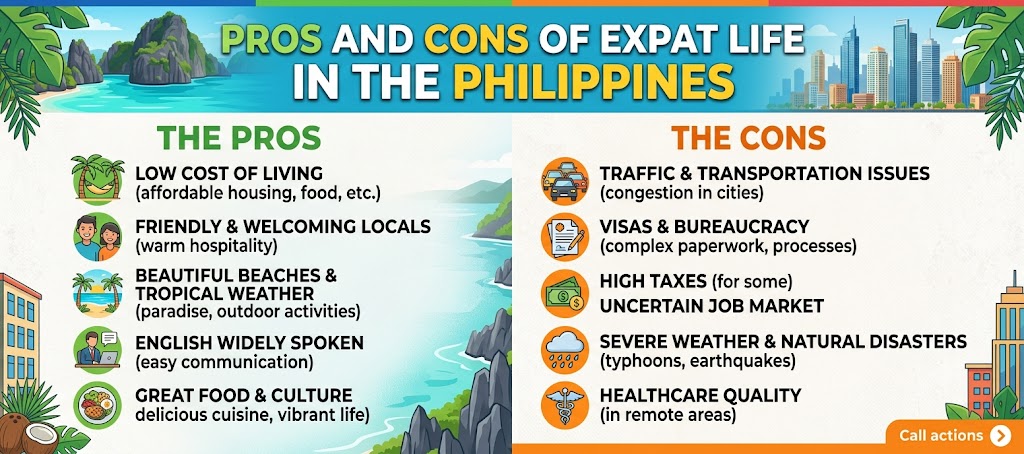
The Philippines has become an increasingly popular destination for expats, retirees, and digital nomads. In 2026, it was named the world’s best place to retire by the Retirement Abroad Index, scoring 78 out of 100 for its combination of affordability, visa accessibility, and community.
But as with any major life decision, the reality is more nuanced. Success here often depends on balancing the country’s undeniable charms against its systemic challenges. Here is the unvarnished truth.
The Pros: Why Many Choose to Call the Philippines Home
Remarkable Affordability
This is the Philippines‘ biggest draw. Your money stretches significantly further than in most Western countries. A retired couple can live comfortably on around £750 to £1,000 per month, though costs are higher in Manila than in smaller cities and coastal communities. Overall, living expenses are about 50% to 90% cheaper than in the United States.
Housing is particularly affordable. A one-bedroom apartment in the city center can cost as little as PHP 10,000 (around USD 200) per month. Even in central Manila, you’ll find options ranging from PHP 25,000 to PHP 45,000 monthly, while smaller cities and suburbs offer apartments for PHP 10,000 to PHP 20,000. Street food is both delicious and cheap, often costing less than a dollar per meal.
In the Expat Insider 2025 survey, a remarkable 74% of expats reported feeling they are paid fairly—far exceeding the global average. The Philippines also ranks among the most affordable destinations for expats globally.
Genuine Warmth and Effortless Community
Filipino culture is famously hospitable. Expats consistently report that forming social circles is easier here than in many other parts of Asia. You’ll get invited to family gatherings, karaoke nights, and local fiestas almost immediately.
Crucially, English is an official language, which removes a common barrier to integration. You can navigate daily life, handle bureaucracy, and access healthcare without needing to learn Tagalog—though learning a few basic phrases will certainly endear you to locals. The Philippines ranks high for ease of settling in, making it one of the easiest places in the world to find friends and feel at home.
Beautiful Natural Environment
The Philippines is an archipelago of more than 7,000 islands with pristine beaches, lush forests, and breathtaking mountains. Palawan’s crystal-clear waters, Bohol’s Chocolate Hills, and the Banaue Rice Terraces are just a few examples. Whether you prefer world-class diving, surfing in Siargao, or the cool highland climate of Baguio, the sheer variety of landscapes is a primary draw for a relaxed, nature-focused lifestyle.
Accessible and Updated Visa Pathways
The Philippines has dramatically improved its visa offerings for foreigners.
For Retirees: The Special Resident Retiree’s Visa (SRRV) remains among the most attractive programs globally. Applicants aged 50 and over who receive a pension can qualify with a fixed deposit of just USD 15,000. As of July 2025, there were approximately 60,000 active SRRV holders. In a recent change, foreign nationals aged 40 to 49 are now also eligible, subject to higher deposit requirements. SRRV holders enjoy indefinite stay, multiple-entry privileges, and exemptions from certain taxes.
For Remote Workers: Following Executive Order No. 86 in 2025, the Philippines launched its Digital Nomad Visa. This allows remote workers earning at least USD 2,000 per month from a foreign employer to live in the country for up to two years, tax-free. This has opened new doors for location-independent professionals.
The Cons: The Realities of Daily Life
Infrastructure and Transit
This is arguably the biggest frustration for expats. Major cities, particularly Manila, are notorious for heavy traffic. This isn’t just “bad” traffic—it is a psychological drain. A 5-kilometer commute can easily take 90 minutes. Roads are perpetually clogged, and public transport is often unreliable, uncomfortable, or unpredictable.
Beyond the capital, you will encounter frequent power outages (“brownouts”) and notoriously unreliable internet outside premium business districts like BGC or Makati. Expats report being profoundly frustrated by the poor air quality and the sheer inefficiency of getting from point A to point B.
Bureaucracy is an Ordeal by Paper
Everyday tasks that would be simple back home can become multi-week ordeals. Forget online portals. Government offices still run on carbon paper, handwritten ledgers, and typewriters.
To open a simple savings account, expect to submit a utility bill, a barangay clearance, your passport, your visa, and two reference letters—all in person. You will make multiple visits, because the first clerk will send you away for a missing stamp, and the second will find a different missing document. Supermarket queues move at a glacial pace, yet no one seems particularly bothered by it. This “lack of digitization” requires the patience of a saint.
Healthcare Quality Varies Dramatically—And Payment is a Trap
The quality of healthcare is a mixed bag, ranging from world-class to bare-bones. Major cities like Manila and Cebu offer access to modern private hospitals with internationally accredited facilities and English-speaking professionals. However, standards drop significantly outside these urban centres, where rural clinics often have outdated equipment and a shortage of staff.
Here is the critical reality that glossy guides leave out: private hospitals will refuse to admit you (except in life-or-death emergencies) without a cash deposit or a letter of guarantee from your insurer. You cannot just flash a health insurance card and walk in. If you are admitted, they will treat you and then stop further non-emergency procedures until the next payment is secured. Comprehensive health insurance isn’t a suggestion; it is a survival tool. Without it, even a minor surgery can quickly drain your savings.
Safety Requires Street Smarts
The “exercise increased caution” advisory is real. Beyond pickpocketing, riding-in-tandem snatch thefts—armed assailants on motorcycles grabbing bags or phones from pedestrians—are prevalent in urban centres. Drive-by robberies are common and considered opportunistic.
The statistics are sobering. According to Philippine National Police data, compared to Japan, robbery occurs about three times more frequently, homicide about four times more, and non-consensual sex about twice as often. In the first nine months of 2025 alone, 1,590 foreigners became crime victims in the Philippines. Common advice from authorities: don’t display wealth, avoid walking alone at night, and stay hyper-aware of your surroundings. You cannot walk around obliviously staring at your iPhone.
The Climate is Relentless
The tropical maritime climate means it is hot and humid year-round. But the dry season (March to May) brings something far worse: a heat index that frequently hits 45°C (113°F) with 80% humidity. You will sweat through your clothes just walking to the corner store. This fundamentally changes how you structure your day—errands are done at dawn or dusk, and afternoons are for air-conditioned hibernation.
Conversely, the rainy season brings 15 to 20 major typhoons annually, alongside regular earthquakes and occasional volcanic eruptions. You are living in a disaster-prone zone; preparedness isn’t optional, it is mandatory.
Imported Goods Are Expensive
While local goods and services are cheap, imported items can be costly. If you have specific dietary preferences, need particular Western brands, or want quality imported wine or cheese, expect to pay a significant premium. Your monthly budget can inflate quickly if you refuse to adapt to local products.
The Bottom Line
Living in the Philippines is a study in contrasts. It is a country that offers profound financial and social rewards, where the warmth of the people and the beauty of the islands can make you feel at home very quickly. However, it also demands a “go-with-the-flow” attitude.
As Dr. Alicor Panao, a data scientist at the University of the Philippines, put it: “For expats, life in the Philippines is a mixed bag. The country’s greatest appeal seems to be in the financial and social dimensions.”
The specific trade-off is this: You get financial freedom and social belonging, but you trade away efficiency, convenience, and predictability.
If you move here expecting everything to work like it does back home, you will find yourself perpetually frustrated. If you move here seeking a lifestyle that prioritizes connection and affordability over rigid structure, and you can laugh at bureaucratic absurdities rather than rage against them, you may find it to be one of the best decisions you ever make.
Pro Tip: Before committing to the SRRV or Digital Nomad Visa, treat your first few months as a trial run. Rent a place on a standard tourist visa. Live through the heat. Go to a local city hall and experience the bureaucracy firsthand. Sit in rush-hour traffic once. If you can still smile after that, the Philippines is absolutely for you.
Author John Paul Ybañez Paquibot Licensed Real Estate Broker | PRC No. 00014132 | DHSUD No. CVRFO-B-03/18-2672 Bachelors Realty and Brokerage, Inc. Cebu G/F Cap Building, Brgy. Corner, Osmeña Blvd. Arlington Pond St. Extension, Cebu City, 6000 Cebu
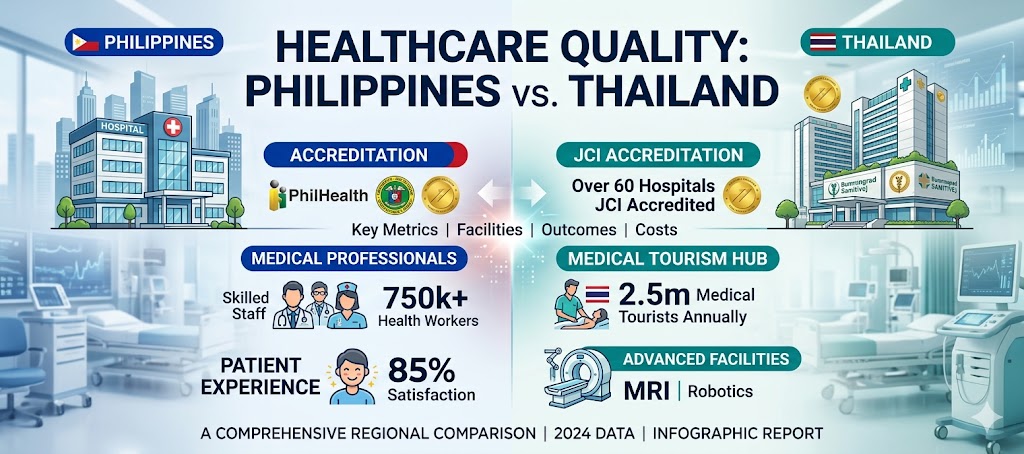
If you are over 50 and planning a Southeast Asian retirement, let us cut to the chase: healthcare is not a “nice to have.” It is the single most important variable in your decision. Not the cost of rent. Not the visa fees. Not the quality of the internet. Healthcare.
The 2026 data presents a nuanced picture. The Retirement Abroad Index 2026 by the Expatriate Group officially ranks the Philippines as the #1 global retirement destination—a testament to its visa accessibility, affordability, and social integration. Thailand sits at a close #2. But when we isolate healthcare infrastructure, Thailand remains the regional benchmark.
Here is the honest, ground-level comparison you need to make an informed decision.
1. Healthcare Philosophy: Institutional Power vs. Human Connection
The two countries approach healthcare from fundamentally different angles, and understanding this philosophical divide will tell you more than comparing hospital bed counts.
Thailand operates on a model of institutional excellence. The government has spent decades building a medical tourism empire. Hospitals like Bumrungrad—ranked #96 in Newsweek’s World’s Best Hospitals 2026—are international brands with standardized, repeatable, and highly efficient processes. Thailand operates on a “five-star hotel” model of care. You receive predictable, high-acuity support across their major cities. The systems are flawless, the protocols are relentless, and the quality control is world-class.
The Philippines takes a human-centric approach. The system is less centralized and less standardized, but it excels in patient-provider communication. Because English is the primary language of medical education and practice, the “quality of experience” is entirely different. You can discuss a chronic condition, argue a billing error, and understand your discharge instructions without a translator, an app, or a Thai-speaking friend. You are a participant in your care, not just a patient. The diagnostic explanations are clearer. The insurance paperwork is comprehensible. The emotional friction of navigating a foreign healthcare system simply evaporates.
The honest trade-off: Thailand gives you a flawless machine. The Philippines gives you a fluent conversation.
2. Quality and Accreditation: The JCI Context
The gold standard for hospital quality is Joint Commission International (JCI) accreditation. Both countries host internationally recognized, JCI-accredited facilities, but the “depth” differs significantly.
Thailand boasts a wider network of JCI-accredited hospitals that are consistent across the country. Bangkok Hospital Headquarters earned its sixth consecutive JCI accreditation in 2023. MedPark Hospital achieved its second consecutive term in February 2026. Whether you are in Bangkok, Chiang Mai, or Phuket, you can expect a reliable, world-class standard. Thailand has built a deep bench of quality that extends beyond the capital.
The Philippines has elite flagship institutions that are globally competitive. St. Luke’s Medical Center in Quezon City was the first hospital in the Philippines—and only the second in Asia—to achieve JCI accreditation back in 2003. It remains the country’s only JCI-accredited Academic Medical Center. In 2026, St. Luke’s earned additional JCI Clinical Care Program Certification for its kidney transplant program, scoring an extraordinary 9.9 out of 10. The Medical City in Pasig also took top honors at the Healthcare Asia Awards 2026.
The catch? Quality is “clustered” in the Philippines. The drop-off from St. Luke’s to a provincial hospital is steep and sudden. In Thailand, the drop-off is gentler; the national integration of healthcare is simply better. In the Philippines, your healthcare quality is directly proportional to your proximity to a major urban hub—Manila or Cebu.
3. The Cost of Care: The “Mandatory” vs. “Voluntary” Trap
The narrative that healthcare in Thailand is roughly 56% more expensive than in the Philippines is broadly accurate for out-of-pocket costs. Monthly insurance premiums average $100 in Thailand versus $75 in the Philippines. Doctor visits and dental care cost nearly 70% more in Thailand.
But the real cost difference is not about the sticker price. It is about the insurance strategy each country forces upon you.
Thailand offers forced protection. If you are on an O-A retirement visa, Thailand mandates health insurance with a minimum coverage of 3,000,000 Baht (roughly $84,000 USD). While this increases your annual budget, it effectively eliminates the risk of being underinsured. You cannot gamble with your health because the government will not let you.
The Philippines presents a hidden risk. Health insurance is not mandatory for the SRRV visa. While this lowers the “entry cost” of your visa, it creates a dangerous temptation for retirees to skip comprehensive coverage. This is the single most common financial disaster among expats. One emergency hospitalization for a cardiac event can wipe out a year’s worth of “savings.”
The honest verdict: Do not fall into this trap. Treat comprehensive international health insurance as a non-negotiable expense, regardless of which country you choose. If you cannot afford it, you cannot afford to retire in either nation.
4. Strategic Location: Your Zip Code is Your Health Outcome
In 2026, the gap between urban and rural health services remains the most critical metric for retiree health outcomes.
Thailand offers better national integration. You have several secondary cities—Chiang Mai, Hua Hin, Phuket—that offer reliable, modern medical access comparable to Bangkok. You have geographic flexibility without sacrificing quality.
The Philippines demands that you choose your home base strategically. Your quality of life is heavily dependent on being within 30 to 60 minutes of a major medical center. If you choose the provincial islands or remote beach towns, you are effectively betting that you will never have a serious medical emergency. The moment you do, you are looking at a costly and stressful evacuation to Manila or Cebu.
The honest advice: If you choose the Philippines, do not retire to a remote province unless you are young, healthy, and have a robust evacuation plan. If you choose Thailand, you have more flexibility, but the same rule applies—stick to major cities or well-serviced hubs.
The Final Verdict for 2026
Choose Thailand if: You prioritize the “Safety-First” model. You want institutional consistency, world-class specialist care, and a system where high standards are mandated by the state. You are willing to pay the higher premiums and navigate annual visa renewals in exchange for a highly predictable medical environment. Thailand is the choice for the retiree who wants to minimize surprises.
Choose the Philippines if: You prioritize the “Integration” model. You want the lowest possible friction in daily life, where you can speak to your cardiologist and navigate your insurance billing in your native English. You are willing to accept traffic congestion and higher energy costs in exchange for a lifetime, “set-and-forget” visa (SRRV) and more seamless social integration.
The Pro Strategy for 2026
Do not rely on “country-wide” rankings. Your medical reality is determined by the hospital within 10 kilometers of your front door, not by a national average.
If you are serious about a specific city—whether it is Cebu, Chiang Mai, Bangkok, or Davao—check the Newsweek 2026 World’s Best Hospitals list for that exact location. It is the most accurate, up-to-date benchmark for your actual, day-to-day access to top-tier care.
Then, do this: Contact those hospitals directly. Get quotes for a routine check-up and for a hypothetical emergency procedure. Ask about their JCI accreditation status. Speak to expats in local Facebook groups who have undergone similar treatments.
And most importantly: secure your health insurance before you land. In Thailand, it is a visa requirement. In the Philippines, it is not—but if you skip it, you are not retiring; you are gambling. And at 50, 60, or 70 years old, that is a bet you will eventually lose.
Choose the country that gives you the care you need, at a price you can honestly afford, in a language you understand. Everything else—the beaches, the food, the nightlife—is secondary. Your health is the foundation on which your entire retirement is built. Do not build it on sand.
Author John Paul Ybañez Paquibot Licensed Real Estate Broker | PRC No. 00014132 | DHSUD No. CVRFO-B-03/18-2672 Bachelors Realty and Brokerage, Inc. Cebu G/F Cap Building, Brgy. Corner, Osmeña Blvd. Arlington Pond St. Extension, Cebu City, 6000 Cebu
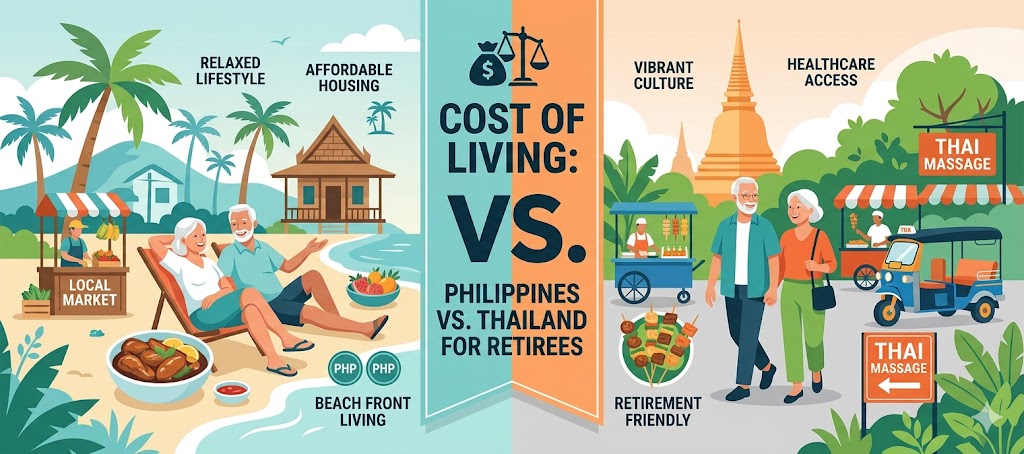
The $1,000-a-month dream is officially retired. As of June 2026, the choice between the Philippines and Thailand is no longer about which beach has whiter sand. It is a hard-nosed strategic decision where you must weigh regulatory reform against infrastructural reliability, and absolute cost against price stability.
Forget the outdated travel blogs. Here is the ground-truth reality of what your money, time, and daily sanity will actually look like this year.
The Economic Landscape: Decoding the Inflation Paradox
The inflation numbers for 2026 present a fascinating contradiction that most expats misinterpret.
The Philippines recently posted a remarkably low headline inflation rate of around 2.0% for January 2026, sitting comfortably within its government target. Thailand, meanwhile, is forecasting a slightly tighter band averaging between 1.3% and 2.9%. On paper, both economies look stable.
However, here is the honest distinction: Thailand offers predictability; the Philippines offers a lower sticker price. Comparative indices from mid-2026 clearly show that the absolute cost of living—covering rent, groceries, and utilities—remains approximately 26% to 35% lower in the Philippines than in Thailand.
The catch? The Philippines remains structurally vulnerable to fuel and energy shocks. While its headline inflation is low right now, a global oil price spike hits Philippine electricity bills much harder than it hits Thailand’s more diversified grid. If you are on a fixed pension, Thailand provides a smoother, less volatile ride. If you have a flexible budget and want your physical cash to go further, the Philippines wins on raw affordability—provided you accept the energy wildcard.
Residency and Red Tape: The 2026 Shake-Up
This is the year everything changed. If you haven’t looked at visa rules since 2024, you are operating on obsolete information.
The Philippines (SRRV Reforms): The September 2025 reforms were a seismic shift. The minimum age for the Special Resident Retiree’s Visa has dropped to 40, opening the door to early retirees. The deposit structure is now tiered, ranging from a remarkably low $1,500 to $50,000, depending on your exact age bracket and whether you have a guaranteed monthly pension.
The core benefit remains untouched: this is a lifetime visa with no annual reporting to the Bureau of Immigration. It is the ultimate “set and forget” solution. The trade-off, however, is liquidity. Your deposit is a locked asset, though the 2026 rules now allow you to convert that deposit directly into a condo purchase or a long-term lease—effectively turning a sunk cost into an appreciating asset.
Thailand (Digitalization and the LTR): Thailand has finally listened to expat complaints. The 90-day reporting requirement is increasingly handled via the ‘ThaID’ mobile app, and the E-Visa portal has streamlined entry. However, the annual renewal for the standard O-A retirement visa remains a mandatory, in-person procedural requirement.
For those with deeper pockets, the Long-Term Resident (LTR) visa remains the premium route, offering a 10-year stamp for wealthier applicants who meet higher financial thresholds. For the average retiree, however, Thailand still demands a yearly administrative “check-in” that the Philippines has completely abolished.
Infrastructure vs. Human Connection: The Daily Friction Test
This is where you stop looking at spreadsheets and start looking at your own tolerance for irritation.
Thailand’s Predictability: If you value efficiency, Thailand is unbeatable. The BTS Skytrain runs like clockwork. The private hospitals maintain a consistent, globally accredited standard. The utility grids are stable. If you want a “Western-adjacent” level of urban convenience, Thailand delivers it seamlessly.
The Philippines’ Social Ease: The Philippines offers a different kind of ease—one that is linguistic and cultural. Because English is an official language, you are never lost in translation. You can discuss a chronic health condition with your cardiologist in fluent English. You can haggle at the market and joke with your neighbors from day one. You aren’t just an expat; you are an active, verbal participant in the local economy.
The honest trade-off is mobility. To get that social ease in the Philippines, you must accept the gridlock of Metro Manila or the underdeveloped public transport of secondary cities. In Thailand, you get the smooth roads and trains, but you must accept that navigating bureaucracy, healthcare paperwork, and daily errands will always require a translation app or a Thai-speaking friend.
Budgeting for 2026: The Reality Check
Let us kill the “shoestring” fantasy right now. To maintain a Western-standard lifestyle in 2026—meaning modern, air-conditioned housing, reliable high-speed fiber internet, and comprehensive private health insurance—you need a realistic baseline of $2,200 to $3,200 per month in the major urban centers of either country.
Yes, you can technically survive on $1,200 to $1,600 in provincial areas. But be brutally honest with yourself: at that level, you are adopting a local standard of living. That means rationing your air-conditioning, relying on public jeepneys or songthaews, and eating a locally sourced diet. It is doable, but it is austerity, not the “expat dream.”
The 20% Non-Negotiable Buffer: Regardless of which flag you fly, add a 20% contingency to your calculated budget. Medical costs in Southeast Asia have seen significant upward pressure since 2025. Assuming you can skip international health insurance to save a few hundred dollars a month is the single most catastrophic financial mistake you can make. One emergency hospitalization will wipe out a year’s worth of “savings.”
The Final Strategic Verdict for 2026
Your decision is not about which country is “better.” It is about which set of frustrations you are personally equipped to handle.
Choose the Philippines if: You crave the administrative peace of a lifetime visa (thanks to the new SRRV reforms) and you value waking up in a country where you can speak, shop, and seek medical care without a language barrier. You accept that your electricity bill will be a gamble, and you are willing to trade traffic jams for effortless human connection.
Choose Thailand if: You prioritize superior urban infrastructure, standardized medical excellence, and a stable, predictable economic environment. You are comfortable with the annual renewal cycle and you are tech-savvy enough to leverage their new digital reporting systems. You accept that you will remain a linguistic outsider, but you gain the convenience of a world-class transit system.
The Pro Strategy: Test Your Friction Threshold
Do not rely on averages or YouTube vlogs. If you are serious about a 2026 relocation, treat it like a business diligence process. Rent an Airbnb for 30 days in a residential neighborhood—not a tourist enclave—in Cebu City, and another 30 days in Chiang Mai or Bangkok.
During those stays, do not act like a tourist. Pay your own utility bills. Navigate the local government offices for a simple errand. Visit the supermarket for a full month’s groceries. Get a routine blood test at a local hospital.
The place where your daily frustrations are lowest is your true destination. At the end of the day, retirement is about reducing stress, not optimizing a spreadsheet. Choose the nation where you can breathe easily, navigate confidently, and afford to live without constantly checking your bank balance. That is the only metric that truly matters.
Author John Paul Ybañez Paquibot Licensed Real Estate Broker | PRC No. 00014132 | DHSUD No. CVRFO-B-03/18-2672 Bachelors Realty and Brokerage, Inc. Cebu G/F Cap Building, Brgy. Corner, Osmeña Blvd. Arlington Pond St. Extension, Cebu City, 6000 Cebu
If you’re dreaming of stretching your retirement savings further while enjoying a warmer climate, richer culture, and a slower pace of life, Asia has never looked more appealing. The 2026 retirement landscape has shifted, with multiple rankings painting a clearer—and sometimes surprising—picture of where your money and your golden years will go furthest.
Here is an honest, boots-on-the-ground look at Asia’s top retirement destinations for 2026, synthesised from the latest global indexes and the essential, real-world considerations that can make or break your move.
The Big Picture: Understanding the Rankings
Before diving into specific countries, it is important to recognise that 2026 has produced two influential, yet slightly different, global retirement benchmarks.
The Annual Global Retirement Index (from International Living) focuses heavily on climate, governance, and overall development, placing Thailand (9th) and Malaysia (10th) in their global top ten. Conversely, the Retirement Abroad Index (from Expatriate Group) places a higher premium on visa accessibility, affordability, and ease of integration, naming the Philippines the world’s No. 1 retirement destination, followed closely by Thailand at No. 2.
So which ranking should you trust? Both—they simply prioritise different retiree needs. Thailand is the only Asian country to appear in the top tier of both major indices, which speaks to its all-around consistency. The takeaway is that Asia offers outstanding options, but the “best” destination for you depends entirely on whether you value world-class infrastructure or ease of residency and lower upfront costs.
The Top Destinations
Thailand: The Consistent All-Rounder
Thailand is the only Asian country to maintain top-tier status across all major 2026 indices—9th in the International Living ranking and 2nd in the Expatriate Group index. That consistency is not accidental.
The Appeal: A comfortable single-retiree lifestyle is achievable for about $1,200 per month, covering a $300 studio apartment in Chiang Mai, daily Thai meals for around $10, and a few local beers during happy hour. A couple living on two average Social Security checks (roughly $3,800 a month) can afford a beachside two-bedroom bungalow in Pattaya or Hua Hin for under $1,000, with groceries costing $300–$400 monthly. Healthcare is ranked as the best in Southeast Asia—9th globally, equal to Finland—with JCI-accredited hospitals and private insurance costing a fraction of US rates. Visa pathways now offer stays of up to 10 years for eligible foreigners.
The Reality: Thailand has become so popular with retirees and digital nomads that some areas—particularly Chiang Mai, Phuket, and Bangkok—can feel overcrowded. The “hidden gem” experience is harder to find today. While the Thailand Privilege Card offers long-term options, its costs have risen significantly in recent years. If you are comfortable with a well-trodden expat trail and reliable infrastructure, it remains unbeatable.
Malaysia: Safety and Value Combined
Malaysia secured 10th place in the International Living global ranking—down three spots from 2024—but it remains a compelling option, particularly for retirees prioritising peace of mind and modern amenities.
The Appeal: Malaysia has been ranked as the third safest retirement destination in the world and the safest in Asia, with the 2025 Global Peace Index placing it 13th globally. Expats often note that people leave wallets or phones on café tables without concern—a level of trust rarely seen in Western countries. Penang remains the premier destination: a modern apartment with a pool and ocean view, or a restored heritage townhouse, typically costs between 1,500 and 3,500 ringgit per month. Private hospitals—Island, Gleneagles, and Adventist—are modern and well-equipped, with doctors often trained in the UK or Australia.
The Reality: As the ringgit fluctuates and competition from neighbours rises, Malaysia is no longer the “bargain” destination it was a decade ago. It is better viewed as a reliable, high-value choice rather than an ultra-cheap one. That said, for retirees seeking an English-friendly, multicultural environment with exceptional food and modern infrastructure, it remains hard to beat.
The Appeal: The Special Resident Retiree’s Visa (SRRV) is one of the most accessible pathways in Asia—applicants aged 50 and above with a stable pension need only deposit $15,000 in a Philippine bank to qualify for long-term residency. A retired couple can live comfortably on roughly $950–$1,250 per month, significantly less than the US average of $6,545. English is widely spoken, and major cities like Manila and Cebu have internationally accredited hospitals with English-speaking staff.
The Reality: Infrastructure outside of major urban centres can be challenging. Traffic in Manila is notorious, and while healthcare is excellent in cities, its quality drops noticeably in remote island paradises. The country is also prone to typhoons and earthquakes—real considerations for any retiree. If you are willing to accept some infrastructural trade-offs in exchange for warm hospitality and affordable coastal living, the Philippines is a compelling choice.
Vietnam: The Emerging Value Player
Vietnam broke into the global top ten for the first time in 2026, ranking 9th in the Retraite sans Frontières index, earning high marks for affordable living costs, a diverse environment, and rapidly improving urban infrastructure.
The Appeal: Less than $1,500 a month can fund a comfortable lifestyle, with exceptionally low rent, fresh local food, and a high sense of personal safety. Hanoi alone is home to around 100,000 expats. Vietnam ranks 38th in the Global Peace Index, and long-term residents report feeling safe even walking alone at odd hours, with violent crime nearly non-existent and petty theft rare. Infrastructure is improving rapidly, with world-class healthcare facilities now available in urban centres.
The Reality: The lack of a dedicated retirement visa is a significant hurdle. Most long-stay visitors rely on tourist visas that require frequent “visa runs”—regular exits and re-entries—while investment visas require capital injections of around $130,000. This makes Vietnam better suited for retirees who are comfortable with administrative flexibility or who qualify for other long-stay options. If you can navigate the bureaucracy, it offers one of the best value-for-money propositions in the region.
Sri Lanka: The Affordability Champion
If pure affordability is your priority, Sri Lanka deserves your attention. International Living named it the most affordable retirement destination in Asia for 2026, ahead of Vietnam, Thailand, Bali, and Malaysia.
The Appeal: A couple can live “extravagantly well” on $2,200 a month—including a beachfront villa, island travel, dining out most nights, massages, and spa treatments. Others maintain a fulfilling lifestyle for as little as $1,000 a month. A villa by the beach with a garden and plunge pool costs just $385 a month, with utilities under $50, and local meals cost as little as $2 per person. Sri Lanka also has one of the easiest and cheapest retirement visa requirements in Asia.
The Reality: This is a destination for the adventurous. Sri Lanka has faced significant economic and political challenges in recent years, and healthcare outside Colombo remains basic. While the cost of living is extraordinarily low, the country’s stability is still recovering. For retirees willing to accept some uncertainty in exchange for exceptional value, Sri Lanka is tempting—but it is not for everyone.
Making Your Honest Choice: A Four-Pillar Framework
Beyond the rankings and glossy brochures, evaluate your potential new home through these four critical lenses. This framework will help you separate a great holiday destination from a genuinely sustainable retirement.
1. Healthcare Infrastructure (Local, Not National) Do not rely on national averages. Research the specific hospital quality and emergency response times within 30 minutes of your intended residence. A world-class hospital in Bangkok or Kuala Lumpur does you little good if you are four hours away on a remote island. Ensure your personal international health insurance policy explicitly covers your chosen country and includes provisions for medical evacuation.
2. Visa Sustainability Avoid relying on temporary tourist visas for long-term living. Look for clear, legal, long-term pathways that do not require frequent, stressful border runs. Always verify the latest financial requirements directly with the relevant embassy or immigration department, as deposit minimums and monthly income thresholds change frequently and without much warning.
3. Lifestyle Integration (Visit in the Off-Season) A vacation spot is not always a great place to live. Before committing, visit for at least one month—preferably during the rainy or off-season—to experience the reality of daily routines, local weather patterns, and social life. Talk to other expats who have been there for years, not just those on their first honeymoon trip. Their lived experience is worth more than any online review.
4. Hidden Costs and Currency Risk Budgeting for rent and food is only the start. Factor in international banking fees, the higher cost of imported goods (from cheese to electronics), annual visa renewal fees, private health insurance premiums that rise with age, and the inevitable expense of travel to visit family back home. Also, consider currency volatility—your home-country pension may buy less if the local currency strengthens against the dollar or euro.
Honest Advice for 2026
Do not chase rankings blindly. The Philippines may be No. 1 in one index, but if you value world-class healthcare and established expat infrastructure, Thailand or Malaysia might suit you better. Rankings are useful starting points, not final answers.
Also, consider the trade-offs honestly: Vietnam is cheaper and more exciting, but the visa situation is a headache. The Philippines is welcoming and English-friendly, but infrastructure and healthcare are inconsistent. Malaysia is safe and modern, but it is no longer the bargain it once was. Thailand is the all-rounder, but it is crowded with other expats. Sri Lanka is extraordinarily cheap, but it comes with political and economic uncertainty.
The best place to retire in Asia in 2026 is not the one that tops any chart—it is the one where your budget, your health needs, your tolerance for bureaucracy, and your personal appetite for adventure genuinely align. Use these rankings as a compass, invest time in on-the-ground research, and trust your own due diligence to find the destination that truly feels like home.
Author John Paul Ybañez Paquibot Licensed Real Estate Broker | PRC No. 00014132 | DHSUD No. CVRFO-B-03/18-2672 Bachelors Realty and Brokerage, Inc. Cebu G/F Cap Building, Brgy. Corner, Osmeña Blvd. Arlington Pond St. Extension, Cebu City, 6000 Cebu
Cebu isn’t just a place people visit. It’s a place people fall in love with.
Every year, millions of travelers arrive in the Queen City of the South expecting beautiful beaches and warm weather. What they find is something deeper — a province that blends 500 years of history with world-class adventure, vibrant city life, and some of the friendliest people on earth.
And here’s the thing: many of those visitors never want to leave.
That’s not just a romantic notion. It’s a business opportunity.
The Tourism Surge — Cebu is No Longer a “Transit City”
Cebu has undergone a remarkable transformation. Once viewed as a stopover before heading to Boracay or Palawan, the Queen City of the South has emerged as a full-fledged destination where visitors stay longer and spend more.
The Numbers Don’t Lie
Record-breaking arrivals tell the story.
In January 2026 alone, Mactan-Cebu International Airport welcomed 1.3 million passengers — a 15% increase from the same month in 2025. Domestic traffic rose 12% year-on-year, while international traffic jumped an impressive 25%.
Cebu’s first-quarter 2026 arrivals surpassed pre-pandemic levels, with domestic arrivals rising from 2.26 million to 2.56 million.
New airline partners including Jetstar Airways, Vietnam Airlines, Firefly Airlines, and Aero-K now offer direct flights to Cebu from Hanoi, Cheongju, Brisbane, and Macau. Getting to Cebu has never been easier.
Cebu has emerged as a top summer destination in 2026, surpassing destinations like Taiwan, Spain, Japan, and Turkey for many travelers. The province hosted the ASEAN Tourism Forum with over a thousand delegates and was chosen as “Province of Charm” to represent the Philippines at the 23rd China-ASEAN Expo 2026.
These milestones have placed Cebu firmly on the global tourism map.
What’s Drawing the Crowds?
The whale sharks of Oslob deliver a 99% encounter rate, drawing thousands of visitors daily to swim alongside the world’s largest fish.
The sardine run in Moalboal offers one of the planet’s rarest marine spectacles — millions of fish swimming in synchronized motion just meters from shore.
The canyoneering experience at Kawasan Falls in Badian, with its trademark gatorade-blue waters and cliff jumps up to 15 meters, remains one of the Philippines’ most thrilling adventures.
History lovers walk the same streets where Ferdinand Magellan planted the first Christian cross in 1521. They visit the Basilica Minore del Santo Niño — the country’s oldest Catholic church — and explore Fort San Pedro, a 16th-century Spanish military fortification. The heritage trail through Cebu City’s old quarter connects visitors to five centuries of history in a single afternoon.
Food enthusiasts come specifically for Cebu lechon, considered by many to be the best roasted pig on the planet. House of Lechon, Rico’s Lechon, and Zubuchon draw hungry crowds daily.
New 2026 Attractions
The NUSTAR Skydeck opened February 1, 2026, offering a semi-circular glass walkway rising over 100 meters above sea level with panoramic views for PHP 500 per person.
The Cebu Lighthouse at Il Corso opened April 18, 2026, combining scenic views, storytelling, and interactive exhibits along the South Road Properties waterfront.
The Lapu-Lapu City Art Gallery and Cultural Hub reopened June 1, 2026 as part of the Department of Tourism’s cultural tourism expansion program.
The City of Naga unveiled Naga’s WaterLight Symphony on February 14, 2026, the first musical floating seawater fountain in the entire province.
Infrastructure Fueling Growth
Major projects are transforming Cebu’s accessibility and livability.
The 4th Cebu-Mactan Bridge, Mandaue Coastal Road, Metro Cebu Expressway, New Cebu International Container Port, and Cebu Bus Rapid Transport System are all underway.
A 67.5-kilometer Metro Cebu Urban Mass Rapid Transit railway is planned, connecting Danao City to Carcar City with a spur line to Mactan-Cebu International Airport.
These infrastructure investments are unlocking economic activity across multiple sectors.
The Short-Term Rental Gap — The Problem
Here’s where the opportunity lies.
Cebu’s hotel sector will see more than 3,000 new rooms come online in 2026 — the largest annual supply increase since 2018. Yet even with this expansion, demand is outpacing supply.
The Accommodation Gap
In January 2026, Cebu hotels achieved 80% to 100% occupancy rates during the peak season — essentially full capacity.
The accommodation gap is real and growing.
Modern travelers — especially younger ones — increasingly prefer the “home-away-from-home” experience over sterile hotel rooms. They want kitchens, living spaces, local neighborhoods, and the flexibility that Airbnb provides.
As Cebu transforms from a transit point to a destination, visitors are staying longer. Digital nomads, remote workers, and slow travelers are choosing Cebu for weeks or even months at a time.
Despite the growing demand, Cebu City has approximately 4,200 to 8,300 active Airbnb listings — a significant but still insufficient number given the millions of annual visitors. Quality units in prime locations are frequently booked solid.
The Problem in Numbers
The average occupancy rate for Cebu City Airbnb listings ranges from 34.6% to 56%.
The average annual revenue per listing stands at PHP 387,000, which is approximately $6,900 USD.
Top-performing properties in the top 10% generate over $1,056 per month.
The average nightly rate ranges from PHP 1,847 to PHP 2,200, approximately $33 to $40 USD.
The demand is clearly there. The supply — particularly in prime locations — is not keeping up.
This gap represents a clear investment opportunity.
The Investment Playbook — Why a Studio Condo is the “Goldilocks” Investment
For investors — especially foreign investors — studio condos offer the most accessible entry point into Cebu’s real estate market.
What Does a Studio Condo Cost?
Saekyung Ocean Residences studio unit price starts at 2.8 million pesos
Plumera Residences Mactan studio price starts at 3.5 million pesos
The average price for a studio condo in Cebu is approximately PHP 4,000,000, which is about $65,000 USD.
The lowest realistic starting budget is PHP 2,500,000.
The most affordable options are in areas like Basak and Marigondon in Lapu-Lapu.
Mid-range options in Cebu Business Park start around PHP 3 million on the resale market.
Premium locations like Punta Engaño and Mactan Newtown average PHP 5.8 million for a studio.
What You Get
A typical studio condo in Cebu ranges from 26 to 29 square meters — compact but functional for short-term stays.
Most buildings offer amenities like swimming pools, gyms, 24-hour security, and WiFi.
Why Studios Are the “Goldilocks” Investment
Lower Entry Price, Higher ROI Potential
Compared to one-bedroom units averaging PHP 7 million or two-bedroom units averaging PHP 12.5 million, studios offer the lowest barrier to entry.
The average gross rental yield for residential properties in Cebu ranges from 5% to 7% annually — competitive among Philippine cities.
Smaller units often generate higher yields per square meter because the nightly rate doesn’t scale linearly with size.
Easier to Clean and Maintain for Turnover
Studios are faster and cheaper to clean, maintain, and furnish.
Turnover between guests is quicker, allowing for higher occupancy rates and more efficient management.
High Demand from Key Demographics
Cebu’s tourist demographic is dominated by:
Solo travelers seeking affordable, well-located accommodation
Digital nomads working remotely for weeks at a time
Young couples on vacation who value privacy and location
Business travelers attending conferences or working in Cebu’s BPO sector
Studios cater perfectly to all these groups. They don’t need sprawling living rooms. They need clean spaces, reliable WiFi, and proximity to attractions.
Top Locations Have Active Airbnb Markets
Check Avida Towers Riala condo in I.T. Park Cebu city.
The neighborhoods with the most active Airbnb listings in Cebu City include:
Lahug — 1,254 active listings
Guadalupe — 334 active listings
Capitol Site — 257 active listings
These areas are close to business districts, tourist attractions, and transportation hubs.
Proximity to IT Park or Airport = “Set It and Forget It” Income
Condos near IT Park or Mactan-Cebu International Airport are particularly attractive.
IT Park is Cebu’s BPO hub, drawing thousands of business travelers and long-stay professionals.
Mactan Airport provides constant demand from transiting tourists and business travelers.
These locations experience steady demand year-round, not just during tourist seasons.
The Simple Math
Let’s run a conservative scenario:
Investment:
Studio condo purchase price: PHP 4,000,000 (~$65,000 USD)
Furnishing and setup: PHP 200,000 (~$3,300 USD)
Total investment: PHP 4,200,000 (~$68,300 USD)
Annual Revenue:
Average annual Airbnb revenue in Cebu City: PHP 387,000
Annual revenue: PHP 387,000 (~$6,900 USD)
Annual Expenses:
Property management (20%): PHP 77,400
Utilities, cleaning, supplies: PHP 60,000
Association dues: PHP 36,000
Insurance and taxes: PHP 30,000
Total expenses: PHP 203,400
Net Annual Income: PHP 183,600 (~$3,300 USD)
Net Yield: ~4.4%
And that’s conservative. Top-performing properties generate $1,056 or more per month. With strategic pricing, strong guest experiences, and good reviews, returns can be significantly higher.
Peak Season Power
January is the peak revenue month for Airbnb in Cebu City, driven largely by the Sinulog Festival.
During this period, tourist arrivals spike and properties in central locations can achieve near-full occupancy.
In January 2026, four million tourists flooded Cebu for the Sinulog, with Airbnb prices surging by 50% to 100% in the city center.
The Strategy
Buy a studio near a high-foot-traffic area like IT Park or the airport. Furnish it well. List it on Airbnb. Let the tourism boom do the work.
This isn’t speculation — it’s a proven model. Thousands of investors are already doing this successfully in Cebu.
The question isn’t whether it works. The question is whether you’ll act before the opportunity narrows.
Legal Considerations for Foreign Investors
If you’re not a Filipino citizen, here’s what you need to know about buying property in Cebu.
What You Can Do
Own a condominium unit in your own name with a clean title
Lease land for up to 99 years (as of January 4, 2026)
What You Cannot Do
Own land directly — the Philippine Constitution restricts land ownership to Filipino citizens
Exceed the 40% foreign ownership cap in any condominium building
Airbnb Operating Requirements
Short-term rentals in Cebu are legal, but operators must secure proper permits:
Mayor’s permit or business license
Barangay clearance
Fire safety inspection certificate
Sanitary permit
BIR registration and tax identification number
Good news for investors: Unlike Metro Manila’s complex zoning restrictions, Cebu City allows short-term rentals in most residential areas with proper permits. Regulation is considered low with minimal registration requirements, pointing to an operator-friendly environment.
The Bigger Picture — Why Cebu, Not Just Now, But Long-Term
Capital Appreciation
Cebu’s real estate market is in a growth phase. The condo stock reached 92,300 units by end 2025, with substantial completions planned through 2029.
Prices are trending upward, driven by:
Strong demand from both local buyers and foreign investors
Infrastructure development making more areas accessible
Economic diversification beyond tourism
Economic Diversification
Cebu isn’t just tourism.
BPO Hub:
Cebu City emerged as the largest BPO leasing market in 2025, with 71,000 square meters of new office space leased — outpacing all Metro Manila submarkets. The BPO sector employs over 200,000 agents in Cebu, growing at approximately 8% year-over-year.
Manufacturing Center:
The West Cebu Industrial Park was expanded by over 64 hectares in June 2026, now covering more than 600 hectares as one of the country’s major industrial and shipbuilding centers.
Education and Healthcare:
World-class universities and hospitals draw students, professionals, and medical tourists.
A diversified economy means more stable long-term demand for rental properties — not just seasonal tourist spikes.
The Foreigner-Friendly Framework
Clear rules for condo ownership by foreigners
Long-term land leases up to 99 years
No restrictions on foreign-owned corporations investing in real estate
English widely spoken, making business and property management accessible
The Opportunity Window
Cebu’s tourism boom is real. The infrastructure is being built. The Airbnb market is established and growing. The entry point — a studio condo — is affordable and accessible.
But the window won’t stay open forever.
As more investors recognize the opportunity:
Prices will rise
Competition for prime properties will increase
Yields may compress
The best time to enter a growing market is before it peaks, not after.
The Offer — Your Call to Action
Are you ready to turn Cebu’s tourism boom into your passive income stream?
Message Us
Why Choose SeekCebu.com?
At SeekCebu.com, we specialize in helping investors identify high-yield properties in Cebu’s most promising locations.
We don’t just sell properties — we help you understand:
What makes a condo Airbnb-ready
Which locations deliver the highest occupancy
How to navigate permits and legal requirements
What to expect in terms of returns and management
What We Offer
Curated listings of studio condos in Cebu’s prime tourism and business corridors
Investment analysis with projected Airbnb returns
Property management referrals to help you “set it and forget it”
Legal guidance on foreign ownership and permits
Market updates on Cebu’s tourism and real estate trends
Investment Types and What to Expect
Studio Condos
Price range: PHP 2.5 million to PHP 5.8 million
Typical yield: 4% to 7%
Best for: First-time investors, budget-conscious entry
One-Bedroom Condos
Price range: Approximately PHP 7 million
Typical yield: 5% to 8%
Best for: Medium-budget investors, higher income potential
Two-Bedroom Condos
Price range: Approximately PHP 12.5 million
Typical yield: 6% to 9%
Best for: Higher capital, maximum returns
Houses and Lots
Price range: PHP 8 million and above
Typical yield: 3% to 5%
Best for: Long-term appreciation, land value
Featured Locations
Lahug
Most active Airbnb market with 1,254 listings. Near IT Park, restaurants, and nightlife. Strong year-round demand.
Guadalupe
334 active listings with affordable entry points. Close to major roads and commercial areas.
Capitol Site
257 active listings in a central location. Government offices and business districts nearby.
Mactan Island
Directly adjacent to the airport with luxury beachfront options. Highest price points but premium rental rates.
Supply and demand trend: Growing, especially in IT Park and Lahug
Major Tourist Attractions Driving Investment
Whale Shark Watching in Oslob
99% encounter rate with thousands of daily visitors.
Sardine Run in Moalboal
One of the world’s most accessible marine spectacles.
Kawasan Falls Canyoneering in Badian
Among the top three most visited natural attractions in the Philippines.
Sinulog Festival in Cebu City
Over four million visitors annually.
Historic Heritage Tour in Cebu City
Over 500 years of colonial history.
Mactan Beach Resorts in Lapu-Lapu
Luxury stays, diving, and island hopping.
Temple of Leah and Tops Lookout
Panoramic views and photography opportunities in the Cebu City highlands.
Bottom Line
Tourists love Cebu because it delivers history, adventure, food, and warmth in a way few destinations can match.
Smart investors love Cebu because that tourist love translates into real, measurable returns.
A studio condo in the right location — furnished well, managed professionally, and listed strategically on Airbnb — can generate steady income while appreciating in value over time. The entry price is accessible. The regulatory environment is favorable. And the tourism pipeline shows no signs of slowing down.
Don’t wait for Cebu’s property market to become unaffordable. Act now while the opportunity window is still open.
Author John Paul Ybañez Paquibot Licensed Real Estate Broker | PRC No. 00014132 | DHSUD No. CVRFO-B-03/18-2672 Bachelors Realty and Brokerage, Inc. Cebu G/F Cap Building, Brgy. Corner, Osmeña Blvd. Arlington Pond St. Extension, Cebu City, 6000 Cebu
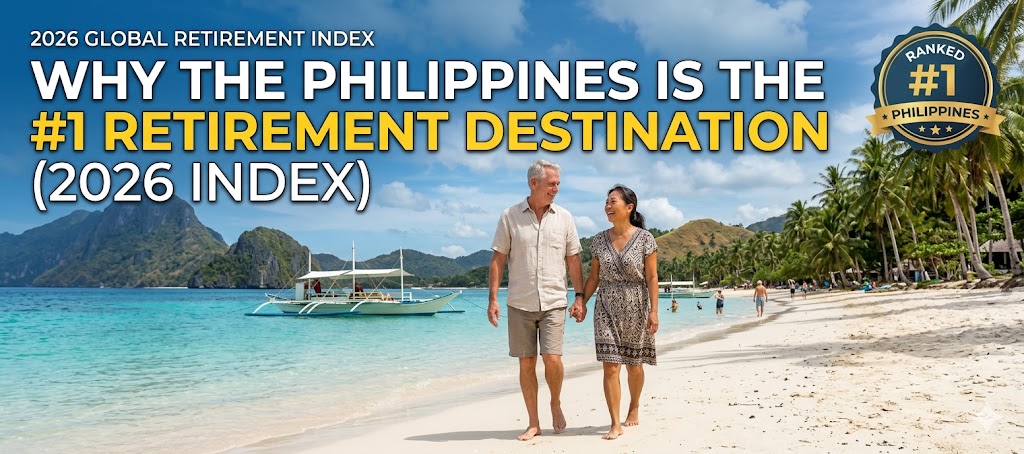
In June 2026, the Philippines received a title that many expats have long suspected was true: the world’s number one retirement destination.
The Retirement Abroad Index 2026, published by the UK-based Expatriate Group—a specialist provider of international health insurance serving expatriates and retirees across more than 180 countries—evaluated 20 countries across five critical categories. The Philippines came out on top with a winning score of 78 out of 100.
This wasn’t a narrow victory. The Philippines ranked first across all five categories, beating Thailand (77), Colombia (73), Portugal (71), South Africa (69), and Sri Lanka (69).
But what does this ranking actually mean? And more importantly, does it reflect reality for retirees on the ground?
This is an honest breakdown of why the Philippines took the top spot—and what the index’s own data reveals about where the country still falls short.
The Five Categories: How the Philippines Scored
The Retirement Abroad Index 2026 evaluated countries across five equally weighted pillars, each worth up to 20 points. Here is how the Philippines performed.
Cost of Living: 18 out of 20
This was the Philippines’ highest score. The index described affordability as “one of the country’s biggest strengths”. A retired couple can typically live comfortably on around £750 to £1,000 per month (approximately $998 to $1,330), though costs are generally higher in Manila than in smaller cities and coastal communities.
For context, this means the Philippines is 50 to 90 percent cheaper than the United States for many everyday expenses. Rent, food, transportation, and domestic help are all significantly more affordable than in Western countries.
Visa Accessibility: 17 out of 20
The index praised the Philippines’ Special Resident Retiree’s Visa (SRRV) as “among the most accessible retirement programmes we assessed”. Applicants aged 50 and over who receive a pension qualify with a fixed deposit of USD 15,000 (around £11,000). Successful applicants enjoy long-term residency without the burden of annual visa renewals. Processing times typically range from four to eight weeks.
This is significantly easier and cheaper than many competing destinations. Malaysia’s retirement programme, for comparison, requires around USD 200,000. Thailand’s OA visa requires health insurance and a police clearance from your home country.
Expat Community and Integration: 16 out of 20
The Philippines scored strongly here, and the reason is straightforward: English is widely spoken and is one of the country’s official languages. This “removes a common barrier to integration” for retirees.
Combined with a well-established expat population across Manila, Cebu, and popular island destinations, this makes the transition to life overseas “much easier than in many competing retirement destinations”. Expats consistently report that locals are friendly, social circles form quickly, and cultural barriers feel lower than in countries where language and formality often stand in the way.
Health Insurance Requirements: 15 out of 20
The Philippines received a mid-range score here. The index noted that while health insurance is available and accessible, retirees should ensure their coverage is “robust enough to bridge the gap” between excellent urban healthcare and more limited provision elsewhere.
Healthcare Quality: 12 out of 20
This was the Philippines’ lowest score—and the index was honest about why.
The major cities such as Manila and Cebu City offer access to modern private hospitals, internationally accredited facilities, and English-speaking medical professionals. However, the index noted a “significant gap” between urban and rural areas. Healthcare standards can vary considerably outside of these urban centres, so location is an important consideration for retirees.
This is a genuine weakness. If you retire in a remote province, you may need to travel hours—or fly—for serious treatment. The index explicitly warns expats to choose their location carefully and ensure their health insurance is sufficient.
The Philippines’ Winning Overall Score: 78 out of 100
What does 78 mean?
It means the Philippines is not perfect. A score of 78 leaves room for improvement, particularly in healthcare. But it also means the country outperformed every other destination when all five categories were combined.
Thailand scored 77—just one point behind. Thailand’s strength is healthcare (it scored joint-highest in the index). The Philippines’ strength is visa accessibility and cost of living. The choice between the two ultimately comes down to personal priorities.
Colombia scored 73, combining low living costs with one of the most accessible retirement visa pathways in the Americas.
Portugal scored 71, offering European infrastructure and healthcare but at a higher cost of living.
South Africa and Sri Lanka both scored 69.
Beyond the Numbers: What the Index Actually Says
The index’s written commentary is worth reading carefully. Here is what it says about the Philippines, in its own words:
On affordability: “Affordability remains one of the country’s biggest strengths”.
On the SRRV: “The country’s Special Resident Retiree’s Visa (SRRV) is among the most accessible retirement programmes we assessed”.
On integration: “English is widely spoken and is one of the country’s official languages, which removes a common barrier to integration for UK retirees. Combined with a well-established expat population across Manila, Cebu, and popular island destinations, this makes the transition to life overseas much easier than in many competing retirement destinations”.
On healthcare: “The major cities such as Manila and Cebu City offer access to modern private hospitals, internationally accredited facilities, and English-speaking medical professionals. However, healthcare standards can vary considerably outside of these urban centres, so location is an important consideration for retirees”.
On cost of living for a couple: “A retired couple can typically live comfortably on around £750 – £1,000 per month”.
The Honest Take: What the Index Doesn’t Tell You
The Retirement Abroad Index 2026 is a data-driven, evidence-based ranking. It is not marketing hype. The Philippines genuinely deserves the top spot based on the five categories evaluated.
But rankings are rankings. The index does not capture everything that matters in daily life.
It does not capture the frustration of bureaucracy. Opening a bank account requires multiple forms. Government processes are slow. Digital systems are often outdated. Patience is not optional—it is essential.
It does not capture the reality of traffic. Metro Manila and Cebu are notorious for congestion. A ten-kilometer drive can take over an hour during peak hours. This affects quality of life in ways that no index can fully measure.
It does not capture the variability of healthcare costs. While the index notes the urban-rural gap, it does not emphasize that private healthcare—while excellent in cities—is expensive. International health insurance is essential, not optional.
It does not capture the cultural adjustment. The Philippines is warm, welcoming, and English-speaking. But it is also different. Pace of life is slower. Systems are less efficient. If you need first-world infrastructure and seamless processes, you will struggle.
The Bottom Line
The Philippines is the world’s number one retirement destination for 2026 according to the Retirement Abroad Index. The ranking is based on real, measurable strengths: exceptionally low cost of living, one of the most accessible retirement visas in the world, and an English-speaking culture that makes integration genuinely easier than in most competing countries.
But the index is honest about the country’s biggest weakness: healthcare outside major cities is limited. If you retire in Cebu City or Metro Manila and have good health insurance, you can access quality private healthcare. If you retire in a remote province, you may need to travel for serious treatment.
The Philippines is a place of genuine warmth, stunning natural beauty, and remarkable affordability. It is also a place of frustrating bureaucracy, underdeveloped infrastructure, and significant healthcare disparities. The index captures the first set of facts. It leaves the second set for you to discover.
The honest verdict: The Philippines is a fantastic retirement destination for the right person. If you value affordability, community, and adventure over efficiency and predictability, this ranking reflects a reality you will experience. If you need first-world infrastructure and seamless systems, even a number one ranking will not make you happy.
Come with your eyes open. Choose your location carefully. Get robust health insurance. And enjoy the warmth, the beauty, and the affordability that made this country number one.
Disclaimer
This guide is intended for informational purposes only and does not constitute professional financial, legal, or medical advice. The Retirement Abroad Index 2026 is published by Expatriate Group; all scores and data cited are based on their published methodology. Retirement planning, visa requirements, and healthcare access are subject to change. You are strongly advised to consult with qualified professionals before making any retirement decisions. The author assumes no liability for any outcomes arising from the use of this information. Always verify current requirements directly with the Philippine Retirement Authority (PRA) and relevant government agencies.
Sources & Methodology: This guide is based on the Retirement Abroad Index 2026 published by the Expatriate Group, as reported by the Manila Bulletin, Daily Tribune, Manila Standard, and other verified news sources as of June 2026. All scores and data have been cross-referenced with multiple sources. This guide is intended for informational purposes only and does not constitute professional advice. Always consult with qualified professionals before making any retirement decisions.
Author John Paul Ybañez Paquibot Licensed Real Estate Broker | PRC No. 00014132 | DHSUD No. CVRFO-B-03/18-2672 Bachelors Realty and Brokerage, Inc. Cebu G/F Cap Building, Brgy. Corner, Osmeña Blvd. Arlington Pond St. Extension, Cebu City, 6000 Cebu
Can I own a condo? Yes, subject to the 40% foreign ownership cap per building.
Can I lease land? Yes, under specific legal conditions.
Are “nominees” safe? No. They are illegal and dangerous.
The Philippines is one of the most welcoming countries in the world for foreign retirees. English is widely spoken, the cost of living is low, and the culture is famously hospitable. But when it comes to property ownership, the rules are not welcoming at all. They are strict, constitutional, and unforgiving.
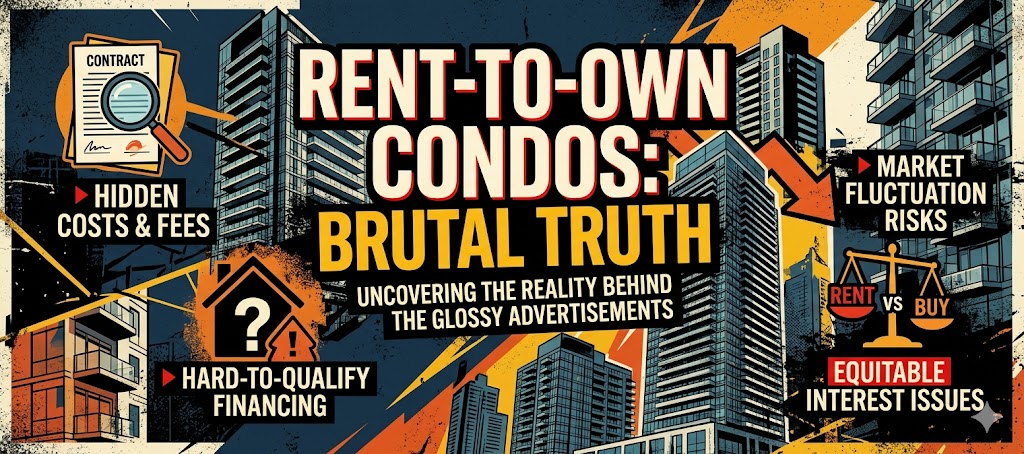
Here is the brutal truth: foreigners cannot own land in the Philippines.
This is not a regulation that can be negotiated, loopholed, or wished away. It is written into the 1987 Constitution. Understanding exactly what you can and cannot own—and the serious consequences of trying to cheat the system—is the most important thing you will learn before investing in Philippine real estate.
The Constitution: The Unshakeable Foundation
The 1987 Philippine Constitution is the source of all property ownership rules. Article XII, Section 7 states that private land ownership is limited to Filipino citizens and corporations with at least 60 percent Filipino ownership.
This restriction applies to all forms of land: residential, commercial, agricultural, and industrial. There are no exceptions for long-term residents, retirees with SRRV visas, or foreign investors. The Constitution does not care how long you have lived in the Philippines, how much money you have, or how much you love the country.
If you are a foreigner, you cannot own land. Period.
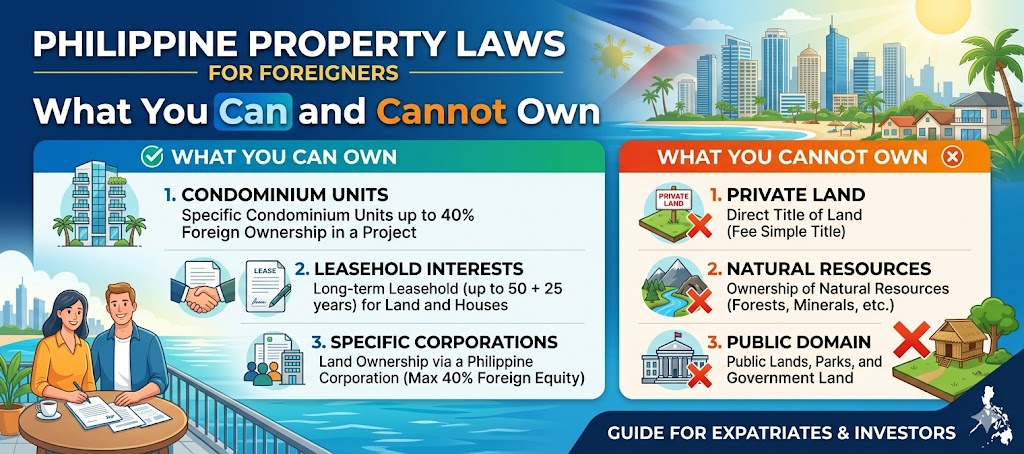
What You CAN Own as a Foreigner
Condominium Units
This is the single biggest exception to the land ownership ban. Under Republic Act No. 4726, the Condominium Act, foreigners can legally own condominium units in their own names.
The 40 Percent Rule
Here is the critical limitation: foreign ownership in any condominium project cannot exceed 40 percent of the total units. The 40 percent limit is strictly enforced. If a condominium building has 100 units, only 40 of them can be owned by foreigners. Once that limit is reached, no more foreign buyers can purchase in that project.
This is a hard cap that applies to the entire building, not per floor or per tower. If you are buying a condo as a foreigner, you must confirm with the developer or the condominium corporation that the 40 percent foreign ownership limit has not been exceeded.
What You Actually Own
When you buy a condominium unit in the Philippines, you receive a Condominium Certificate of Title (CCT) . This gives you exclusive ownership of your unit. The condominium corporation holds title to the land and common areas, and you become a shareholder in that corporation. This structure is what makes foreign ownership legally possible—you own a unit in a building, not the land itself.
Important: A foreigner can own a condominium unit without needing to form a corporation or use a Filipino nominee. The unit is titled directly in your name.
Long-Term Leases on Land
If you want a house with a garden or a piece of land to build on, you cannot own it. But you can lease it.
The law governing long-term leases for foreign investors is Republic Act No. 12252, known as the Amended Investors’ Lease Act, signed into law on September 3, 2025. This law significantly liberalized the lease terms available to foreigners.
The 99-Year Lease
Under the amended law, foreign investors can lease private lands for a maximum aggregate period of 99 years. Previously, the maximum was 50 years with one 25-year renewal.
Key Conditions for the 99-Year Lease:
The investment must be registered under the Foreign Investments Act of 1991, the CREATE Act, or other applicable laws.
The leased land must be used only for the approved investment purpose.
The lease contract must be registered with the Registry of Deeds and annotated on the certificate of title covering the leased area.
The lease agreement must have termination clauses related to change in purpose or failure to commence the project within a reasonable period.
What This Means for Retirees
Here is the honest truth: the 99-year lease is designed for foreign investors with registered business investments, not for retirees who simply want a house and garden. For a retiree, the more relevant option is a standard long-term lease of private land. Under general Philippine property law, foreigners may lease private land for a maximum term of 25 years, renewable for another 25 years upon mutual agreement.
One critical warning: A lease gives you the right to use the land, not to own it. You can build on it, live on it, and enjoy it. But the land itself always belongs to the Filipino owner. Your lease is a contract, not a title.
Inherited Property
If you are a former Filipino citizen who has acquired foreign citizenship, you can inherit property under certain conditions. Former natural-born Filipinos may own residential property up to 1,000 square meters of urban land or one hectare of rural land. This exception does not apply to foreigners who were never Filipino citizens.
What You CANNOT Own
Land of Any Kind
This is the absolute prohibition. Foreigners cannot own residential land, commercial land, agricultural land, industrial land, or any other type of land.
This includes:
House and lot packages (you can lease the land but not own it)
Vacant lots
Farmland
Beachfront property
Commercial lots
If a seller tells you that a foreigner can own land “through a special arrangement,” they are either misinformed or trying to deceive you.
Majority Ownership in a Real Estate Corporation
Foreigners can invest in Philippine corporations, but they cannot own more than 40 percent of a company that owns land or engages in the real estate business. This is known as the 40 percent foreign equity limit.
The Securities and Exchange Commission (SEC) enforces this strictly through the Two-Tier Test:
First Tier: At least 60 percent of voting shares must be Filipino-owned.
Second Tier: At least 60 percent of all outstanding capital stock—both voting and non-voting shares—must be Filipino-owned.
If a corporation fails either test, it is considered foreign-owned and cannot legally own land in the Philippines.
The Anti-Dummy Law: The Teeth Behind the Constitution
The Constitution is the rule. The Anti-Dummy Law (Commonwealth Act No. 108) is the enforcement mechanism.
This law penalizes anyone who uses a Filipino’s name or citizenship to evade constitutional or legal restrictions on foreign ownership. It makes it a criminal offense to:
Use a Filipino citizen as a “dummy” or nominee to acquire land on behalf of a foreigner.
Falsely simulate the existence of the required minimum Filipino capital ownership.
Allow foreign intervention in the management of a corporation engaged in a partially nationalized activity.
The Penalties Are Serious
Violations of the Anti-Dummy Law can result in criminal prosecution, fines, and imprisonment. The law has been used recently in high-profile cases. In April 2026, former Bamban mayor Alice Guo was indicted for Anti-Dummy Law violations in connection with land acquisitions made through misrepresented identities.
A Proposed New Law Would Make It Even Harder
In November 2024, a group of lawmakers filed House Bill 11043, which would authorise the government to seize illegally acquired real estate properties owned by foreign nationals. The bill would create a prima facie presumption that real estate titled under a foreign national is unlawfully acquired unless proven otherwise—shifting the burden of proof to the buyer.
The bill was filed in response to investigations revealing that some foreign nationals secured fake birth certificates and passports to purchase land illegally. While the bill is not yet law, it signals the government’s determination to enforce the constitutional prohibition.
Common Traps and Scams to Avoid
The “Nominee” or “Dummy” Arrangement
Some unethical sellers will offer to put land in a Filipino’s name with a “side agreement” that you are the real owner. This is illegal, dangerous, and almost always ends badly.
What can go wrong:
The Filipino nominee can sell the land without your consent.
The nominee’s heirs can claim the land after their death.
The arrangement can be discovered and the land forfeited to the government.
You can be criminally prosecuted under the Anti-Dummy Law.
Do not do this. Ever.
The “99-Year Lease” Misunderstanding
Some developers and agents market “99-year leases” to foreigners as if they are the same as ownership. They are not. A lease is a contract. It can be broken, challenged, or not renewed. You do not hold title. You do not have the same rights as an owner.
The honest truth: A 99-year lease is a legitimate option for investors with registered business investments. But for a retiree looking for a home, a 25-year renewable lease with a trusted Filipino landowner is the more practical—and legally sound—option.
The “Corporation Loophole”
Some agents will tell you that forming a corporation will allow you to own land. This is only partially true and often misleading.
Here is the actual rule: A corporation can own land in the Philippines only if it is at least 60 percent Filipino-owned. If you are a foreigner forming a corporation, you can own at most 40 percent of that corporation. You cannot use a corporation to circumvent the constitutional prohibition.
If an agent tells you otherwise, they are either ignorant or dishonest.
What About the SRRV?
The Special Resident Retiree’s Visa (SRRV) gives you permanent residency in the Philippines. It does not give you the right to own land.
However, there is one important benefit for SRRV holders: you may withdraw your SRRV deposit to purchase a condominium unit or acquire a long-term lease, subject to PRA rules. Your deposit is converted into an investment. This is a legitimate use of the SRRV deposit, but it does not change the underlying property laws—you still must comply with the 40 percent condominium rule or lease land from a Filipino owner.
The Honest Bottom Line
The Philippine Constitution is clear: foreigners cannot own land. There are no exceptions for retirees, long-term residents, or investors. The only legal ways for a foreigner to have a property interest in the Philippines are:
Buy a condominium unit in a project where the 40 percent foreign ownership cap has not been exceeded.
Lease land through a legally registered long-term lease contract.
Inherit property if you are a former Filipino citizen (subject to limits).
Any arrangement that claims to give a foreigner outright ownership of land is almost certainly illegal, risky, or both. The Anti-Dummy Law is real, and the government is increasingly aggressive in enforcing it.
My advice: Work with a reputable Philippine lawyer who specialises in real estate. Do not rely on the seller’s agent, the developer’s marketing materials, or online forums for legal advice. Visit the property, check the title at the Registry of Deeds, and confirm the 40 percent foreign ownership limit with the condominium corporation before buying a condo.
The Philippines is a wonderful place to retire. But property law here is not flexible, not forgiving, and not open to interpretation. Know the rules, follow them, and you can enjoy your retirement without legal nightmares.
Disclaimer
This guide is intended for informational purposes only and does not constitute professional legal advice. Property laws, regulations, and interpretations are subject to change. You are strongly advised to consult with a licensed Philippine attorney who specialises in real estate law before making any property investment. The author assumes no liability for any outcomes arising from the use of this information. Always verify current legal requirements directly with the relevant government agencies and your legal counsel.
Sources & Methodology: This guide is based on the 1987 Philippine Constitution, Republic Act No. 4726 (Condominium Act), Republic Act No. 12252 (Amended Investors’ Lease Act), the Anti-Dummy Law (Commonwealth Act No. 108), SEC-OGC Opinion No. 24-36, official government announcements, and verified legal analyses as of June 2026. All legal citations have been cross-referenced with official sources. This guide is intended for informational purposes only and does not constitute professional legal advice. Always consult with a licensed Philippine attorney before making any property investment.
Author John Paul Ybañez Paquibot Licensed Real Estate Broker | PRC No. 00014132 | DHSUD No. CVRFO-B-03/18-2672 Bachelors Realty and Brokerage, Inc. Cebu G/F Cap Building, Brgy. Corner, Osmeña Blvd. Arlington Pond St. Extension, Cebu City, 6000 Cebu
Rent-to-own sounds like a dream. Move in now, pay rent like you always have, and someday—magically—the place becomes yours. No bank loan headaches. No massive down payment. Just a simple path to ownership.
That’s the promise. Here’s the reality.
What Rent-to-Own Actually Is
Rent-to-own is exactly what it sounds like: you rent a property for a set period—typically one to three years—with the option to buy it at the end. A portion of your monthly rent goes toward the eventual purchase price, building what the industry calls “equity”.
Think of it as dating before marriage. You get to test the property, the neighborhood, the building management, and the lifestyle before committing.
But here’s the brutal truth that most sales agents won’t tell you: rent-to-own is not a shortcut. It’s often a more expensive, higher-risk path to ownership than a traditional bank loan.
The Brutal Truth #1: You’re Paying a Premium
Rent-to-own monthly payments are almost always higher than market rent. Why? Because part of your payment is supposed to go toward the purchase price.
One industry analysis notes that “the monthly payments are usually higher than market-rate rent, meaning buyers who cannot convert lose both the premium they paid and the time they spent building equity”.
In other words, you’re paying extra every month for the privilege of maybe owning the place someday. If you don’t end up buying, that extra money is gone forever.
The Brutal Truth #2: The Option Fee Is Gone If You Walk Away
Most rent-to-own agreements require an upfront option fee—a non-refundable payment that gives you the right to buy the property at the end of the lease.
If you decide not to buy, you lose that fee.
And here’s the kicker: you also lose every rent credit you accumulated. All those months of paying above-market rent? Gone. Forfeited.
One source puts it bluntly: “If you fail to make your monthly payments as agreed, you risk losing not only your right to purchase but also all the rent credits you’ve accumulated thus far”.
The Brutal Truth #3: You Might Not Qualify for Financing When the Time Comes
Here’s the scenario that plays out more often than developers admit.
You sign a rent-to-own agreement. You pay above-market rent for two or three years. You accumulate credits toward the purchase. The lease ends. You’re ready to buy.
Then the bank says no.
Your credit score isn’t high enough. Your income documentation isn’t sufficient. The property appraisal comes in lower than the agreed purchase price. The bank won’t approve your loan.
Now what?
You can’t buy. You lose your option fee. You lose your rent credits. You’ve been paying above-market rent for years, and you have nothing to show for it.
This is not a hypothetical risk. This is the single biggest danger of rent-to-own agreements.
The Brutal Truth #4: Many “Rent-to-Own” Programs Aren’t Really Rent-to-Own
Property consultancy Colliers Philippines made a striking observation: many developers’ rent-to-own schemes are “essentially early move-in programs with extended payment terms”—not genuine rent-to-own models.
What does that mean?
You’re not really building equity toward ownership. You’re just moving in early and paying installments under a different name. The flexibility to walk away? Often nonexistent.
Colliers noted that “as far as we know, it’s only DMCI Homes that provides this kind of setup where renters can truly transition from renter to owner, with the flexibility to opt out if they choose”.
If even the industry experts are pointing out that most programs are misleading, you should be paying very close attention.
The Brutal Truth #5: You’re Locking in a Price That Could Go Down
Rent-to-own agreements typically fix the purchase price at the beginning of the lease. This is marketed as a benefit—you’re protected if property values go up.
But what if they go down?
If the market cools and the condo’s value drops below your agreed purchase price, you’re stuck. You’ll be paying above-market rates for a property that’s worth less than what you owe.
Here’s where context matters. In Cebu’s current market, prime areas like Cebu IT Park, Mactan Newtown, and the South Road Properties have been steadily appreciating. The demand from BPO workers, offshore gaming employees, and young professionals has kept prices on a generally upward trajectory. In these established townships, the risk of a significant price drop is relatively low.
But the equation is very different outside these prime areas. In fringe locations, unproven townships, or areas with oversupply, prices are more vulnerable. If you lock in a high purchase price in a location where demand is weak, you could end up paying above-market rates for a property that isn’t appreciating as expected.
The honest take: In highly developed townships with strong demand, prices are generally stable and the risk of a major drop is low. But in fringe or unproven locations, the risk of locking into an overpriced unit is much higher. Before signing, ask yourself: Is this location genuinely in high demand, or is the developer trying to inflate prices based on promises that haven’t materialized yet?
The Brutal Truth #6: You’re Responsible for Maintenance
During the rental period, you’re typically responsible for maintenance and repairs—just like a standard tenant.
But here’s the catch: if you’re paying above-market rent with the intention of buying, you might be inclined to spend more on upgrades and improvements. New paint. Better fixtures. Minor renovations.
Then you don’t buy. You lose the option fee, the rent credits, and the money you spent on improvements.
The Brutal Truth #7: Scammers Love Rent-to-Own
The rent-to-own model is fertile ground for fraud.
Common scams include:
Fake ownership: Someone rents a condo they don’t own and offers it to you as rent-to-own.
Hidden fees: Agreements that impose impossible conditions or hidden costs to ensure you never actually own the property.
Misrepresentation: Glossy brochures with misleading layouts and unrealistic promises.
“Sangla-Tira-Benta” schemes: Fraudsters pose as owners, collect payments, and disappear.
The Philippine real estate market, with its strong demand and complex legal processes, is unfortunately a breeding ground for these scams.
So When Does Rent-to-Own Actually Make Sense?
With all that said, rent-to-own isn’t always a bad deal. There are situations where it can work.
You have poor credit but a solid income. Banks won’t touch you, but you can afford the payments. Rent-to-own gives you time to rebuild your credit while living in the property.
You’re self-employed with irregular income. Proving income to a bank is difficult. Rent-to-own programs often have more flexible verification.
You want to test the neighborhood before committing. Rent-to-own gives you a trial period.
You’re an OFW or expat. You need time to get your documents in order and decide if you really want to settle in the Philippines.
You’re dealing with a reputable developer with a transparent program. DMCI Homes’ HomeReady™ program, for example, allows you to walk away with “no strings attached” if you decide not to buy. Filinvest’s “Rent it. Own it. Easy.” program offers zero percent interest over ten years with no bank loan required.
These are legitimate programs. But they’re the exception, not the rule.
What to Look For in a Rent-to-Own Contract
If you’re determined to go the rent-to-own route, here’s what you need to check before signing anything:
The option fee. Is it refundable under any circumstances? (Spoiler: usually not.)
The rent credit. Exactly how much of your monthly payment goes toward the purchase price? Get it in writing. DMCI Homes, for example, credits at least 60% of lease payments toward the purchase. Many programs credit far less—or nothing at all.
The purchase price. Is it fixed, or can it change? If it’s fixed, what happens if the market drops? This is especially important in fringe or unproven locations where prices are more volatile.
The timeline. How long do you have to decide? What happens if you need more time?
The penalties. What happens if you miss a payment? How many missed payments trigger forfeiture?
The maintenance responsibilities. Who pays for major repairs? Structural issues? Appliance replacements?
The financing clause. What happens if you can’t secure a bank loan at the end of the lease? Can you extend the term? Can you walk away with any of your money?
Red flags to watch for:
Vague or missing terms
Monthly payments way above fair market rent
No rent credit toward the purchase
Unreasonable penalties
Seller can terminate easily for minor violations
You’re responsible for all repairs, even major structural issues
If you see any of these, walk away.
The Bottom Line
Rent-to-own is not a shortcut to homeownership. It’s a higher-cost, higher-risk alternative to a traditional mortgage.
The brutal truth is this: most people who enter rent-to-own agreements never actually buy the property. They either can’t qualify for financing when the time comes, or they realize they’ve been paying above-market rent for years with nothing to show for it.
Risky rent-to-own schemes have grown in popularity precisely because of the “affordability gap” that economists have flagged in the Philippine housing market. They’re a workaround for a broken system—not a solution.
If you can qualify for a bank loan, get the bank loan. The interest rates might seem high, but at least you’re building real equity from day one. The property is yours. You’re not at risk of losing everything if your circumstances change.
If you can’t qualify for a bank loan, rent-to-own might be your only option. Just go in with your eyes wide open. Understand that you’re paying a premium. Understand that you could lose everything you’ve put in. Pay close attention to the location—if it’s a prime, established township, the price stability is in your favor. If it’s a fringe or unproven area, the risk of overpaying is significantly higher.
And never, ever sign a rent-to-own agreement without having a lawyer review it first.
The dream of homeownership is real. But don’t let that dream blind you to the brutal truth about how rent-to-own actually works.
Sources & Methodology: This guide is based on verified industry reports, developer announcements, and independent analysis as of June 2026. Information on DMCI Homes’ HomeReady™ program sourced from Colliers Philippines and official company disclosures. Filinvest’s program details sourced from company announcements. Scam information sourced from NBI reports and consumer protection guides. Cebu market context sourced from real estate industry reports, BIR zonal value data, and independent market analysis. This guide is intended for informational purposes only and does not constitute professional financial or legal advice. Always consult with a licensed real estate professional and attorney before entering any property agreement.
Author John Paul Ybañez Paquibot Licensed Real Estate Broker | PRC No. 00014132 | DHSUD No. CVRFO-B-03/18-2672 Bachelors Realty and Brokerage, Inc. Cebu G/F Cap Building, Brgy. Corner, Osmeña Blvd. Arlington Pond St. Extension, Cebu City, 6000 Cebu
Managing property from a distance—whether you are an Overseas Filipino Worker, a busy professional in another city, or a property investor—is a strategic business move. However, distance creates a visibility gap. To succeed as a remote landlord in 2026, you must replace physical presence with digital systems, local partnerships, and rigorous legal compliance.
This guide combines strategic insight for long-term wealth with tactical operations for daily management. Whether you are a first-time landlord or an experienced investor, these principles will help you protect your asset and grow your income from anywhere in the world.
The Strategy: Mindset Over Location
Managing from afar is harder than being next door. Acknowledge this early. You cannot pop over to check a faucet or knock on a door to discuss late rent. Success depends on building a business system rather than treating your property as a hobby.
Your goal is to treat your property as an income-generating asset, not just a family home. Adopt the mindset that no news is not good news—proactive monitoring is cheaper than emergency repairs. See yourself as the CEO of your property; your boots on the ground are your operational team.
Operations: Building Your Boots on the Ground
You cannot be everywhere, so you need reliable proxies. The single most important decision you will make as a remote landlord is choosing who will represent you on the ground.
Option One: Professional Property Management Company
For many remote landlords, this is the safest route. Professional property management companies handle marketing, tenant screening, rent collection, maintenance coordination, and legal compliance. They have established relationships with contractors, understand local laws, and have systems in place to handle emergencies.
The cost is typically a percentage of monthly rent, often ranging from eight to twelve percent. For OFWs and overseas investors, this fee is often well worth the peace of mind.
Option Two: Local Representative
If you prefer a more hands-on approach without the full cost of a management company, consider hiring a local representative. This could be a trusted relative, a former colleague, or a professional property manager who works on a fee-for-service basis. Your representative should handle showings, coordinate maintenance, conduct inspections, and be your eyes and ears on the ground.
If you choose this path, vet them like an employee. Check referrals and consider a trial period. Start with a small project before committing long-term. Your local team is your most valuable asset as a remote landlord.
Option Three: The Hybrid Approach
Some landlords combine both strategies. They use a property management company for tenant placement and lease execution, then manage day-to-day operations themselves with the help of local contractors and virtual tools. Many modern landlords also hire a Property Management Virtual Assistant who handles the ledger, coordinates with the local repair team, and manages tenant communication via email or dedicated messaging apps.
Option Four: Reliable Vendor Network
Regardless of your primary management structure, you need a network of reliable contractors. Before you need them, identify electricians, plumbers, handymen, and HVAC technicians who are trustworthy and responsive. Have a clear, pre-negotiated budget for emergency repairs so your caretaker can act instantly without waiting for your approval for a small fix.
Technology: Your Digital Eyes and Ears
In 2026, manual processes are a liability. Use technology to build an audit trail and maintain visibility into your property.
Centralized Communication
Use one dedicated channel—a specific email or messaging app—for all tenant communication. Never use personal SMS for business. A centralized record is vital if a dispute reaches the Barangay or the Department of Human Settlements and Urban Development.
Automated Rent Collection
Move away from manual cash handling. Use bank transfers, GCash, or Maya for rent collection. Require a screenshot of the transaction for every payment; this serves as your digital receipt. Online rent collection also reduces the risk of late payments and eliminates the headache of tracking physical checks.
Virtual Inspections
Use video calls through Zoom, Viber, or FaceTime for move-in and move-out inspections. Record these sessions. A time-stamped video of the unit’s condition is your strongest defense against damage claims and disputes.
Smart Tools
Consider smart locks for remote access for your repair team. Wi-Fi cameras for common entryways can provide additional security, but ensure you comply with privacy laws. Property management software platforms like Buildium, AppFolio, and local solutions can help you track leases, collect rent, manage maintenance requests, and generate financial reports from anywhere in the world.
Legal Compliance: The 2026 Regulatory Environment
Informal landlording is a recipe for legal trouble. Stay compliant with Philippine law to protect yourself and your investment.
The Rent Control Act and 2026 Caps
If your unit rents for ten thousand pesos or below, you are subject to the one percent rent increase cap for 2026 for existing tenants, per National Human Settlements Board Resolution No. 2024-01. Trying to bypass this with an arbitrary hike can lead to fines and legal disputes.
Written Contracts
Verbal agreements are worthless in court. Your lease must clearly detail the payment schedule and late fees, repair responsibilities—structural issues are the landlord’s responsibility while daily upkeep belongs to the tenant—and grounds for eviction.
Formal Notice
Never rely on a quick text for rent increases or lease terminations. Use formal emails or letters to ensure the notice is legally binding. This protects you if the tenant disputes the communication later.
Security Deposits
Philippine practice typically requires two months’ advance rent and two months’ security deposit. The security deposit can be used for unpaid utilities or damages beyond normal wear and tear. Document the condition of the unit thoroughly at move-in so you have a reference point at move-out.
Eviction Procedures
Evicting a tenant in the Philippines requires following proper legal procedures. You cannot simply change the locks or cut off utilities. Work with a lawyer or your property management company to understand the process before you need it.
Tax Obligations
Rental income is subject to income tax. You may also be liable for VAT if your annual gross receipts exceed the threshold. Consult a tax professional to ensure compliance.
Maintenance: Remote Insurance
Preventive maintenance is the only way to avoid the emergency repair nightmare. A small leak ignored today becomes a flooded unit tomorrow. A broken air conditioner in the middle of summer becomes a tenant complaint and a potential lease-breaker.
Scheduled Walkthroughs
Schedule a video call with your tenant every three to six months for a virtual walkthrough. Check sinks, electrical outlets, and walls. This not only helps you spot issues early but also shows your tenant that you care about the property.
Annual Deep Clean
Budget for an annual deep clean and maintenance check. It is significantly cheaper to service an air conditioning unit annually than to replace a fried compressor. Regular maintenance extends the life of your appliances and systems.
Reporting Protocol
Provide your tenant with a clear, step-by-step guide on how to report issues. Encourage them to report problems early. A small fix today prevents a major renovation tomorrow, and rewarding tenants for early reporting builds goodwill.
Spending Limits and Approval Processes
Decide in advance how much your local representative can authorize for emergency repairs without your approval. This prevents delays in genuine emergencies while protecting you from unnecessary expenses.
Tenant Screening: Your First Line of Defense
Screening tenants thoroughly is even more important when you are remote. A bad tenant can destroy your property, drain your finances, and create legal headaches that are exponentially more difficult to resolve from a distance.
Income Verification
A common benchmark is that a tenant’s monthly income should be at least three times the monthly rent. Below this threshold, the default rate spikes significantly.
Employment Verification
Call the employer. Confirm the tenant’s position, length of employment, and stability.
Rental History
Contact previous landlords. Ask about payment history, property care, and whether they would rent to this tenant again. This is often the most revealing part of the screening process.
Personal Interview
Even if conducted via video call, have a face-to-face conversation with your tenant. This gives you a chance to assess their communication style, reliability, and whether they seem like someone you can work with long-term.
Background Check
Where legally permitted and with proper consent, run a background check. Do not skip this step just because you are remote. If anything, being remote makes thorough screening more important, not less.
The OFW Advantage
For Overseas Filipino Workers, remote property management is not just a necessity—it can be a strategic advantage. Real estate is one of the smartest ways for OFWs to secure their financial future. By investing in Philippine property and managing it remotely, you build an asset that generates income while you work abroad.
The key is to treat it like a business, not a hobby. Use professional services. Build systems. Document everything. And remember that the goal is not just to collect rent—it is to build long-term wealth through a well-maintained, income-producing asset.
Your Master Property Folder
Before you implement any of these strategies, create a cloud-based folder specifically for your property. This folder is the nerve center of your remote landlording operations and should be accessible from anywhere in the world.
Inside this folder, set up distinct sub-folders. The Legal sub-folder should contain scanned lease agreements, notarized documents, title copies, and tax declarations. The Financials sub-folder should hold your digital ledger—a Google Sheet works well—along with receipts of all payments and expenses. The Property Assets sub-folder should contain high-quality photos and videos of the unit from move-in, documenting its condition. Finally, the Contacts sub-folder should include a contact sheet for your boots on the ground, including your property manager, electrician, plumber, and any other service providers.
Having this folder organized and accessible ensures that even if you are halfway around the world, you can pull up any document or record within seconds.
The Handover Test
If you are currently working with a caretaker or property manager, send them this Remote Landlord’s Playbook. This serves two critical purposes.
First, it explicitly outlines the professional standards you expect. It sets expectations for video walkthroughs, formal notice procedures, and the level of communication you require. When everyone is working from the same playbook, misunderstandings are minimized.
Second, it protects you. If your manager ever deviates from your agreed-upon process, you can point to the documented standards in this guide. This is not about mistrust—it is about clarity and accountability.
The 2026 Health Check
Now that you have the knowledge, perform a health check on your current unit. Start by ensuring your records are digital. If you are still using physical paper receipts, move to digital immediately. Scan everything and store it in your Master Property Folder.
Next, verify your compliance. Double-check your current rent rate against the Rent Control Act caps mentioned in this guide. If you are charging ten thousand pesos or below, ensure your annual increases do not exceed the one percent cap.
Finally, check on your team. Send a quick message to your local repair person to ensure they are still active and available. Ask your property manager or representative if they have any concerns about the property that you should know about. A simple check-in can prevent small issues from becoming big problems.
Your Remote Landlord Checklist
Here is a quick summary of everything you need to have in place.
For documentation, ensure you have a signed, notarized lease agreement for every tenant. For financials, maintain a digital ledger using Google Sheets or cloud software tracking all payments and expenses. For screening, verify income at three times the rent, employment, and previous rental references for every tenant. For legal compliance, provide DHSUD-compliant notice for any rent or policy changes. For inspections, conduct time-stamped video walkthroughs at move-in and move-out. And for your network, maintain a pre-vetted list of handymen, electricians, and plumbers.
Final Honest Word
The distance between you and your property is measured in the quality of your systems, not in kilometers. By treating your property as a business—utilizing professional screening, digital record-keeping, and reliable local partners—you transform a remote asset into a stable, long-term wealth builder.
Remote landlording is not for everyone. It requires patience, organization, and a willingness to delegate. It requires trusting others to care for your investment as much as you would. And it requires accepting that things will go wrong—and having a plan for when they do.
But for those who are willing to put in the work, the rewards are substantial. A well-managed remote property provides passive income, builds equity, and creates financial security for you and your family.
Start by building your local team. Screen your tenants thoroughly. Embrace technology. Stay informed. And never stop learning.
The goal is not just to collect rent. It is to protect the asset that builds your future.
Author John Paul Ybañez Paquibot Licensed Real Estate Broker | PRC No. 00014132 | DHSUD No. CVRFO-B-03/18-2672 Bachelors Realty and Brokerage, Inc. Cebu G/F Cap Building, Brgy. Corner, Osmeña Blvd. Arlington Pond St. Extension, Cebu City, 6000 Cebu